Walls with mineral wool
How to choose screws for insulated wall panels with a mineral wool core before installation begins?
In brief
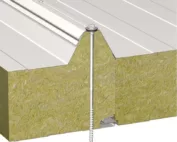
A screw for a sandwich panel is selected to suit the panel and the structure. The material of the support, its thickness and the loads are what matter. The panel or core length alone is not enough. A suitable seal and controlled pressure are also needed. Establishing these data before delivery limits improvisation when closing the walls. First establish the material and thickness of the support. A fastener for steel is not automatically suitable for timber or concrete. Drilling capability, anchorage and load-bearing parameters are important. The information ‘steel hall’ is often too general if different structural elements have different thicknesses.
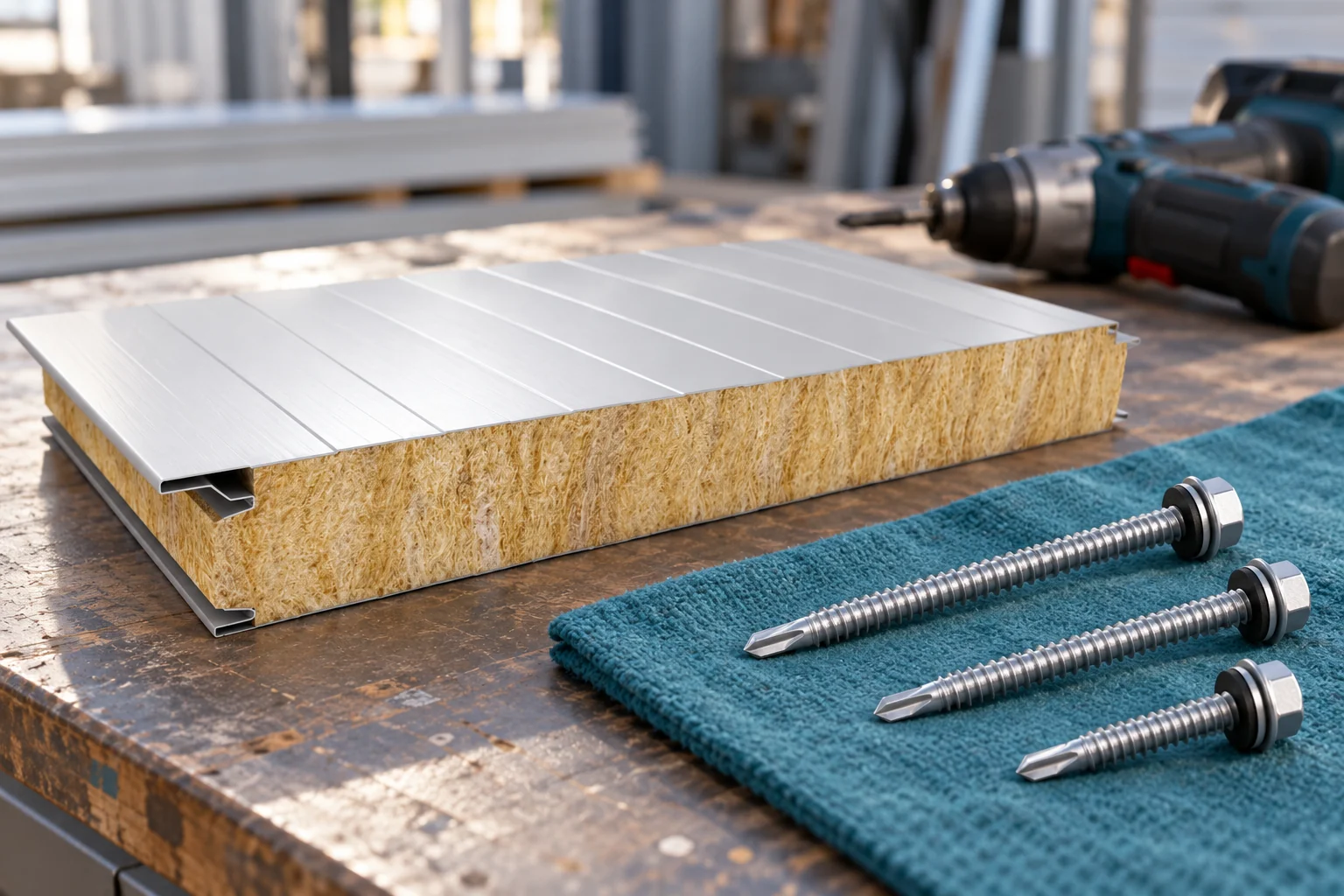
What data should you start the selection with?
Next, check the panel thickness and the type of fixing: visible or concealed at the intended connection point. The system geometry influences how forces are transferred. A new fixing point should not be created simply because it is easier to reach with the screwdriver.
The design should specify the fastener requirements and their layout. The supplier can help select the right variant, but needs the complete set of data. The name of the mineral core alone does not determine the entire selection.
Why is the length not equal to the panel thickness?
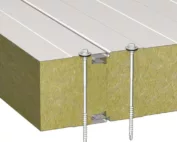
The screw must pass through the component and achieve the required anchorage in the support. Details of its construction and scope of application are also relevant. It is therefore not selected by adding a few random millimetres to the panel thickness. A selection table for the specific fastener is required.
A component that is too short may not achieve the required load-bearing capacity. One that is too long is not always neutral: it may hinder installation or conflict with other parts. For extensions, it is worth checking the actual space behind the support. This is particularly important with a substructure fixed to an existing wall.
If different supports occur on one façade, the schedule may include several screw types. They should be clearly separated for the crew. Mixing similar fasteners in one container increases the risk of using the wrong variant.
What does the washer with seal do?
It helps seal the penetration through the cladding and distribute the contact pressure within the intended range. Its material and diameter must match the solution. It should not be replaced with a random washer from the workshop. The entire fastener is assessed as a set with specific properties.
Tightening should ensure proper contact without excessively compressing the seal and deforming the sheet. A screwdriver with the appropriate limit facilitates control. Greater force should not be regarded as a guarantee of tightness. Excessive contact pressure can damage the components that are meant to protect the connection.
After installation, it is worth inspecting the first section of fixings. Correcting the tool setting at the start is easier than reworking the entire façade. Indentations around successive heads may indicate a recurring installation error.

How many fasteners should be allowed for in the order?
The number results from loads, building geometry and the support layout. Corner zones may require a different arrangement than the middle of the wall. There is no single value per square metre that can be safely applied to every building. The number of panels and support lines is also important.
For the cost estimate, the total number of fixings from the design and the agreed installation allowance can be calculated. Fasteners for flashings are listed separately because they serve a different purpose. They should not be treated as substitutes for the main structural screws. A similar head appearance does not mean the same load-bearing capacity.
When deliveries are staged, it is best to complete the fixings for the entire section being closed. A shortage of a few correct pieces should not lead to using a random type in a location that cannot easily be inspected later.
How should connections be received and maintained?
Check that the types match the schedule and that they are seated correctly. Inspect the seals, the position of the screws and the condition of the cladding. Swarf produced during drilling must be removed. If left on the surface, it can corrode and soil the coating. The inspection also covers flashings that conceal some of the fixings.
Do not correct a loose connection by arbitrarily enlarging the hole or changing the diameter. The repair requires a compatible solution that maintains load-bearing capacity and tightness. For a wall with a required fire resistance, the conditions of its classification must also be maintained.
In the documentation, it is worth recording the types of fasteners used and the locations of deviations approved during the works. This will make it easier to reproduce the connections during later extension. It also protects against assessing the fixing solely by the visible head.
Short answers from site
Can a longer screw replace any shorter screw for the panel?
No. The drilling range, anchorage, material and other parameters must match. Length alone does not confirm compatibility.
Can the fixings for flashings be included in the panel’s load-bearing capacity?
This should not be assumed. The main panel fixings and the flashing fasteners have different functions. The load-bearing arrangement results from the design.
7 branches. Materials closer to your project.

- SEROCK — Dzierżenin 34 E
- BŁONIE — ul. Sochaczewska 138A
- RADOM — ul. Grobickiego 8
- ŁÓDŹ — Natolin 8
- OLSZTYN — Barczewo, ul. Prosta 9
- WROCŁAW — ul. Jerzmanowska 10C
- GORZÓW WLKP. — ul. Zielona 33/34