Mineral wool walls
How do you calculate the weight of mineral wool panels for delivery and installation?
In brief
The weight of a mineral wool panel depends on the core thickness, its type and the steel facings. For delivery planning, the total weight of the batch is needed. For installation, the weight and length of the individual element also matter. These two aspects should not be confused. Even a relatively light pack may contain panels that are difficult to handle. It is best to use data for the precisely selected variant. Panels of the same thickness may have a different core and facings. An example wall panel 100 mm with mineral wool of nominal density 100 kg/m³ and 0.5/0.5 mm steel sheets weighs approximately 18.1 kg/m². A lighter variant of this thickness may weigh 16.6 kg/m².
Where to get the correct unit weight?
Do not pick the more favourable weight from one table and the remaining parameters from another. This produces a set that no specific product has. The cost estimate and lifting plan should record an unambiguous panel designation.
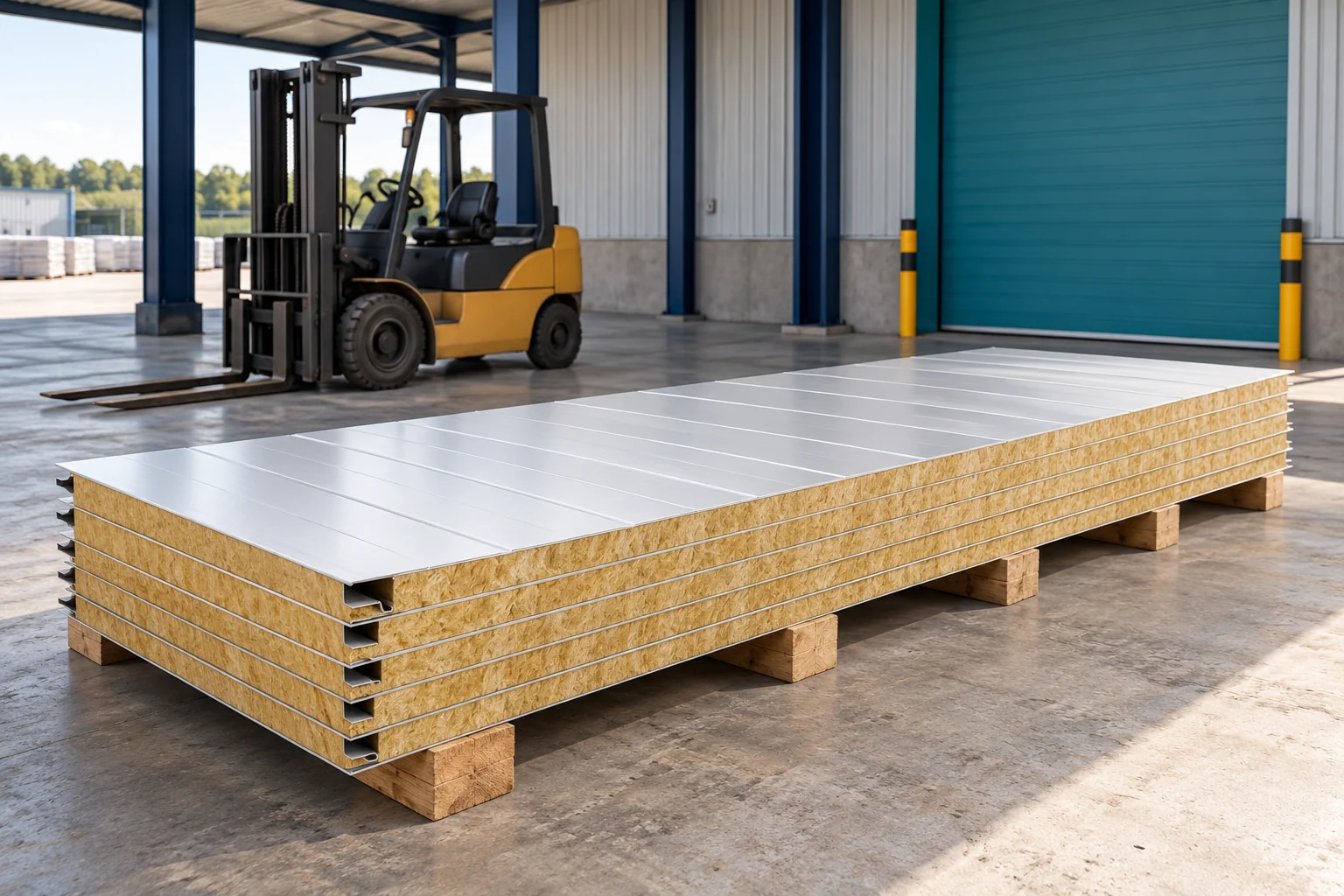
If the offer gives only the pack weight, also ask for the number and dimensions of the items. This allows the weight of a single piece to be assessed. Packaging and spacers also have weight, so the data for the entire consignment should be used for transport.
How to calculate a single panel?
Multiply the element area by the unit weight. For an example panel with a cover width of 1.13 m and a length of 4 m, the cover area is 4.52 m². At 18.1 kg/m² the calculated weight is approximately 81.8 kg. This is an example based on the stated configuration.
For the same width and a length of 6 m, the area rises to 6.78 m² and the weight to approximately 122.7 kg. A change in length therefore affects the weight, but also the way it is gripped and its rigidity during handling. Installation cannot be planned on the basis of kilograms alone.
Check what area the manufacturer’s table refers to. The bases of calculation should be consistent. With non-standard dimensions and additions, the exact weight should be confirmed before selecting the equipment.
How does thickness change the load?
In one example family of mineral panels, the weight is 14.1 kg/m² for 60 mm, 18.1 for 100 mm, 23.1 for 150 mm and 28.1 for 200 mm. The values relate to specific facings and core. They show why increasing the thickness matters beyond the thermal design of the wall.
For 100 m² of cladding, the difference between 100 and 200 mm in this example is approximately 1000 kg. This does not, however, mean a single point load. The way the weight is transferred to the structure depends on the wall build-up and the fixings. It must be assessed in the design.
Thickness also affects the lengths of fixings and flashings and the position of openings. A change made after the structure is built can therefore entail more costs than the purchase of a heavier panel alone.

How to use the weight in the delivery plan?
Calculate the whole batch and determine the arrangement of the packs. Check access, the load-bearing capacity of the unloading area and the reach of the equipment. The lifting capacity of a crane or truck depends on the operating conditions, not only on the maximum figure stated in its description. Long packs may require particular handling.
It is worth agreeing the packing and delivery sequence. Panels needed first should not be buried under items for the final stage. Every additional transfer increases the risk of damage. On a small plot, staged delivery may be more advantageous, although its cost must be taken into account.
The storage area must allow correct support and protection against water. The pack should not be rested casually on uneven ground. Transport protection does not exempt from the requirements for storage on site.
For an example batch of 40 units weighing 81.8 kg, the total is approximately 3272 kg before packaging is added. This helps to determine the scale of the delivery in advance. The final data should come from a confirmed transport schedule. The weight should not be rounded down to match the available equipment.
What to agree with the crew before lifting?
The contractor should know the weight, lengths and permitted method of gripping. The selection of suction cups, spreader beams or other devices requires compatibility with the panel and the conditions. There should be no improvisation based on how a lighter PIR panel was handled previously.
The plan also covers the direction of rotation and access to the installation point. A long element may conflict with scaffolding or an adjacent part of the building. In wind, the large surface area of the panel becomes an additional problem. The conditions for carrying out the work must correspond to the instructions and the safety organisation.
After delivery, compare the actual batch with the plan. If the thickness or facings have been changed, the weight may have changed. Such a difference must be clarified before installation, not only when the equipment proves insufficient.
Short answers from site
Is the wool density sufficient to calculate the weight of the entire panel?
No. The claddings and other components of the product must be taken into account. It is best to use the declared unit weight of the specific variant.
Are two panels of the same weight handled in the same way?
Not always. Length, width and the way they are gripped affect manoeuvring. The installation plan must take geometry into account, not just kilograms.
7 branches. Materials closer to your project.

- SEROCK — Dzierżenin 34 E
- BŁONIE — ul. Sochaczewska 138A
- RADOM — ul. Grobickiego 8
- ŁÓDŹ — Natolin 8
- OLSZTYN — Barczewo, ul. Prosta 9
- WROCŁAW — ul. Jerzmanowska 10C
- GORZÓW WLKP. — ul. Zielona 33/34