Installation and details
Exterior steel window sills: five benefits and how to specify them
In brief
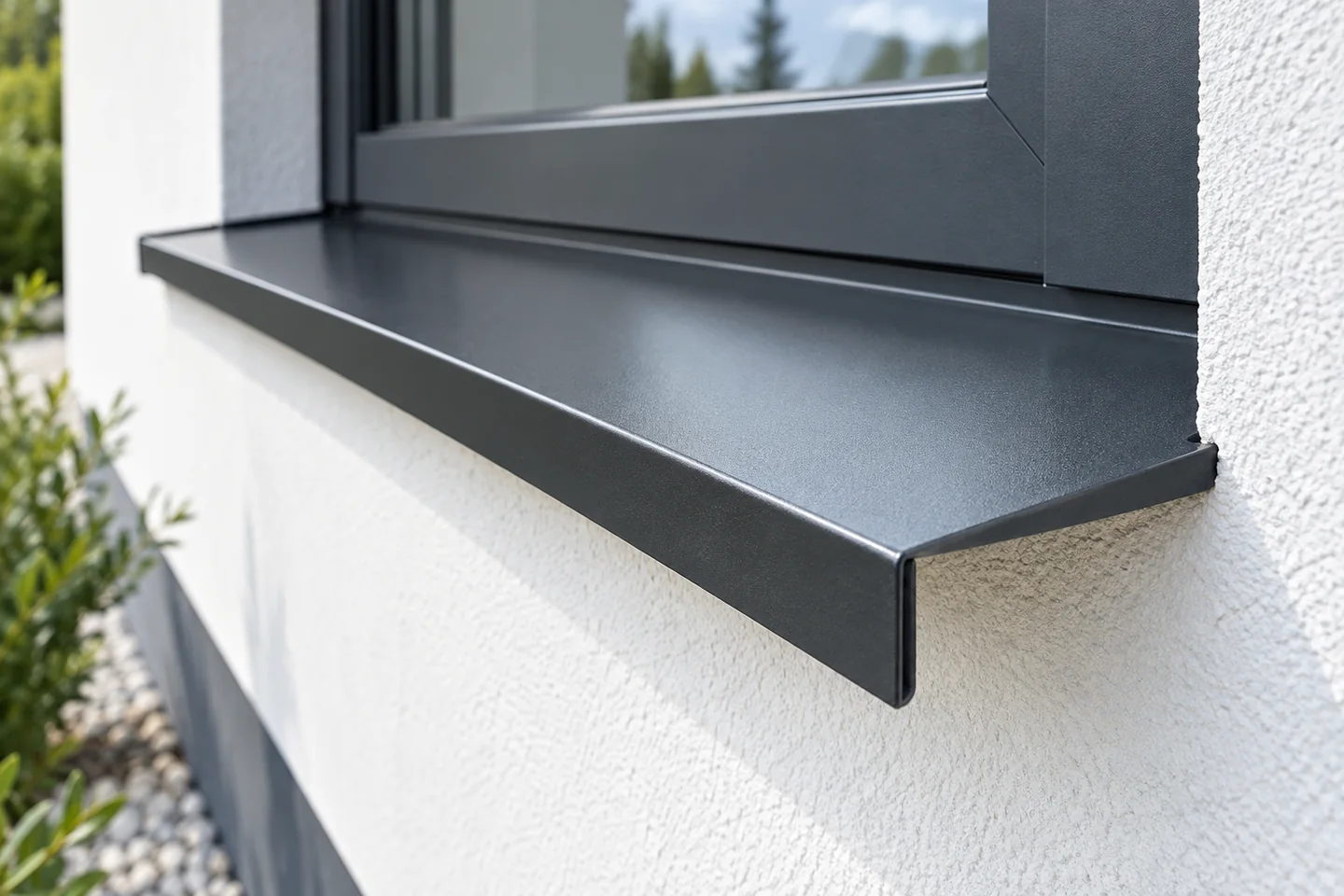
A steel external window sill primarily drains water beyond the façade face and tidies the window’s appearance, and its advantages are low weight, made-to-measure fabrication, a choice of coatings and consistent finishing with other trims. Durability, however, depends above all on the installation detail, so before ordering check the drainage, sealed ends and allowance for thermal movement. Also establish the fixing method and the space for element movement, since a good sheet alone will not ensure a tight joint. For several windows, confirm dimensional repeatability on site, because apparent similarity of reveals does not guarantee equal width.
1. Low weight makes fitting easier
A window sill made of thin steel sheet is relatively light. This matters when replacing the detail on an existing façade. The element is easier to carry and prepare for setting without loading the reveal like a heavy slab. This does not mean, however, that stable support can be dispensed with or that it can be fixed with only a few random spots of adhesive.
The substrate should be level and prepared for the system used. Lack of support can promote deflection, vibration and noise during rain. A long window sill also requires thermal movement to be taken into account. Before installation, the fixing method and the allowance for movement of the element are determined. These details are worth checking before ordering the sheet width.
2. Made to measure, it can shield the façade
The sheet can be formed to the required width and length. This allows the window sill to be adapted to the depth of the reveal and the thickness of the insulation. The drip edge, which detaches water from the underside, is important. It should be located beyond the finished wall face. Measuring before plastering requires the final thickness to be taken into account.
The projection width alone is not the only criterion. A slope away from the window towards the outside and proper side terminations are also needed. An element that is too flat can retain water. Incorrect contact at the reveal will allow water to penetrate into the insulation. Dimensions and connections should be matched to the specific window and façade system rather than reproducing a random detail from a neighbouring house.
3. Factory coating reduces the scope of maintenance
Coated steel can retain an aesthetic appearance for a long time with regular cleaning and inspection for damage. The decorative coating and the metallic protection have different tasks. Select them according to the conditions of use. A window sill on a busy street or near aggressive pollutants may require different protection than in a sheltered location.
Remove mortar residues and metal filings from the surface before they cause permanent damage. Do not clean the steel window sill with a stiff brush or a product intended solely for stone or ceramics. The agent should be compatible with the coating. Damage from cutting and installation is repaired with the material specified for the given product. A full repaint of a new element is not a normal way of accepting a defective delivery.

4. The colour can be matched to the roof and flashings
Window sills are often visually combined with the roof covering, gutters or joinery. On a façade with T18 trapezoidal steel sheet, they can become part of a coherent set of opening flashings. However, it is not necessary to repeat the colour of all elements of the building. What matters is a calm overall composition and a match with the façade, especially when the window sill is wide and clearly visible from street level.
Compare samples under the same light. The same colour code in different coatings does not guarantee an identical effect. Matt, gloss and texture change how a colour is perceived. If you care about a uniform appearance, order the visible flashings together and confirm that the finish matches. If a section is replaced later, the difference may also be caused by the natural ageing of the existing surface.
5. A simple shape keeps pricing straightforward
A steel window sill can be priced according to dimensions, thickness, coating and the scope of bending. However, compare finished elements including their terminations and installation. A price per linear metre alone, without a stated width, does not allow you to assess an offer. Also establish whether measurement, substrate preparation and repair of the reveals are included in the service.
With several identical windows, it is worth confirming dimensional repeatability on site. An apparent similarity does not mean that all reveals have the same width. A measurement error may make it necessary to remake the flashing. It is better to spend time listing each opening than to repair terminations that are too short later with additional sealant.
What determines correct installation?
The junction between the window sill and the window must work together with the drainage of the profile and the sealing layer. Do not cover the water drainage openings in the frame. At the sides, retain the solution intended for the façade and the necessary clearance. The seal is to direct water outwards, not to create a closed pocket under the window. The connection points on wide window assemblies are also important.
After completion, check the slope, the terminations and the stability. Remove the protective film within the period specified for the product, particularly where exposed to the sun. It is worth carrying out acceptance before the scaffolding is dismantled, when access to the detail is convenient. A correctly installed window sill protects the wall and looks good. Inaccurate installation can undo all the advantages of the chosen material.
7 branches. Materials closer to your project.

- SEROCK — Dzierżenin 34 E
- BŁONIE — ul. Sochaczewska 138A
- RADOM — ul. Grobickiego 8
- ŁÓDŹ — Natolin 8
- OLSZTYN — Barczewo, ul. Prosta 9
- WROCŁAW — ul. Jerzmanowska 10C
- GORZÓW WLKP. — ul. Zielona 33/34