Roof covering
Assessing second-grade trapezoidal sheeting for roofs and façades
In brief
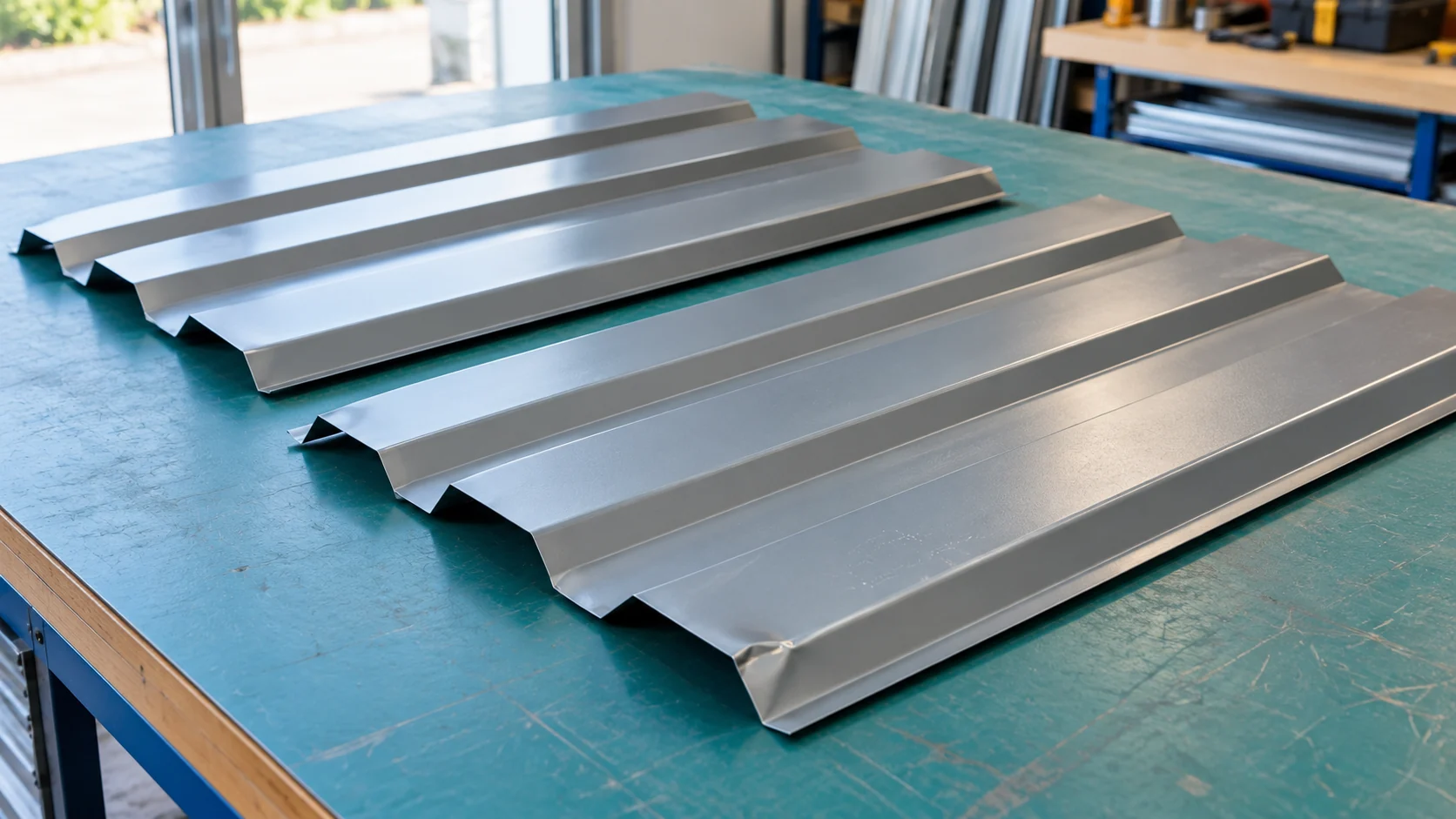
Second-grade sheet metal can lower the cost of a simple roof or façade. The prerequisite is knowing the defects and having a good cutting plan. A minor colour difference is assessed differently from a damaged overlap. Before purchase, check the specific batch and plan where each sheet will go. This allows you to separate a bargain from a costly correction. Ask for a written description of the defects and the material parameters. These should cover the profile, the thickness of the steel core, the coating and the available lengths. There is no single universal definition of a defect that can be applied to all such batches. The trade term alone does not say whether the sheet is suitable for a roof.
How to establish what second grade means in this offer?
When receiving the delivery, inspect a larger portion of the material, not just the top sheet. The pack may contain items in varying condition. Also check the underside and signs of improper storage. Surfaces covered by film or soiled require careful assessment before accepting the batch as compliant with the agreement.
Which places are particularly important on a roof?
On the roof slope, the edges forming the laps and the continuity of the profile from top to bottom are important. A crushed rib can make it difficult to connect with the next sheet. Deformation at the fastening point affects the seal compression. Such damage should not be assessed solely as a cosmetic issue.
Check whether the profile is intended for roof application and whether it suits the pitch and supports. A low price does not change the system requirements. A sheet of unknown thickness and technical origin provides no basis for adopting load capacity from tables for a similar product. Identification of the actual material is required.
What changes when used on a façade?
On a wall, the shade, gloss and surface irregularities are often more visible. A scratch considered insignificant on a high roof may be at eye level. Before installation, lay out several sheets side by side and assess them in light similar to the target conditions.
The façade is also subject to wind loads and requires proper fastening. An arbitrarily weakened sheet cannot be used for it simply because it does not retain snow. Check the support spacing, edges and the coating’s resistance to service conditions. In the plinth zone, soiling and the risk of mechanical damage are also important.
How does the cutting plan help to use sheets with a local defect?
If the defect is located in the part intended to be cut off, it may not affect the finished element. However, this must be marked out before cutting. After removing the fragment, the correct edges, coverage width and fastening points must still remain. Not every damaged sheet can be saved in this way.
In the model roof in Żnin, shorter elements can go into a side storage compartment. This is an example of planning, not a description of an existing project. Using offcuts makes sense if it does not force an unforeseen overlap or additional support. Small fragments without a clearly defined use should be counted as waste.

When does a low price stop being an advantage?
Calculate the cost of the area you will actually use. Assume, solely for the calculation, 40 m² at an agreed €6.94/m². The purchase costs €277.60. If 32 m² is usable, the cost of the sheet metal alone will be €8.68 per square metre used. This is a calculation example, not a current selling price.
Add transport, cutting, coating repair and any purchase of missing sheets. Also include sorting time. If the defect requires painting the entire surface, compare the total with full-value material. In a small order, the delivery cost can offset a significant part of the savings on the unit price.
How to prepare a batch for efficient installation?
Before starting work, divide the sheets by purpose and length. Mark the cutting points in a way that does not damage the coating. Agree with the contractor which defects are acceptable and how the acceptance of the finished surface will be carried out. Do not leave this decision until the last day.
- Confirm the profile and overlap compatibility.
- List the number of usable elements.
- Prepare the right cutting tools.
- Remove swarf after every processing step.
- Assess the coating before covering hard-to-reach areas.
It is worth planning the purchase of second-grade material before dismantling the old roof covering. This gives you time to supplement the material or change the cutting plan if the inspection reveals greater losses than anticipated.
Short answers from the construction site
Can all dents be straightened without losing properties?
No. The method and extent of repair depend on the damage and the coating. Straightening may leave marks or impair the sheet’s protection. Overlaps and fastening points require particularly careful assessment.
Can sheets of different profiles be joined thanks to similar height?
Similar height does not mean compatibility. Rib spacing, edges and coverage width may differ. Direct joining requires matching geometry, and where there are differences, a separate transition detail is needed.
7 branches. Materials closer to your project.

- SEROCK — Dzierżenin 34 E
- BŁONIE — ul. Sochaczewska 138A
- RADOM — ul. Grobickiego 8
- ŁÓDŹ — Natolin 8
- OLSZTYN — Barczewo, ul. Prosta 9
- WROCŁAW — ul. Jerzmanowska 10C
- GORZÓW WLKP. — ul. Zielona 33/34