Roof coverings
Choosing trapezoidal steel sheet thickness for a replacement roof
In brief
The sheet thickness is selected together with the profile and the support spacing. The roof area alone does not answer whether the sheet will be suitable. When replacing, the condition of the old structure is also a factor. First, therefore, the working conditions of the covering must be established, and then variants with confirmed parameters compared. Measure the support spacing and check their alignment. Note the bearing width and the locations of sheet joints. An assessment of the structure’s condition is also needed. A new covering will not repair a weakened purlin or a connection that requires replacement.
What data should be collected from the old roof?
Check the loads assumed in the design. Snow, wind and other actions arising from roof use matter. They are not selected solely by city name. Location, geometry and terrain conditions must be assessed as part of the design.
Mark equipment, skylights and service penetrations. Their presence can change the support layout and the requirements for the covering. If the roof is to accommodate additional equipment later, it is worth allowing for it before replacing the sheet. A thickness reserve in the sheet alone does not replace such a check.
Why is the profile just as important as the thickness?
The height and shape of the profile affect the stiffness of the sheet. Two profiles made of the same steel and with the same thickness can have different permissible spans. The designation T18 or T35 does not describe all cross-section dimensions. Data for the specific family must be used.
The support scheme also matters. A sheet resting on two supports behaves differently from one in a multi-span arrangement. Load tables refer to specific conditions. One convenient value should not be selected from them without checking the assumptions.
A change to a higher profile may require adjustments to flashings and details. On an existing roof, check the eaves, ridge and perimeters of penetrations. Before purchase, the load-bearing requirements must be combined with the ability to properly close the roof slope. The sheet alone is only part of the system.
What changes when moving from 0.5 to 0.6 or 0.7 mm?
Thicker steel usually means a greater sheet weight. For the specific roof profile T35, the weight is 4.71 kg/m² effective at 0.5 mm. For 0.6 mm it is 5.65 kg/m², and for 0.7 mm 6.59 kg/m². These are not values for every profile with a similar name.
The difference between the first and last variant is 1.88 kg/m². Over 180 m² of effective covering, this gives 338.4 kg of additional steel. This is a simple comparison of the weight of the sheets alone. The structure must be checked for the full set of loads, not only for this difference.
A greater thickness may improve mechanical parameters, but the permissible span is determined by the relevant data. Do not assume a fixed percentage improvement. The same profile, steel grade, support arrangement and assessment criterion are required. Without these, the comparison will not be reliable.

How to read the thickness in a quote?
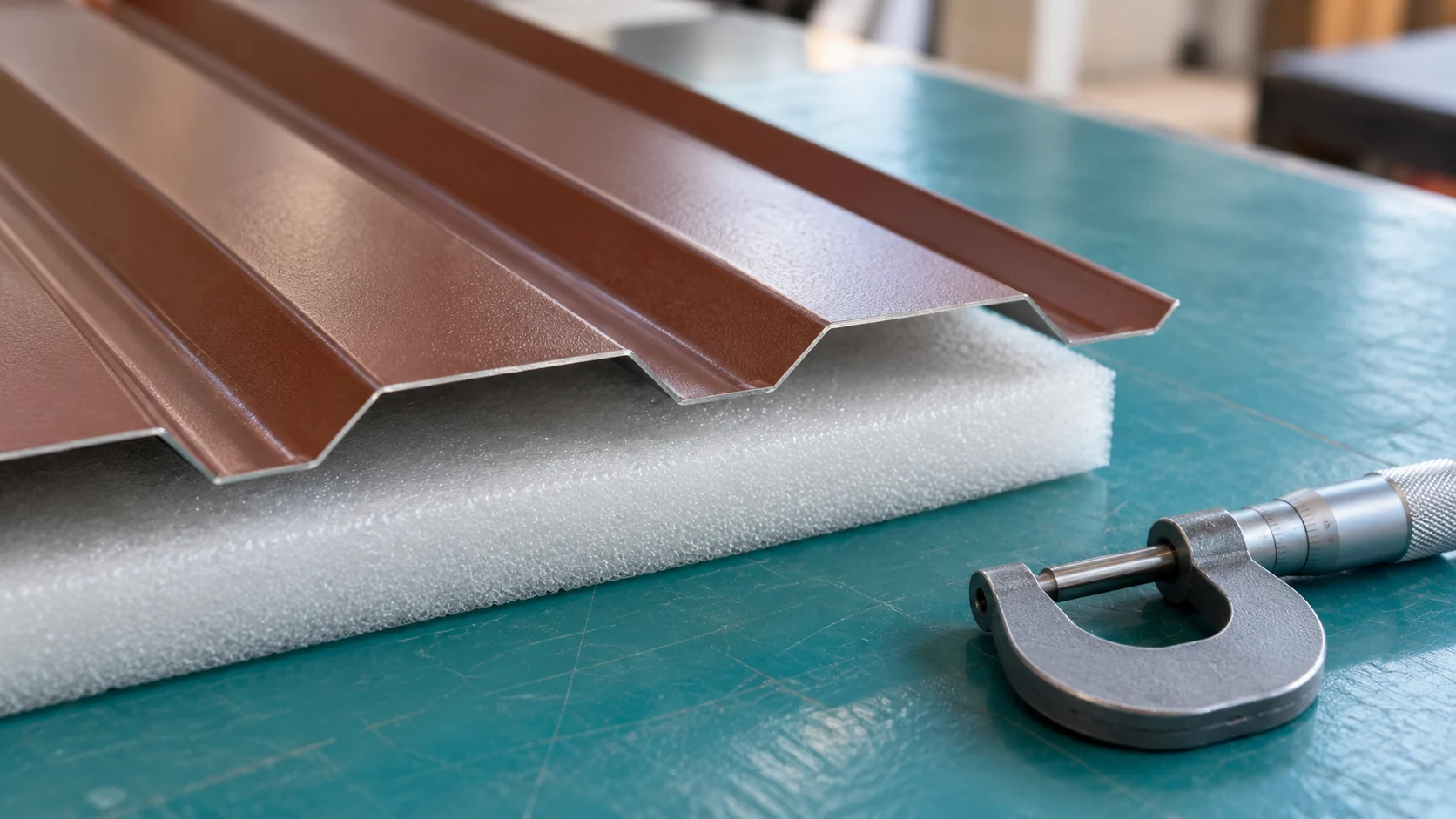
Establish whether the offer states the thickness of the steel substrate and according to which rules. Protective layers are a separate product feature. Steel thickness should not be equated with the thickness of the organic coating. Both values describe different functions.
Check the type of metallic coating and the surface finish. A thicker sheet does not automatically provide adequate resistance to a specific environment. Durability requires the correct choice of protection, proper installation and maintenance of the covering.
At acceptance, compare the documents and the order marking. A single measurement at the edge is often affected by the coatings and by how the instrument is used. In case of discrepancies, the proper inspection procedure must be applied. It is not worth deciding conformity on the basis of one random reading.
How to choose a variant and close out the design change?
Compare several variants that meet the requirements. In addition to the price of the sheet, calculate the cost of supports, flashings and installation. A thicker or higher profile may change the scope of work, but savings should not be assumed without checking the entire system.
For renovation, establish whether the existing support spacing can be retained. If not, the cost of changing it should be included in the quote before purchasing the sheets. The contractor also needs information on the correct fasteners. The drilling capacity and the fastening method must match the structure.
Record the final choice in the specification: profile, thickness, steel, coating and set of lengths. Attach the approved support and fastening arrangement. This ensures that the order, delivery and installation relate to the same solution. Changing any one of these elements requires re-checking.
Short answers from the site
Is 0.5 mm sheet always sufficient for a garage roof?
This cannot be determined on the basis of the building’s function alone. The profile, supports and loads must be known. The correct variant results from the data for the specific sheet and the roof design.
Will tightening more compensate for a missing sheet thickness?
No. The fastener does not change the section properties of the sheet. Over-tightening can additionally damage the coating and the seal. Fixing is carried out according to the adopted solution.
7 branches. Materials closer to your project.

- SEROCK — Dzierżenin 34 E
- BŁONIE — ul. Sochaczewska 138A
- RADOM — ul. Grobickiego 8
- ŁÓDŹ — Natolin 8
- OLSZTYN — Barczewo, ul. Prosta 9
- WROCŁAW — ul. Jerzmanowska 10C
- GORZÓW WLKP. — ul. Zielona 33/34