Steel profiles and structures
Installing sigma sections: from cross-section drawings to assembly
In brief
Sigma has a more complex web than a standard C profile. The contractor must therefore pay attention to the actual contact surfaces and the position of the holes. Careful preparation helps to exploit the advantages of this section. However, one should not expect the additional bends to forgive every mistake. Cold-formed profiles perform in accordance with the design only when their geometry and fixings remain consistent with the assumed conditions. The height of the sigma profile alone is not sufficient to prepare the detail. The flange widths, sheet thickness and the run of the bends are needed. The bend radii and the position of the edge stiffeners are also important. The shop drawing should clearly indicate the orientation of the element. This allows assessment of whether the support and the fastener land in the right place.
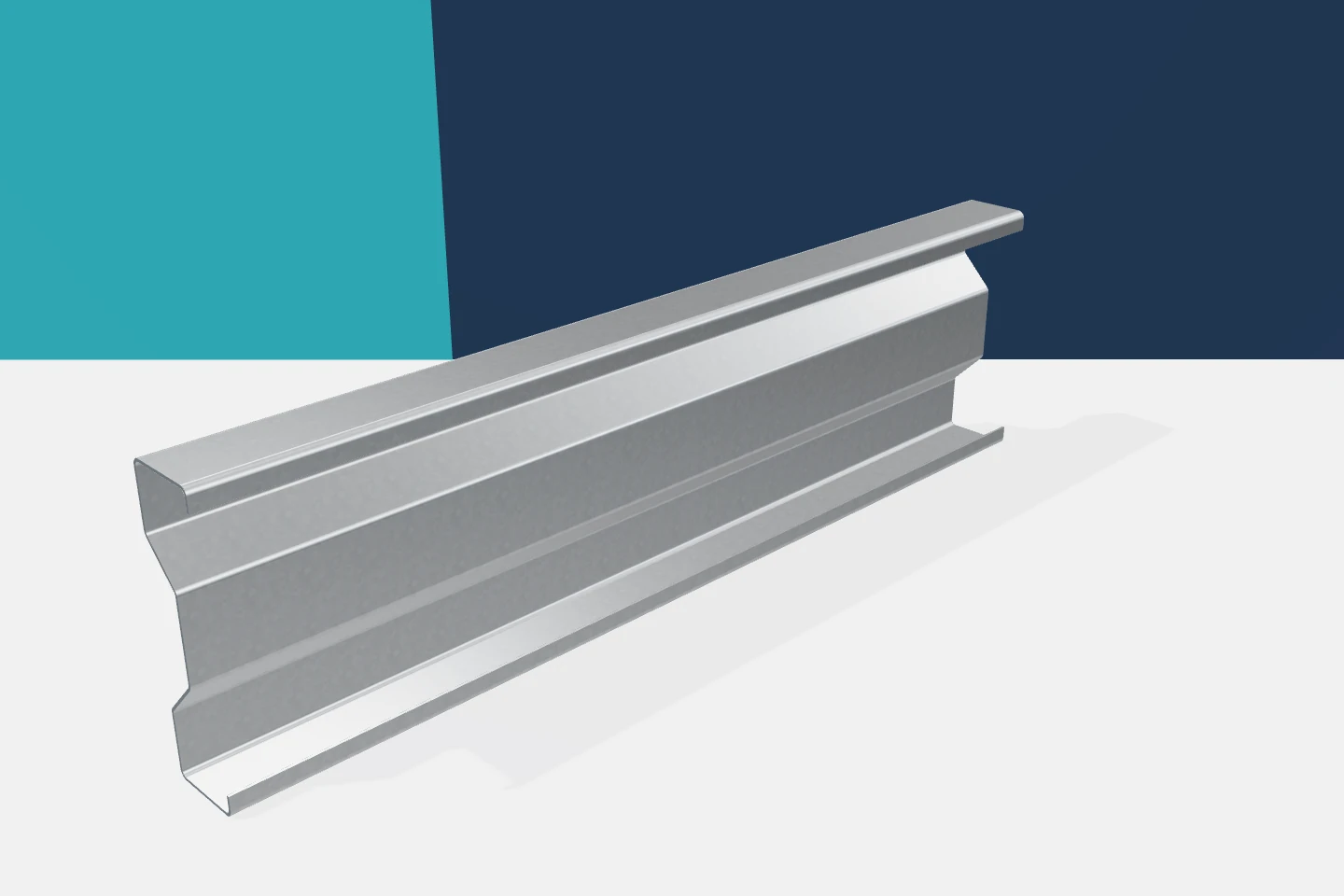
The drawing must show the entire section
It is worth checking that the profile drawing matches the node drawing. It happens that one document shows a modified variant and the other an earlier one. Even a small difference in width can make installation difficult. Galvanised profiles from different series are not necessarily interchangeable. A matching sigma name does not settle the fit with the prepared support sheets.
The fixing plane must not be arbitrary
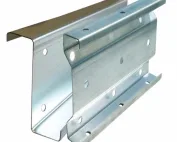
A folded web forms several sections set at different angles. The fastener should pass through the location provided for in the design. If the hole lands too close to the bend, there may be a problem with the washer seating or with tool access. Such a detail should not be corrected by crushing the profile. It must be agreed before production.
The position of the bolt also affects how force is transferred. It is not merely a matter of installer convenience. The preparation of intermediate sheets should take account of the actual thickness and shape of the profile. Z-sections and C-sections have different contact surfaces. Their node cannot be copied to a sigma without checking. Similarity of an element’s function does not mean identical connection geometry.
It is worth determining the hole pattern before cutting the entire batch
Prefabrication of sigma profiles makes it possible to prepare repeatable elements. It requires, however, an approved hole list and lengths. Each part should have an unambiguous marking. If left-hand and right-hand variants occur on site, they must be distinguished. A mistake in orientation can mean that a correctly made profile is regarded as defective.
For repeatable details it is useful to check that the first complete set of documents from all trades is consistent. Collisions with the enclosure and services should also be taken into account. An additional bracket should not later force drilling in an unforeseen location. Cold-formed profiles make the best use of prefabrication when the scope of work on site is defined in advance.
Transport and lifting should protect the bends
When handling a long profile, local crushing of the walls must be avoided. This applies especially to support points and grips. Damage to a bend can change the shape of the cross-section. Its significance should not be judged solely by the size of the visible crack. Sometimes the coating looks good even though the element has been deformed. In such a case a technical assessment is needed.
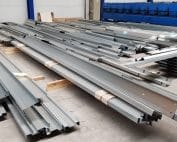
Galvanised profiles are stored on suitably arranged supports. The arrangement of the bundles should limit deflection and moisture. Mismatched parts must not be forced into one another to reduce the stack volume. Sigma, lipped channel and zed profiles may require different packing methods. The supplier’s recommendations must be followed and labels must remain legible.

Stabilisation also applies to the installation stage
Additional web folds do not mean that the element is fully resistant to torsion and loss of stability. Bracing or connecting straps may be specified in the design. They must be installed in the specified sequence. If the final enclosure is intended to provide part of the support, the condition before its fixing requires separate attention. The installer should know these assumptions before starting work.
A stabilising element must not be removed because of a clash with a duct or cable route. Such a clash requires a design solution. Omegas used for the installation subframe are not a default substitute for bracing. Each element has a specific function. Cold-formed profiles can form an efficient system if that function is maintained during execution.
Fitting should not rely on straightening
If the sigma profile does not bear against the support, the cause must be established. The dimensions of the parts, the setting angle and the conformity of the element with the schedule should be checked. Forcing the position by tightening a screw may deform the thin wall. This creates a condition different from that envisaged in the design. Sometimes the problem results from an installation error rather than a defective profile.
Cutting out a section of stiffening also requires agreement. It changes the local geometry and may affect the behaviour of the element. Every approved correction should include a description of how it is to be carried out and how the surface is to be protected. Galvanised profiles should not be modified without recording the changes. As-built documentation helps later to assess the actual structure.
What to check before covering the profiles
Acceptance should cover the correct type of element, its position, connections and stabilisation. It is worth checking whether the bearing pads/washers are in contact in accordance with the detail and whether any fasteners are missing. The surface and critical bends should also be inspected. Inspection before installation of the enclosure gives access to places that will later be more difficult to see. Any doubts are then easier to resolve.
Sigma profiles are useful when their properties meet the requirements of the design. They do not need to be surrounded by a special legend. Like zed, lipped channel and omega profiles, they simply require proper preparation. Well-described cold-formed profiles reduce the number of reworks and questions on site. It is precisely the conformity of details that allows complex geometry to be used in practice.
7 branches. Materials closer to your project.

- SEROCK — Dzierżenin 34 E
- BŁONIE — ul. Sochaczewska 138A
- RADOM — ul. Grobickiego 8
- ŁÓDŹ — Natolin 8
- OLSZTYN — Barczewo, ul. Prosta 9
- WROCŁAW — ul. Jerzmanowska 10C
- GORZÓW WLKP. — ul. Zielona 33/34