Roof covering
Replacing a T18 or T35 roof: checks before changing the profile
In brief
Switching from T18 to T35 is not simply a matter of choosing a trapezoidal sheet with a higher profile. It can change the cover width, the number of sheets and the detailing at the terminations. In a renovation, the existing supports must also be checked. Below we compare actual profile types and show how to go from their dimensions to the cutting plan and the complete order. The number in the name usually indicates the nominal profile height in millimetres. T35 has a higher rib than T18. However, this does not mean that the name alone determines the load-bearing capacity. The assessment requires the full geometry, the steel thickness and grade, and the support conditions.
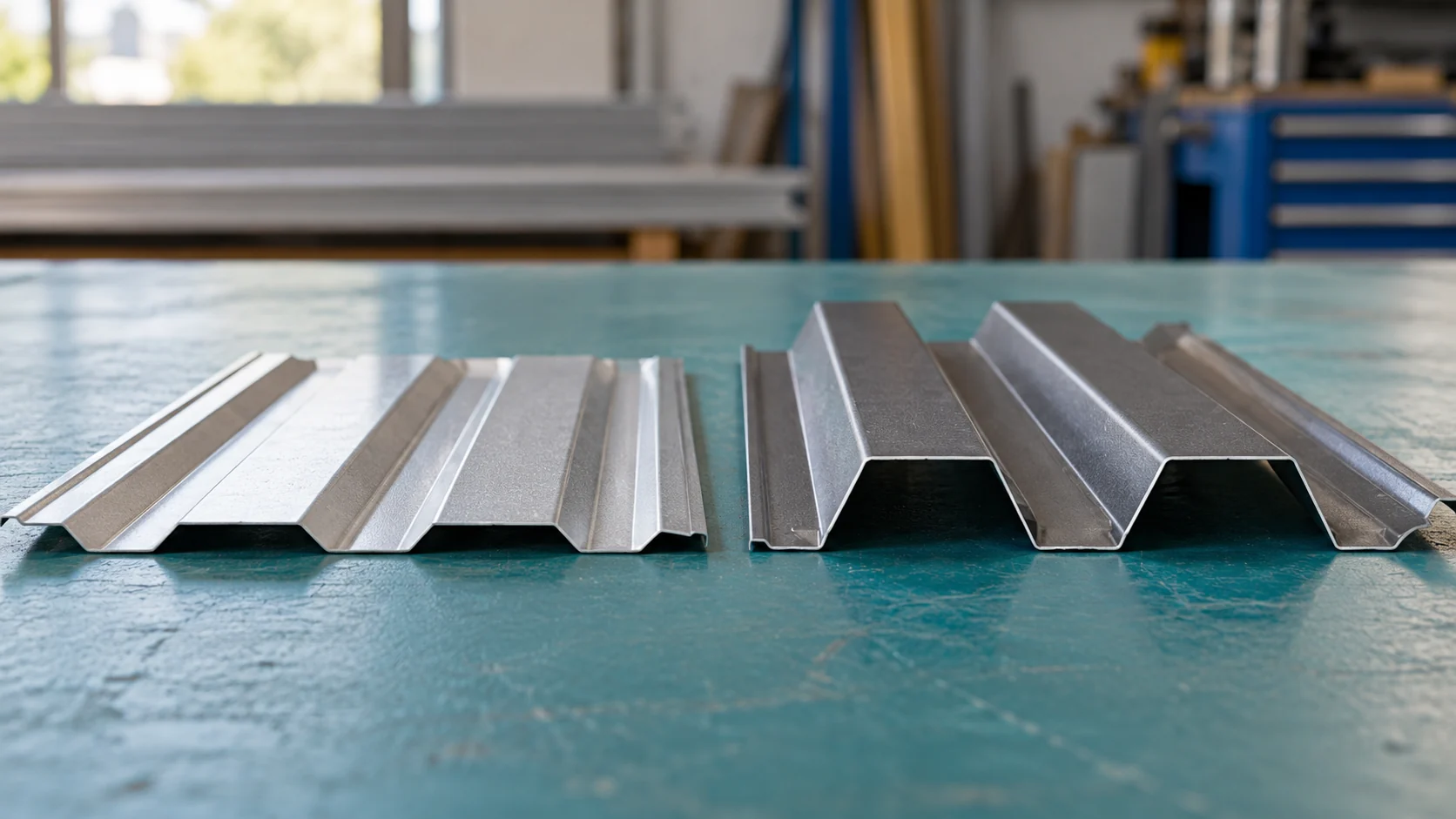
What difference do the designations T18 and T35 describe?
Different families of sheets may be available under a similar designation. Pay attention to the rib spacing and the shape of the overlap. The roof variant may differ from the façade variant. If you are replacing only part of the roof slope, check the compatibility of the old and new profile. A similar height alone does not allow them to be joined without an additional detail.
How do the actual coverage dimensions differ?
The table below shows two example variants of available geometries. It does not describe all sheets with these names. The correct dimensions must be confirmed in the offer for the selected family.
| Parameter | Example T18 | Example T35 |
|---|---|---|
| Profile height | 18 mm | 35 mm |
| Overall width | 1137 mm | 1082 mm |
| Cover width | 1100 mm | 1035 mm |
| Main rib spacing | 137.5 mm | 207 mm |
Use the cover width to calculate the number of sheets. The overall dimension also includes the overlap. A difference of a few centimetres on one run can change the number of elements across the whole roof.
Does a higher profile allow all old supports to be retained?
This cannot be determined without calculations. A higher rib may increase stiffness, but sheet thickness also matters. A thin T35 is not automatically better than any T18. The tables must be read for the correct configuration and loads.
When replacing the covering, measure the support spacing and inspect their condition. Check the connections and whether the screws can be properly seated. If the old structure is uneven, the new sheet will not remove these irregularities. Any required corrections should be carried out before the sheets are delivered. Otherwise, the team may try to fit the covering to a structural error.
It is also worth checking the width of the sheet bearing on the purlin. A configuration that is correct for one profile does not necessarily match the conditions in the tables for another. If the roof is to be fixed to timber, assess the locations of old holes and the condition of the substrate. The new fastener needs a secure seat, not just the correct length.
How does changing the profile affect the number of sheets?
Consider a model eave length of 10.90 m. With a cover width of 1.10 m, ten runs are needed. With a cover width of 1.035 m, eleven are needed. In both cases, the last run must be adjusted to the end of the roof slope. The different number of sheets also affects the number of joints and installation operations.
If each sheet is 4.70 m long, the area based on cover width is 51.70 m² for the first variant and approximately 53.51 m² for the second. This calculation is for a simple rectangle, without hips or openings. The seller’s basis for settlement must be checked separately. Do not assume that the price per square metre covers exactly the same quantity of material.

Which flashings and accessories need to be checked again?
A higher profile changes the geometry at the ridge, eave and gable edge. Check the fit of profiled seals and the terminations at the wall. An element intended for T18 does not necessarily fit T35. Previously purchased accessories should be compared with the new profile drawing.
Also determine the length and type of fasteners and the fixing pattern. Do not carry it over automatically from the old covering. When changing sheets, check the condensation solution under the steel sheet. Felt can act as a moisture buffer, but it requires drying conditions and does not replace thermal insulation. The entire system should match the function of the building.
How can the two options be compared before signing the order?
Prepare two cutting plans for the same roof slope. In each, include the correct number of sheets, accessories and any changes to supports. Add transport and the lifting method. Long elements require careful handling regardless of the profile height.
- Confirm the steel and coating parameters.
- Check the load-bearing capacity and deflection for the supports.
- Compare the quantity of material after cutting.
- Price the complete set of correct flashings.
Choose the profile that meets the roof requirements and gives a favourable cost for the entire scope. T35 is not always necessary, and T18 is not always sufficient. The answer results from the geometry, structure and usage conditions of the specific building.
Short answers from the site
Can the T18 flashings be kept after switching to T35?
Some may be suitable after checking the dimensions, but this should not be assumed in advance. Particularly important are the fit to the profile, the height of the terminations and the seals. Carry out the assessment before dismantling.
Does a wider coverage width always mean cheaper roofing?
It may reduce the number of runs, but the total cost also depends on the steel, coating, supports and cutting layout. Both variants must be calculated for the same roof slope and an identical scope of accessories.
7 branches. Materials closer to your project.

- SEROCK — Dzierżenin 34 E
- BŁONIE — ul. Sochaczewska 138A
- RADOM — ul. Grobickiego 8
- ŁÓDŹ — Natolin 8
- OLSZTYN — Barczewo, ul. Prosta 9
- WROCŁAW — ul. Jerzmanowska 10C
- GORZÓW WLKP. — ul. Zielona 33/34