Installation sequence
Planning bonded anchors for a steel-framed building
In brief
Anchors for columns must be planned before the structure arrives. The concrete, the layout of the base plate and the loads on the entire connection all matter. Choosing the rod diameter alone is not enough. A chemical anchor also requires the hole to be executed correctly and time for curing. The installation schedule should account for both of these stages. Start with the foundation documentation and acceptance of its execution. Information is needed on the concrete, the dimensions of the element and the reinforcement. The condition of the substrate is also important. A solution intended for a specific concrete class does not provide a basis for assuming the same load capacity in an arbitrary old slab.
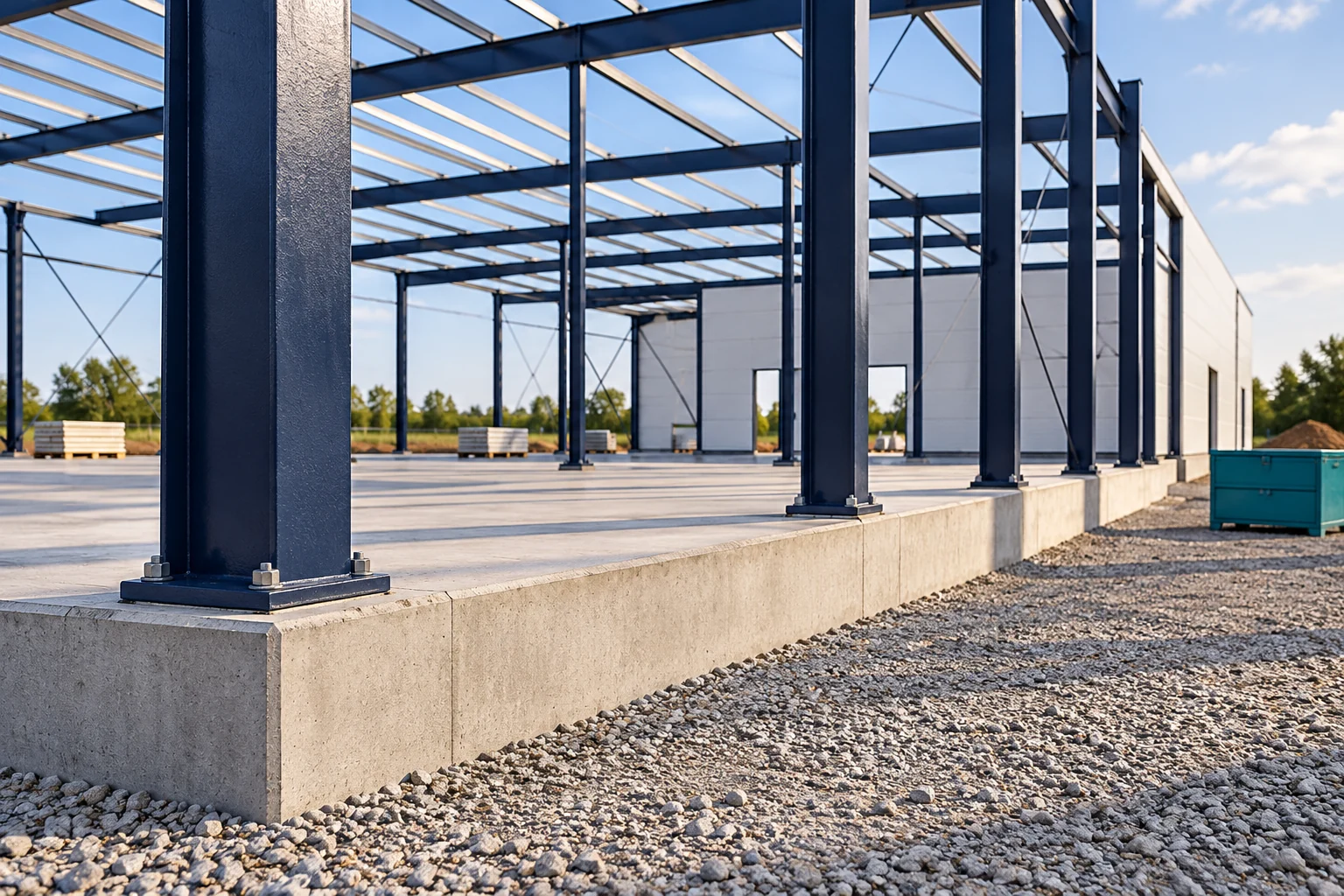
What do you need to know about the foundation?
Floor slab, screed and foundation are different elements. A few centimetres of levelling layer is not a place for anchoring a hall column. If the structure is to stand on an existing building, the actual construction of the substrate must be confirmed.
The designer also determines the concrete working conditions. It matters whether the connection requires an anchor assessed for cracked concrete. Such a variant must not be freely replaced with a solution for non-cracked concrete. The technical assessment of the anchor defines its scope of application.
How should you select the layout of the rods under the column base plate?
The connection is verified as a whole. It comprises the rods, the base plate, the concrete and the way forces are transferred. Tension, shear and their combination occur here. The distances between anchors and from the foundation edge are important. A group of rods may behave differently from a single anchor far from the edge.
The rod diameter is only one of the parameters. The effective anchorage depth and the permitted range of the given solution count. The hole depth does not have to be the same as the depth considered in the calculations. These values must be read from the documentation of the correct set.
Before drilling, compare the column base template with the actual hole spacing. Check the axes, elevations and installation tolerances. If the spacing does not match, stop this stage. An additional hole next to a badly made one may reduce the distances required for anchoring. The repair must be agreed.
Why does hole preparation determine the connection?
A chemical anchor works as a defined set of mortar, rod and substrate. The drilling and cleaning process must correspond to the instructions of this set. There is no single number of brush strokes valid for all products. The permitted tools and the moisture conditions of the hole also differ.
Dust remaining on the walls may weaken the bond. Therefore the cleaning stage should not disappear from the schedule under pressure from the installation crew. The brush used must be of the correct size and condition. A superficial blow-out of the hole alone does not replace the full procedure if the instructions require additional steps.
Before drilling, the position of the reinforcement must be identified. Encountering a rebar does not permit cutting it. Changing the anchor position also requires verification. The position of the holes should follow from the approved solution, not from the places where the drill meets the least resistance.

How should temperature and curing time be taken into account?
The time needed to set the rod differs from the time after which the connection may be loaded. The first determines when work with the mortar can proceed. The second decides when further installation can begin. Both values depend on the specific product and the conditions given in its instructions.
Check the substrate temperature, not just the weather forecast. In the morning, concrete may be at a different temperature than the air in the middle of the day. The storage conditions of the mortar and its expiry date also matter. A wet hole is permissible only if it is covered by the documentation of the selected solution.
Plan drilling and anchoring before the date for erecting the columns. Do not assume that the anchor will be ready after a fixed number of minutes regardless of the weather. Moving the rod too early or loading the connection can undo correctly performed earlier work. Tightening should also take place at the right moment.
How to accept the anchoring before installing the hall?
Prepare a simple record of the work. It should include the anchor location, the system used, the temperature and the setting time. Also record the expected time of release for loading. Such information helps coordinate the work of two crews without guessing whether the mortar has already set.
The inspection covers the position of the rods, their protrusion and conformity with the design. The required tightening torque must be verified. It should not be chosen by feel. If the design provides for tests or trials, the scope and method of assessment are determined by the person responsible for the structural solution.
Before lifting the columns, confirm that the entire zone is ready. This includes the foundation, the anchors and the preparation of the base supports. The base plate must not hang accidentally on the nuts without a provided solution. Only once these points are settled can installation of the structure and subsequent cladding proceed.
Short answers from site
Does a larger rod diameter always increase the safety of the fastening?
It does not guarantee that. The outcome is determined by the entire connection, including the concrete, edge distances, spacing and embedment depth. Any change in diameter must be verified in the design.
Can the anchor be loaded when the mortar already appears hard?
Do not judge readiness by finger or surface appearance. The load-bearing time specified for the given set, substrate temperature and other execution conditions applies.
7 branches. Materials closer to your project.

- SEROCK — Dzierżenin 34 E
- BŁONIE — ul. Sochaczewska 138A
- RADOM — ul. Grobickiego 8
- ŁÓDŹ — Natolin 8
- OLSZTYN — Barczewo, ul. Prosta 9
- WROCŁAW — ul. Jerzmanowska 10C
- GORZÓW WLKP. — ul. Zielona 33/34