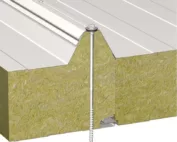
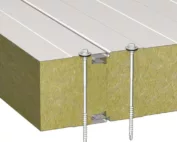
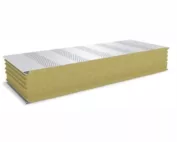
Mineral wool walls
Lighter or denser mineral wool core: how do you compare two panel families?
In brief
Two mineral wool panel families can have the same thickness but different mass and performance. A higher core density does not automatically mean the best choice for every wall. The whole product must be compared. Load-bearing capacity, thermal insulation and the scope of classification are particularly important. Only then can the value of a lighter variant be assessed. The core works together with the facings in a composite panel. Its density and mechanical properties matter, but they do not on their own describe the load-bearing capacity of the entire panel. Fibre orientation, composite action and the steel sheets also count. The product should therefore not be selected solely by the number of kilograms per cubic metre.
What does the core variant actually change?
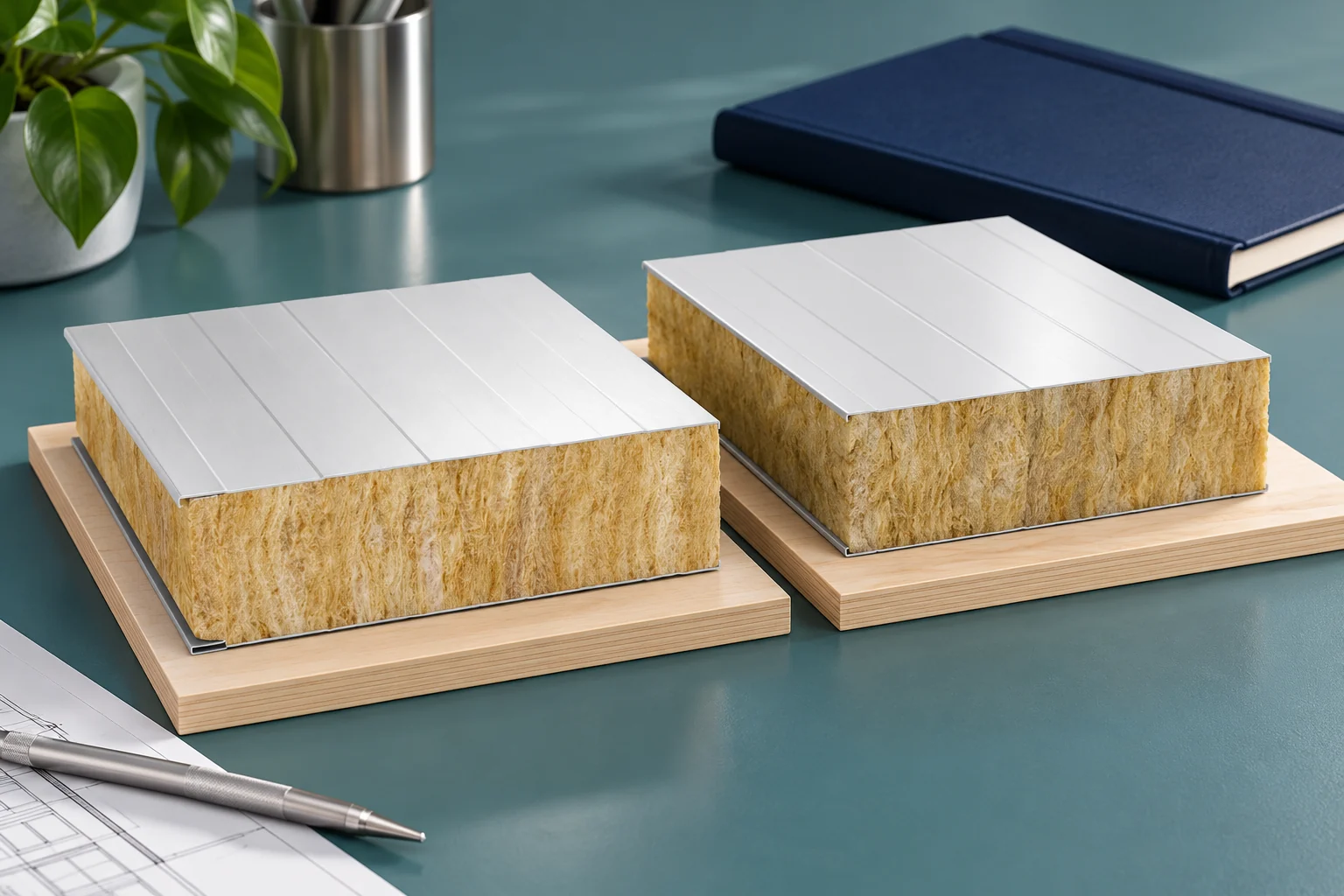
In practice, you may encounter families with a nominal core of 100 kg/m³ and a lighter one of 85 kg/m³. These are not universal values for all manufacturers. They serve here to show how to compare specific variants. The marketing name is not needed if we know the required parameters.
Mineral lamellas are arranged so that the fibres work in the appropriate direction relative to the facings. The colour or appearance of the exposed cross-section alone does not allow the full product specification to be reliably identified.
What does the comparison at 100 mm look like?
For an example heavier family with 0.5/0.5 mm facings, the mass is 18.1 kg/m² and Uc approximately 0.39 W/(m²K). For a lighter variant of this thickness, 16.6 kg/m² and Uc 0.38 W/(m²K) can be found. In this comparison, lower mass does not mean poorer thermal insulation.
For 200 m² of panels, the mass difference is approximately 300 kg. This may be relevant logistically, but is not on its own a justification for changing the material. The load-bearing capacity and all project requirements must be checked. The weight saving does not replace the permissible support spacing.
It is worth comparing data in a single table with clearly described facings. A change in sheet thickness can affect the result. Without this information, it is easy to attribute the difference to the core alone, even though the panels being compared also differ in other characteristics.
Why is the load-bearing table essential?
The panel works under wind load and its own weight in a specific arrangement. The permissible spans depend on the variant, thickness and number of spans. It cannot be assumed that a denser core will always allow supports to be spaced a certain percentage further apart. The result requires data for the entire product.
With an existing substructure, the actual spacings and bearing widths must be checked. A lighter panel may suit the project, but this must be confirmed. If it does not meet the requirements, the change may mean additional structure. Its cost should be included in the comparison of offers.
Load-bearing capacity is not only about ultimate failure. Deflections and serviceability conditions also matter. Excessive deformation can affect appearance, connections and the performance of the entire wall.

How do you compare fire and acoustic performance?
Do not assume that both families have an identical range of classification. The specific thicknesses, orientation and installation conditions must be checked. A mineral wool core does not automatically transfer the results from one panel to another. This applies to both reaction to fire and wall resistance.
The acoustic comparison looks similar. Mass can matter, but the result depends on the entire assembly and the test. Better sound insulation should not be promised solely on the basis of core density. Full steel facings do not act like an exposed absorbent layer.
If the project has specific requirements, enter them in the comparison table. Missing data does not mean equivalence. It means that it is necessary to clarify whether the variant is suitable for the intended application.
When can the selected variant be changed?
The easiest way to do this is before ordering the structure and accessories. Then the panels can be compared together with the support spacing, fastenings and transport. Once the frame has been erected, the scope for permissible change is narrower. Compliance must be checked before a more favourable price is accepted.
When building in two stages, it is not advisable to mix families without a plan. Connections may differ in geometry and surfaces in appearance. Even if the parameters are suitable, the junction between the parts requires a solution. Colour matching alone is not enough.
The decision should be recorded together with the complete set of parameters. This gives the contractor an unambiguous order. The comparison of a lighter and a denser core then becomes a technical choice rather than an assessment of which name sounds more solid.
In the cost comparison, also include the number of full elements and the available lengths. If the lighter variant is available in a different range of dimensions, it may require additional joints. Their support and flashings have their own cost. A lower pack weight does not always mean a lower cost for the finished wall.
Short answers from the construction site
Does a density of 100 kg/m³ always mean a better panel than 85 kg/m³?
No. Suitability is determined by the properties of the whole product and the requirements of the wall. Density is only one of the core parameters.
Can a lighter panel have a similar Uc?
Yes, specific variants show this. However, load-bearing capacity, facings and classifications must also be compared before they are considered interchangeable.
7 branches. Materials closer to your project.

- SEROCK — Dzierżenin 34 E
- BŁONIE — ul. Sochaczewska 138A
- RADOM — ul. Grobickiego 8
- ŁÓDŹ — Natolin 8
- OLSZTYN — Barczewo, ul. Prosta 9
- WROCŁAW — ul. Jerzmanowska 10C
- GORZÓW WLKP. — ul. Zielona 33/34