Walls with mineral wool
How to plan a quieter interior with insulated wall panels?
In brief
Choosing a panel with mineral wool does not automatically guarantee a quiet hall. Noise passing through the wall must be separated from reverberation inside. Doors, openings and connections are of great importance. An acoustic plan is best prepared before ordering the enclosure, when the layout of rooms and installations can still be changed. First establish where the sound source is and who is to be protected. An office next to a workshop requires a different solution from a warehouse next to a busy road. The type of noise, frequencies and operating times of equipment matter. The wall area alone does not indicate what result will be required.
What noise should the new wall reduce?
Separate airborne sound from structural vibration. A machine fixed to a shared frame can transmit vibration beyond the panel itself. In that case, a thicker wall panel does not necessarily remove the main transmission path. A change to the equipment support or the room layout may be needed.
Before dividing the hall, it is worth marking the sources, workstations and all passages. This allows you to check whether the new partition actually crosses the noise path, instead of leaving an open door or a shared duct beside it.
What does the Rw rating of a panel mean?
Rw describes the weighted sound insulation index under specified test conditions. For one of the available wall configurations of panels with mineral wool, Rw ≥ 32 dB is given, and the RA1 and RA2 indices are at least 29 and 28 dB respectively. These differences show that the character of the sound matters.
This result should not be transferred to all thicknesses, facings and joints without checking the scope of the data. It is also not a promise of an identical result in a completed building. The wall on site contains connections, openings and other sound transmission paths.
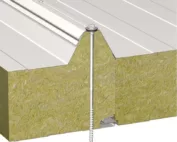
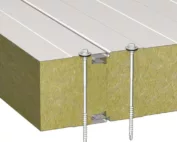
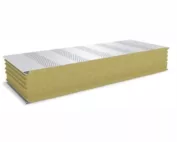
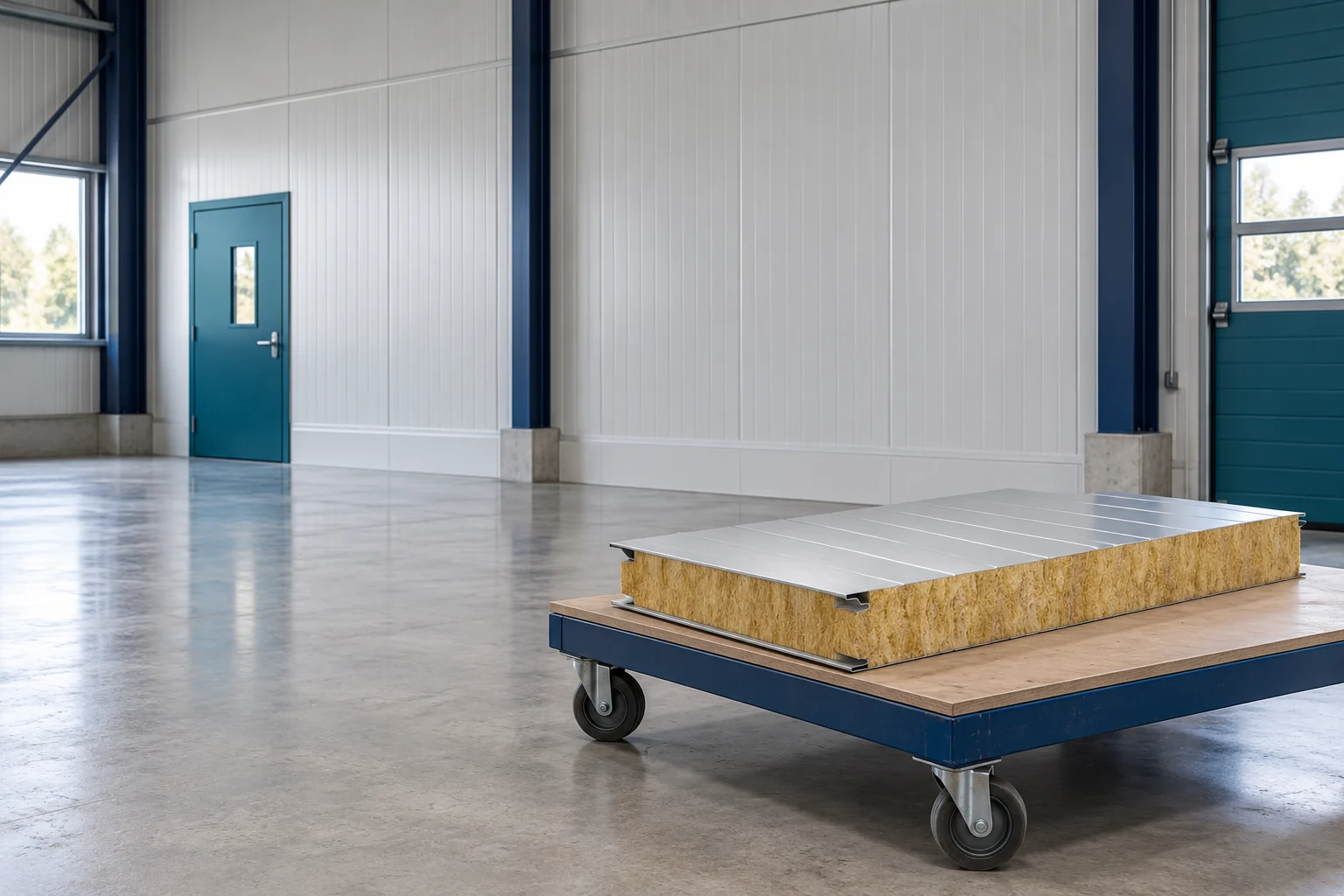
When comparing materials, collate the data obtained for the relevant variants. Mineral wool density or thickness alone is not sufficient to determine Rw. The panel is a composite product in which the facings, the core and the way the elements are connected all act together.
Does mineral wool in a steel panel absorb reverberation?
The full steel facing conceals the porous core. It does not act like exposed mineral wool in a sound-absorbing assembly. Therefore, a panel with good insulation does not necessarily have to strongly reduce sound reflections in the room. Insulating against noise and absorbing sound are separate tasks.
For an example configuration with full facings, an absorption coefficient αw = 0.20, class E, is given. Such a wall should therefore not be presented as an automatic replacement for an acoustic ceiling. In a large interior with a hard floor, the reverberation may remain pronounced.
Where absorption is required, systems intended for that purpose are selected. Their installation must take account of loads, fire and the way the interior is maintained. The panel facing must not be perforated independently in the hope of improving acoustics without assessing the effect on the whole product.

Where does the benefit of a well-chosen panel most often get lost?
Door openings, gates and service penetrations can weaken the partition. Their parameters and sealing must be matched to the intended effect. A very airtight wall next to a permanently open gate will not effectively separate a noisy workshop. It is worth checking how the building actually operates.
Pay attention to the junction at the floor and under the roof. A shared space above the wall can bypass the entire partition. Likewise, continuous structural elements create additional transmission paths. The selection should cover the connections, not just the middle of the panel.
Services are best coordinated before installation. A penetration prepared later without proper sealing can weaken the effect. Acoustic sealing must be reconciled with fire requirements and the ability of the duct to move. Not every material is suitable for all functions.
How do you carry out an extension and check the result?
In the example workshop in Przeworsk, start by separating noisy and quiet zones. Then select the partition, doors and penetrations. If machines are to be relocated, determine their location before the walls are closed. A change after installation can invalidate earlier assumptions.
At acceptance, check the continuity of the connections and the conformity of the components used. If a specific result is required, the method of confirming it should be agreed in advance. A subjective impression of quiet during machine downtime says little about working conditions.
Keep the data for the specific assembly and the documentation of the openings. This makes it easier to assess the effect of additional doors or a fan during later expansion. Acoustics should return to the plan whenever the sound path changes.
Short answers from the construction site
Will doubling the thickness of the wool double the insulation in decibels?
No. Decibels do not work as a linear measure of thickness. The result depends on the entire panel configuration and must be derived from the relevant data.
Can reverberation be assessed from Rw alone?
No. Rw relates to sound transmission through a partition. Assessing reflections within a room requires data on absorption and the properties of the entire room.
7 branches. Materials closer to your project.

- SEROCK — Dzierżenin 34 E
- BŁONIE — ul. Sochaczewska 138A
- RADOM — ul. Grobickiego 8
- ŁÓDŹ — Natolin 8
- OLSZTYN — Barczewo, ul. Prosta 9
- WROCŁAW — ul. Jerzmanowska 10C
- GORZÓW WLKP. — ul. Zielona 33/34