Building insulation
How do you convert EPS to PIR before changing the material in an order?
In brief
Switching from EPS to PIR can reduce the insulation thickness. However, there is no single conversion factor for every wall and board. First compare the declared lambda, then check the system and the details. The saving in centimetres should result from a calculation, not from a promise attached to the material name alone. The thermal resistance of homogeneous insulation follows from thickness and lambda: R = d/λ. Thickness must be given in metres. Two different insulations can provide similar resistance at different thicknesses. That is a good starting point for comparison. It does not, however, mean the products are fully interchangeable.
What are we comparing: the layer or the whole wall?
The U-value applies to the whole building element. It takes account of the other layers and surface resistances, and within a defined range also corrections. If changing the material requires a different substructure, fixings or joint layout, the effect of these changes must be checked. Keeping the R of the foam alone is not enough.
Before calculating, read the parameters of the specific variant. Facade, floor and load-bearing insulation EPS differ in their intended use. Likewise, PIR in foil and PIR under render should not be treated as the same product.
What does a simple thickness conversion look like?
For example, 160 mm of EPS with a lambda of 0.038 W/(m·K) gives an R of approximately 4.21 m²·K/W. To obtain the same design resistance with PIR with a lambda of 0.022, approximately 92.6 mm is needed. For the variant with a lambda of 0.019, 80 mm is needed. These are layer calculations, without ensuring equivalence of the whole walls.
The order must state an available thickness, not the fraction from the calculator. If 90 and 100 mm boards are available, the 90 mm variant with a lambda of 0.022 gives an R of approximately 4.09. It does not exactly reproduce the assumed level of 4.21. The 100 mm board gives approximately 4.55. The difference must be taken into account in the final selection.
For PIR under render, a different lambda may apply. For the example of 120 mm and a value of 0.025, the resistance is 4.80. This result does not arise from deterioration of the material on site. It describes a different variant and its declared parameters.
What must remain consistent after changing the insulation?
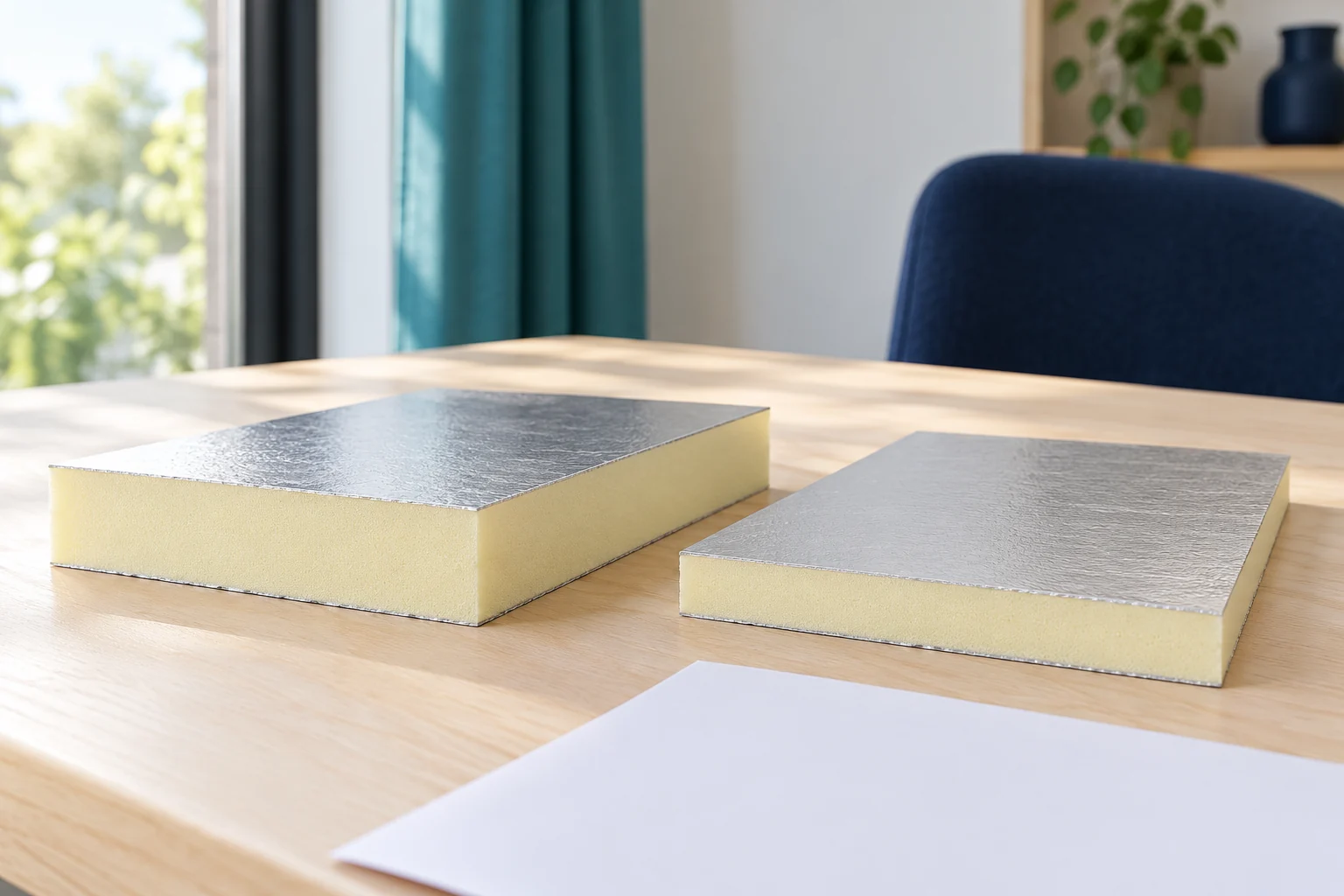
Check whether the selected product is intended for the given system. Insulation with render requires compatibility of the insulation, mortars, fixings, mesh and finish. EPS cannot be replaced with a board with an aluminium surface without checking the system. An adhesive intended for one substrate is not automatically suitable for another.
On the roof, the type of covering, the method of fixing and the support matter. In the floor, behaviour under load must be checked. The stress value at 10% deformation is not a ready-made permissible value for permanent pressure. Data corresponding to the actual application are needed.
The change may also alter behaviour with respect to water vapour and fire requirements. A low lambda does not describe these characteristics. The assessment should cover the entire assembly, particularly when insulating from the inside or changing the roof layers.

How does a change in thickness affect the following trades?
A reduced façade thickness changes the reveal depth, the projection of window sills and the position of flashings. If these elements have already been ordered, check whether they can still be used. Thinner material does not always mean fewer adjustments. Sometimes brackets, service penetrations or profile dimensions need to be corrected.
In the example renovation in Łęczna, two complete wall cross-sections can first be compared. Only after the selected variant has been approved is it worth ordering the finish. This way the window team and the insulation team work to the same dimension.
Pay attention to tolerances and substrate unevenness. If the wall requires levelling, part of the gained space will be taken up by the preparatory layer. In the cost estimate, therefore, compare the thickness of the finished building element, not just the descriptions of the boards on the pallet.
How do you compare the price after a fair conversion?
Assemble materials that provide the assumed thermal effect and comply with the design. Calculate the purchase area, offcuts and packaging. Add fixings, finish and transport. The price of one cubic metre does not always help when choosing a wall of limited thickness. More useful is the cost of a complete square metre of the given assembly.
Also check the delivery sequence. Boards of a different format may require more storage area and a different cutting layout. If the material is to arrive in two batches, agree on the same grade. Retaining the name PIR when the facing changes does not mean that all properties are retained.
The final decision should combine calculations with feasibility. The centimetres saved are valuable when there is still room for correct connections and finishing.
Short answers from the site
Does 10 cm of PIR always correspond to 20 cm of polystyrene?
No. The relationship depends on the lambda of both products. R must be calculated for the specified thicknesses and then the entire building element assembly checked.
Can insulation be changed after ordering the fixings?
First check the lengths, the substrate and the requirements of the new system. A change in thickness or board type may require different fixings and re-approval of the details.
7 branches. Materials closer to your project.

- SEROCK — Dzierżenin 34 E
- BŁONIE — ul. Sochaczewska 138A
- RADOM — ul. Grobickiego 8
- ŁÓDŹ — Natolin 8
- OLSZTYN — Barczewo, ul. Prosta 9
- WROCŁAW — ul. Jerzmanowska 10C
- GORZÓW WLKP. — ul. Zielona 33/34