Fibre cement roofing
Factory-prepared fibre cement sheets: holes and corner cuts
In brief
Factory-drilled holes and cut corners can reduce the amount of work needed on site. Fibre cement sheets prepared in this way still require a proper installation plan. Asbestos-free fibre cement cannot simply be laid in any direction. The preparation helps when the sheet variant matches its position on the roof slope. The holes and corner cuts are not arbitrary finishing details. The manufacturer prepares them for a particular overlap arrangement and installation direction. Before ordering, check how each version is identified. Sheet size and colour alone do not explain its intended position within the system. Establish from the outset which elements are needed in the middle of the roof slope and which at its edges.
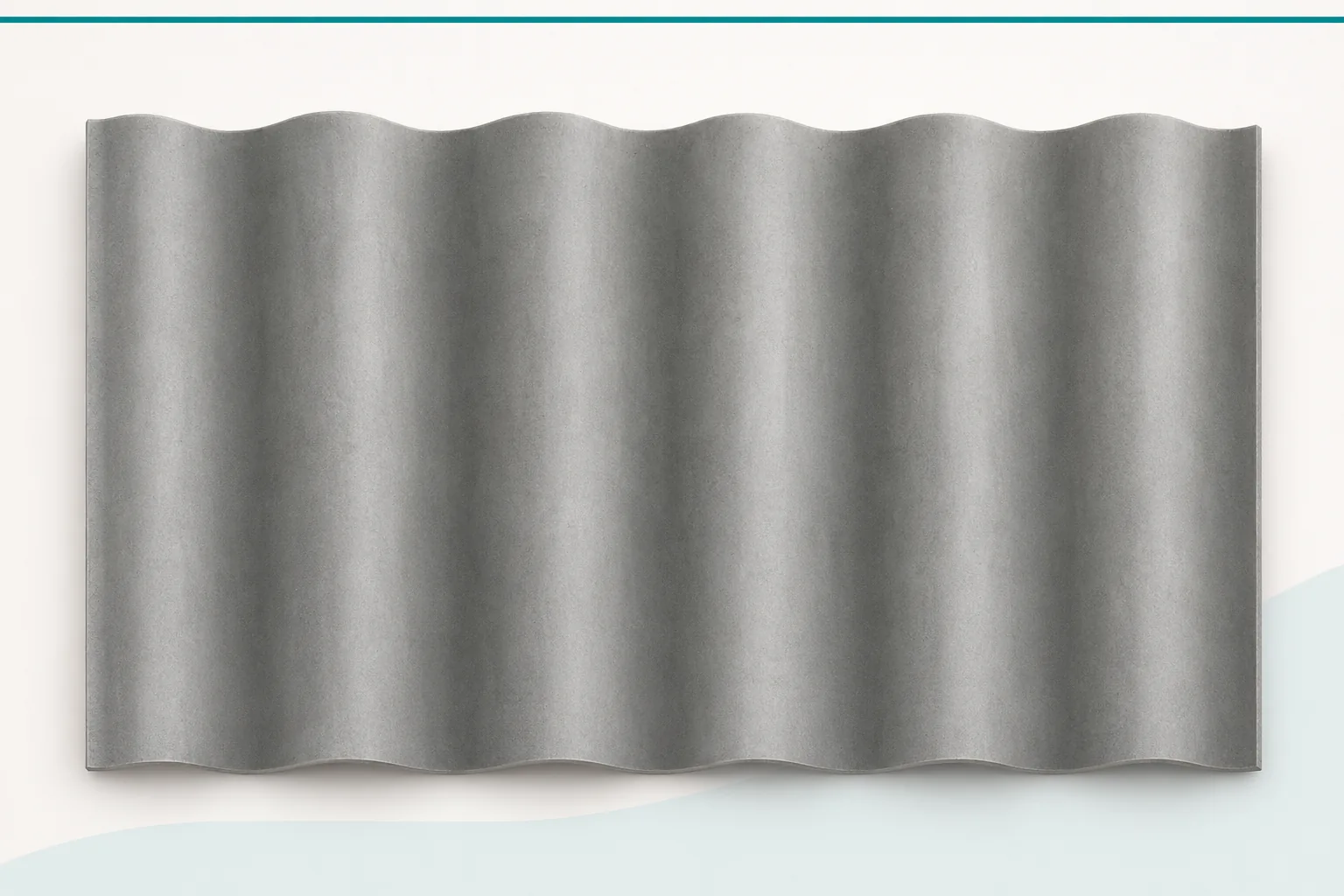
Preparation is tied to a specific layout
Not every sheet on the roof has the same connections with its neighbours. Standard and prepared sheets can complement each other in a single order. The selection results from the laying plan, not from a single universal list of pieces.
The mitre prevents unfavourable build-up of thickness
Four sheets may meet at the intersection of laps. Without suitable preparation, some of the material would create a bulge. The sheets could then stand proud or become stressed when tightened. Corrugated fibre cement sheets require this point to be resolved in accordance with the system.
Cut corners allow the components to be laid correctly, but correct laps and gaps are also needed. Do not copy the mitre length from another profile. Different side lap widths change the geometry. Factory preparation is specific to a particular sheet, not to every corrugated covering.
The installation direction must be known to the team
A sheet with prepared corners may need to be laid in a fixed sequence. Turning it for transport convenience does not mean it can be fixed on the roof in the same way. Before starting, the top and bottom edges and the lap side must be identified. Markings and instructions help.
Asbestos-free fibre cement prepared for installation is best planned at ground level. It is worth labelling the packs by roof slope and row. This reduces the number of transfers at height. If the laying direction does not match the factory mitres, the problem must be resolved before drilling and fixing.
Holes are not always the same
Corrugated fibre cement sheets may have different holes at the top and bottom of the sheet. Their size depends on how the specific joint works. Do not assume that the difference means a production error. Check the fixing diagram and how adjacent elements overlap.
The intended clearance helps limit stresses between the sheet and the structure. It should not be removed by accidental filling or by choosing an overly thick fastener. The factory hole must work with the correct seal and fixing. The fact that the screw passes through the sheet does not prove that the whole assembly is compliant.
The structure must meet the prepared fixing points
Preparing the sheet does not remove the need to check the supports. The holes must be located in the positions intended relative to the battens or purlins. If the structure has been built at a different spacing, its layout should not be adapted by arbitrary additional drilling. An assessment of the non-compliance and a proper correction are needed.
Corrugated fibre cement sheets should lie on a flat plane. A ready-made hole does not prevent cracking if the sheet is pulled down to an uneven support. It is worth checking the structure before lifting the material. Factory preparation shortens working time but does not replace preparing the substrate.
Roof slope edges may require different components
At the eaves, ridge and gable, the arrangement of joints differs from the middle of the roof. Not every prepared mitre will be needed there. In some places standard sheets are used, worked according to their position. The details follow from the instructions for the chosen system.
Asbestos-free fibre cement should be ordered with these zones in mind. Buying only the most convenient variant may leave an improperly prepared edge on the outside of the roof slope. It is also worth marking penetrations and valleys on the plan. There, saving on processing is not always more important than the correct detail.
Less cutting does not mean no quality control
Factory preparation reduces some of the work, dust and measuring on site. The condition of the corners and holes still has to be inspected after delivery. The edge may have been damaged during transport. A doubtful sheet should not be installed just because it was prepared at the plant.
Fibre cement sheets are lifted from the stack without dragging them over the adjacent surface. With mitres, impacts must be avoided. After removing material, the remaining pack requires proper protection from water. Faster installation will only be an advantage if the sheet reaches the roof slope in good condition.
Compare the cost of the completed stage
When choosing a variant, it is worth calculating not only the price per piece but also the preparation time and the amount of waste. A large, repetitive roof slope may make good use of ready-made holes and corners. On a complex roof, some sheets will still require individual cutting. The benefit depends on the specific layout.
After installation, the panel version marking and the element usage plan are retained. For repairs, not only the profile but also the preparation of the sheet will be important. A replacement should not then be selected solely by length. Holes, laps and edges must again form a compatible connection.
Before choosing panels with pre-formed holes, prepare a plan of the rows and edge zones. This way, the factory preparation will genuinely reduce work on site.
7 branches. Materials closer to your project.

- SEROCK — Dzierżenin 34 E
- BŁONIE — ul. Sochaczewska 138A
- RADOM — ul. Grobickiego 8
- ŁÓDŹ — Natolin 8
- OLSZTYN — Barczewo, ul. Prosta 9
- WROCŁAW — ul. Jerzmanowska 10C
- GORZÓW WLKP. — ul. Zielona 33/34