Renovation and maintenance
Clearing snow from roofs: when is it needed and how should it be organised?
In brief
Whether a roof needs clearing follows from the load, the state of the structure and the weather — not from a single depth measurement. Damp, compacted snow can be far heavier than fresh powder; the same layer varies in mass with its water content and how packed it is. A thaw, rain or refreezing alters conditions on the roof. Uneven deposition counts as well: drifts at parapets and higher parts of the building stress the structure locally more than an even cover. The owner should monitor the building and arrange safe works.
Why are centimetres of snow not enough for assessment?
The same layer can have a different mass depending on its water content and degree of compaction. After a thaw, rain or refreezing, the situation on the roof can change. Uneven snow deposition also matters. Drifts at parapets and higher parts of the building can load the structure locally more than a uniform cover.
One should not adopt a safety threshold from general advice found online. Information is needed about the specific roof, its load-bearing capacity and its current condition. This applies both to a house and to a hall made of sandwich panels or structural trapezoidal steel sheet. The sheet thickness or the profile name alone does not allow a safe amount of snow to be determined.
When to react without delay?
Observe unusual deflections, displacements of elements, cracking sounds and sudden difficulties in opening doors related to deformation of the structure. Such signals should not be ignored. If danger is suspected, access by people must be restricted and the appropriate services and a person competent to assess the structure must be called. Do not go onto the roof at that time to check the situation yourself.
Danger can also occur at entrances and pedestrian routes. Sliding snow and icicles require the area below to be secured. An assessment should be commissioned before the next heavy snowfall, particularly in buildings with large roof areas. A response plan prepared in advance is far more useful than looking for a random crew at the last moment.
Who should carry out snow removal?
Work on the roof requires preparation, efficient equipment and fall protection. The commission should go to a contractor who can plan safe access and protection of the surroundings. For workers, the required training and the ability to work at height matter. The mere presence of a harness does not mean that the workplace is safe.
The anchor points for the fall protection systems must be intended for such a task. It must not be assumed that a chimney, a gutter or any roof ladder is suitable for attaching equipment. Slippery surfaces, hidden skylights and edges must also be taken into account. If safe conditions are lacking, work should not begin merely because the deadline is urgent.

How to prepare the scope and sequence of works?
The contractor should know the structure, the type of covering and the places sensitive to damage. An assessment of the snow load together with people and equipment is needed. The order of snow removal matters for the distribution of forces. One section should not be emptied arbitrarily, nor should piles be created elsewhere. The plan must correspond to the specific roof.
In the work order, define the drop zone, its fencing and the method of removing snow from the area. The works must not endanger pedestrians, vehicles or equipment. Pay attention to cables and adjacent lower roofs. Snow should not be thrown onto an element whose load-bearing capacity has not been verified. Access to the building must be organised with account taken of the works being carried out.
How to protect steel sheet and sandwich panels?
The tools and working method should reduce the risk of scratching the coating and damaging joints and flashings. Chipping ice with a sharp tool can puncture or deform thin sheeting. Do not use random chemicals or heat the covering with an open flame. The procedure must be agreed with the material documentation and the condition of the roof.
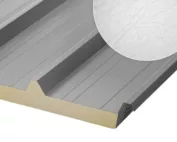
On sandwich panels, the permissible movement over the surface and the support of work areas are important. The properties of the whole panel do not mean that its outer facing can withstand any point load. After completing the works, it is worth inspecting the connections, flashings and drainage. Any damage should be recorded and repaired using the appropriate method.
Do snow guards solve the problem?
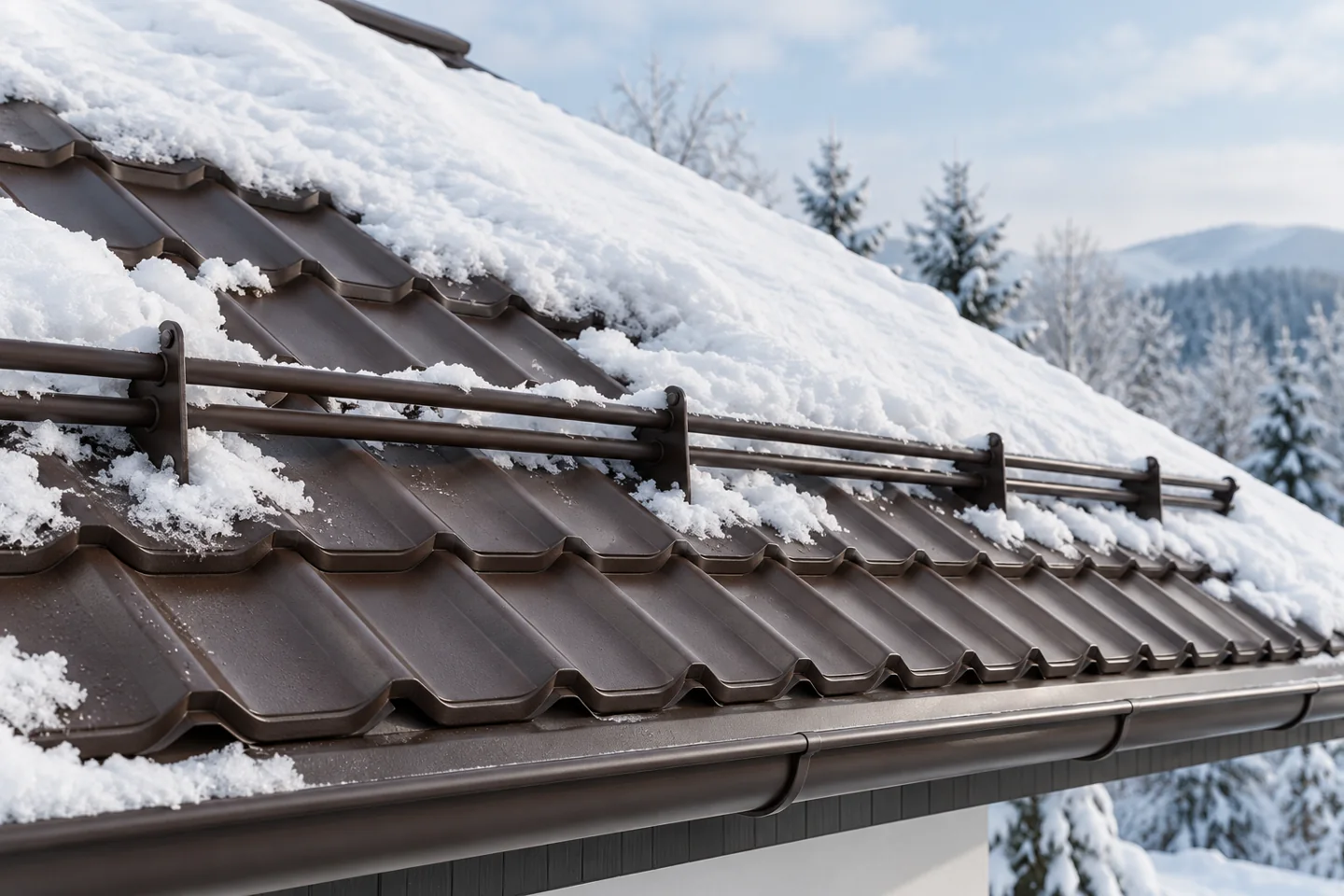
Snow guards and other systems can limit uncontrolled snow sliding when they are properly selected and fixed. However, they do not automatically increase the load-bearing capacity of the structure. Retained snow still loads the roof. The arrangement and method of fixing must be matched to the snow zone, the geometry of the roof slope and the substrate to which the forces are transmitted.
Before winter, check the condition of these elements, the patency of drainage and service access. For a larger facility, designate persons responsible for observation and for ordering a load assessment. Well-prepared winter maintenance combines structural inspection with protection of people. It is not limited to removing snow only when it starts sliding off in front of the entrance.
7 branches. Materials closer to your project.

- SEROCK — Dzierżenin 34 E
- BŁONIE — ul. Sochaczewska 138A
- RADOM — ul. Grobickiego 8
- ŁÓDŹ — Natolin 8
- OLSZTYN — Barczewo, ul. Prosta 9
- WROCŁAW — ul. Jerzmanowska 10C
- GORZÓW WLKP. — ul. Zielona 33/34