PIR insulation
SOPREMA PIR boards: managing and protecting the work area
At a glance
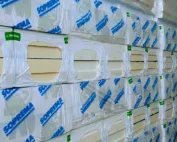
Work around the rooflight is ready for the next stage once the vapour control layer has been accepted; preparing space for the PIR alone is not enough. The crew laying BLUE A must know whether this layer has already been sealed to the rooflight upstand, so that an unfinished joint is not covered. Before starting the complete roof build-up, including vapour control, insulation and roof covering, agree the unloading arrangements and the order of work. For EFYOS BLUE A, start by examining the vapour-control connection to the rooflight wall. The crew needs a detail drawing showing each protective layer separately, as well as the material list.
Preparing the work section
The positioning of the layers at the base of the rooflight is measured before cutting, because a discrepancy revealed after cutting increases waste. Thermal continuity, air tightness and protection against rain remain separate work objectives. The decisions concerning the detail are passed on by the coordinator for the execution of all roof layers.
The product itself and the scope of its data
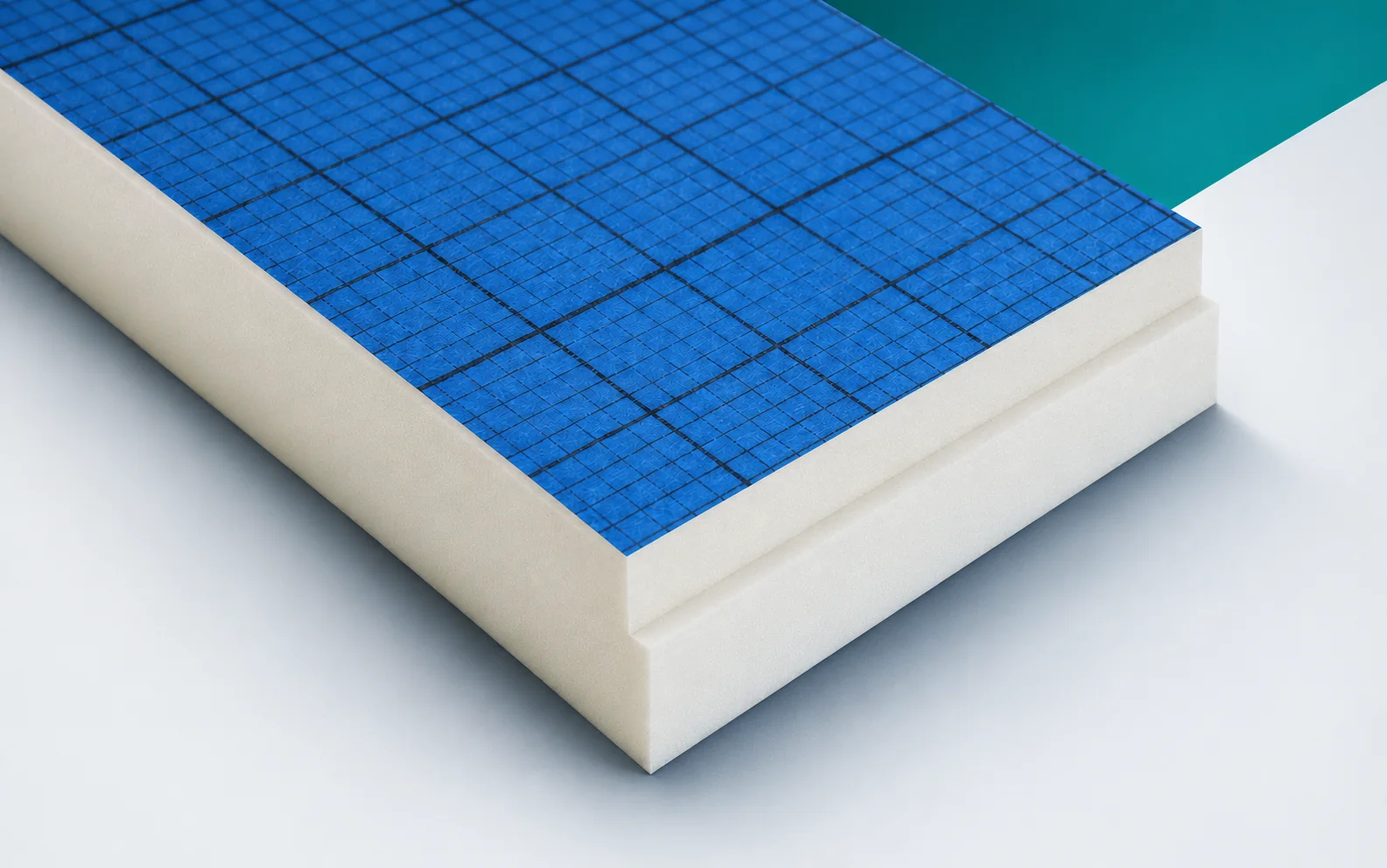
The thermal layer here is EFYOS BLUE A: a PIR core with aluminium facings, λD 0.022 W/(m·K), CS(10/Y)120 and reaction to fire E. These data describe a specific product, not an adhesive, covering, vapour control layer or the classification of the finished roof assembly — each component has its own task in the roof design. SOPREMA PIR boards are assessed here in the context of a complete roof with vapour control layer, thermal insulation and covering, and the properties of the complete board include the core and the facings.
A calculation to help with planning
The stage at the rooflight is handed over while the required connection is still visible — the team laying EFYOS BLUE A then confirms the condition of the vapour control layer. After the insulation has been laid, the perimeter remains accessible for acceptance, and the covering starts after a further check. Thanks to this sequence, a correction does not require dismantling the work of the next team.
With EFYOS BLUE A, the reference point is a specific section of the works, not the entire roof slope. Access to the sealing must remain open after the subsequent layers have been laid, so before repetitive laying each layer must be traced from the roof field to its termination at the vertical upstand. The rooflight detail should have a separate line for each protective layer. The aluminium facing of the board with a lambda of 0.022 W/(m·K) helps to identify the variant, but does not replace measurement of the installed surface. Material for the scope covering a complete roof with vapour control layer, thermal insulation and covering requires clear labelling even after full packs have been split.
Decision before repeating the layout
Before the first section, it is worth establishing whether the project includes repairing the missing connection at the rooflight or increasing the thickness in the central roof field, if this results from an agreed change. The first section with EFYOS BLUE A proves its worth at the junction between the vapour control layer and the rooflight upstand, not only in an easy, obstacle-free field. The foil on a single board cannot be regarded as an airtight vapour control layer for the entire roof. The assessment is made by the coordinator responsible for the execution of all roof layers before the team moves on to a larger scope. After the change, a single materials list linked to the cross-section and details must serve both the delivery and the cutting station.
What to check during fitting
When laying EFYOS BLUE A, the geometry of the joint between the insulation boards does not replace the sealing of the vapour control layer. The working surface is the aluminium facing, so the method of handling should not damage it. The layer build-up must provide a substrate prepared for fixing the entire roof covering. Photographs of the continuous joints before they are covered, collected on site, will facilitate acceptance. The next stage is the covering with the rooflight flashing, so any fitting error should be eliminated beforehand. The junction between the vapour control layer and the rooflight upstand requires a separate check, as continuity is easily lost there when cutting or changing the direction of work.
Delivery matched to the team’s capacity
The quantity of EFYOS BLUE A at the station corresponds to the scope that can be prepared and secured. The layout is organised by a single materials list linked to the cross-section and details. Access to the junction between the vapour control layer and the rooflight upstand must be left open so that acceptance does not require moving the entire delivery. The work-break plan takes into account the covering with the rooflight flashing and the securing of the open boundary. After a change of front, access to the sealing after the laying of subsequent layers is reconsidered. The boards remain identifiable by type, not by where the pack was placed.
Handover of the completed layer
Handing the roof over to another team requires comparing the completed works with the drawing and the agreed corrections, not merely confirming that insulation is present. In EFYOS BLUE A, the basis for identification is a set of photographs of the continuous joints before they are covered. It must be recorded whether the scope allows thermal continuity, airtightness and protection against rain to be maintained separately. The rooflight detail is handed over with a separate line for each protective layer and information on the places requiring care; it is also recorded how the vapour control layer was connected to the rooflight upstand and who approved this section.
7 branches. Materials closer to your project.

- SEROCK — Dzierżenin 34 E
- BŁONIE — ul. Sochaczewska 138A
- RADOM — ul. Grobickiego 8
- ŁÓDŹ — Natolin 8
- OLSZTYN — Barczewo, ul. Prosta 9
- WROCŁAW — ul. Jerzmanowska 10C
- GORZÓW WLKP. — ul. Zielona 33/34