Flashings
Sheet thickness and developed width: reading a flashing order
In brief
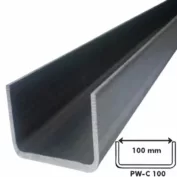
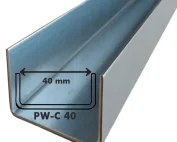
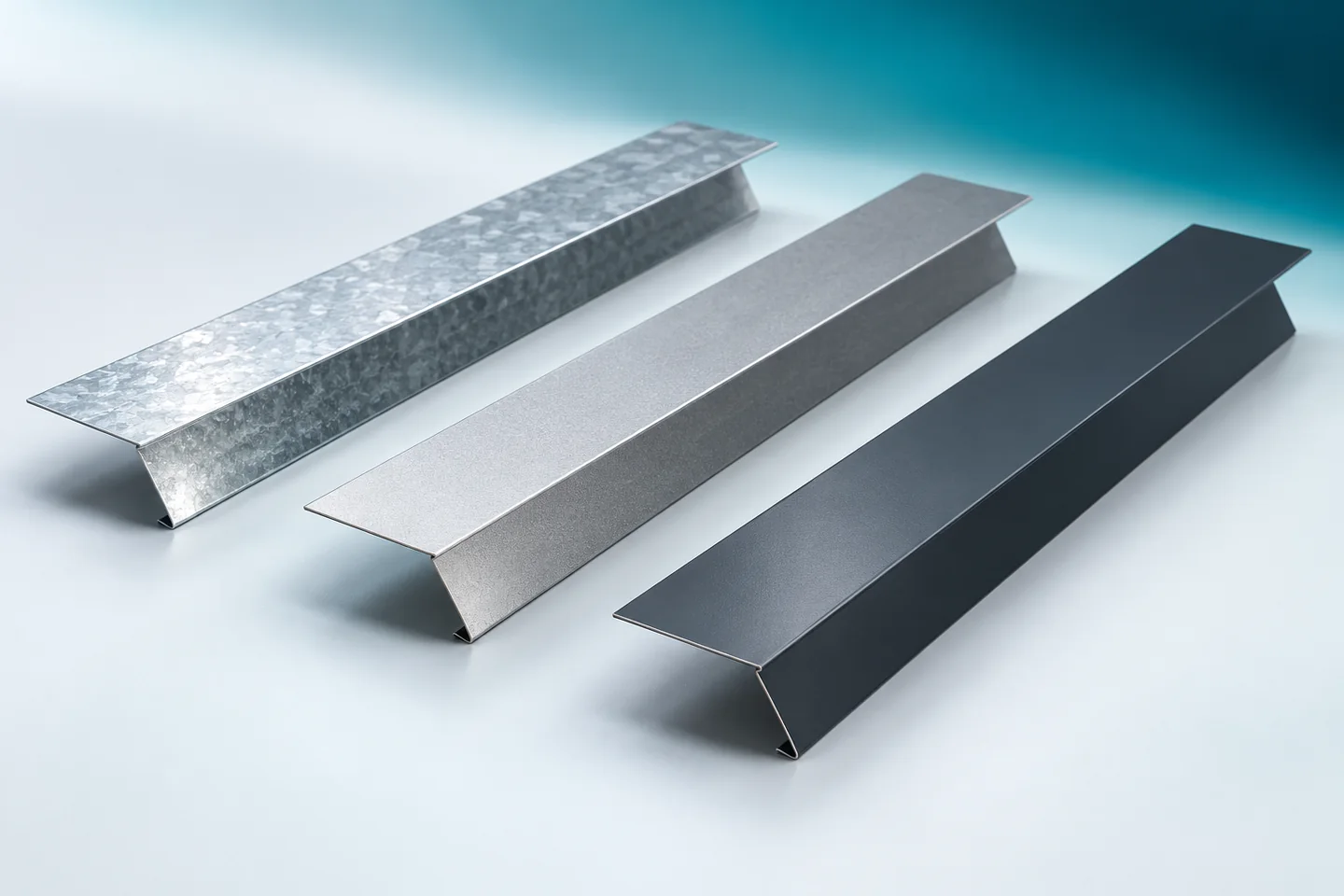
The description of a flashing includes millimetres, linear metres and square metres. Each of these units answers a different question. Thickness refers to the dimension of the sheet in the material cross-section. The developed width describes the width of the strip required before bending. Length defines the section of the finished profile. If these figures are mixed up, two similar quotes may relate to completely different products. It is worth organising them before ordering. A finished flashing has a defined cross-section and length. Its legs are formed from a strip of sheet whose width is the developed width. Thickness remains a separate parameter. A wide profile does not have to be thick, and a narrow strip can be made from a thicker sheet.
Three basic dimensions
In the schedule, it is best to record these quantities in separate fields. State the units so they do not have to be guessed. Barge flashings, ridge caps and starter profiles may have a similar length but different developed widths. The number of linear metres alone therefore does not determine the material consumption of the entire delivery.
The developed width is not the visible width
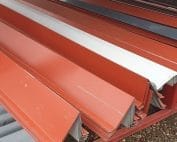
After bending, parts of the sheet form vertical legs, offsets and hems. They are not visible as a single flat width, but they still consume material. The developed width therefore usually differs from the width of the covered zone. This also applies to seemingly simple gutter aprons.
An accurate developed width requires a drawing and data on the bending process. Radii and the dimensioning method affect the result. The sum of the external leg dimensions need not be the finished blank dimension. When placing an order, it is best to agree the cross-section and leave the technological developed width for the fabricator to confirm.
How to convert material area?
For a rectangular strip, the area results from the product of the developed width and the length. For example, a strip 0.30 m wide and 2 m long has an area of 0.60 m². This is the calculation of the quantity of material in the blank. It is not a complete quote for the finished flashing nor for its covering length.
The number of pieces and the cutting method must be taken into account. Waste, perforation, ends and additional operations may be added. Unusual flashings with a similar area need not cost the same. One profile may have two bends, while another has many difficult, closely spaced bends.
Thickness affects how the profile is made
The choice of thickness is linked to the function of the flashing, its span between supports and its geometry. It should not be selected solely on the principle that more is better. Thicker material may require different tools and bending radii. It may also not fit the intended fixing detail.
On the other hand, a thin, wide flat surface may require appropriate support or stiffening. Increasing the leg length alone does not solve this problem. The requirements should follow from the detail and the documentation. A covering flashing does not become a load-bearing structure by changing one dimension.

The coating has its own designations
Galvanised, aluzinc and coated steel sheets differ in their protective layers. The documentation may state the mass of the metallic coating in g/m². This is not the thickness of the steel core in mm. Organic layers are also described separately. These parameters should be read in accordance with the material data sheet.
A coloured finish requires the colour, gloss and texture to be specified. The same colour may be available in different coating systems. When comparing offers, the full description must therefore be checked. Chimney or parapet flashings should have a material suited to the conditions, not just a matching shade.
Price per piece, metre and square metre
The price of a standard flashing may refer to a single piece of a specified length. In an individual quote, the basis may be the area or the linear metre of a given section. Before comparing, the items must be brought to the same quantity and specification. Otherwise, a lower figure in the price may be misleading.
It is worth separating the cost of material from additional operations and transport if the offer presents them in this way. Net values should also be compared with net, or gross with gross. Gutter aprons with a different developed width are not an identical product. A price difference may result from a genuine difference in the product.
When comparing, also record the date and the validity period of the quote. A change in commercial terms is not a change in technical parameters. In the comparison, both pieces of information should be visible separately so that the basis of the order can later be reconstructed.
How to prepare a clear schedule?
Give each flashing a number and assign a drawing to it. Next to it, record the material, thickness, length and number of pieces. Add a description of the finish and the coated side. The developed width can be entered as a value confirmed by production engineering, not one randomly estimated from a photograph.
Before production, check the consistency of the data between the drawing and the table. Similar starter profiles or mirrored verge flashings are particularly easy to confuse. Clear records are also useful when receiving the delivery. They make it possible to establish whether the difference concerns a dimension, the material or the number of ordered items.
Questions and answers
Does a running metre of flashing always mean the same amount of sheet metal?
No. It depends on the developed width. Two profiles of the same length can use different surface areas of material.
Does the coating mass in g/m² indicate the sheet thickness?
No. It is a surface protection parameter. The thickness of the steel core is a separate value, usually given in millimetres.
7 branches. Materials closer to your project.

- SEROCK — Dzierżenin 34 E
- BŁONIE — ul. Sochaczewska 138A
- RADOM — ul. Grobickiego 8
- ŁÓDŹ — Natolin 8
- OLSZTYN — Barczewo, ul. Prosta 9
- WROCŁAW — ul. Jerzmanowska 10C
- GORZÓW WLKP. — ul. Zielona 33/34