Gutters and drainage
Fitting a rainwater gully at the foot of a downpipe
In brief
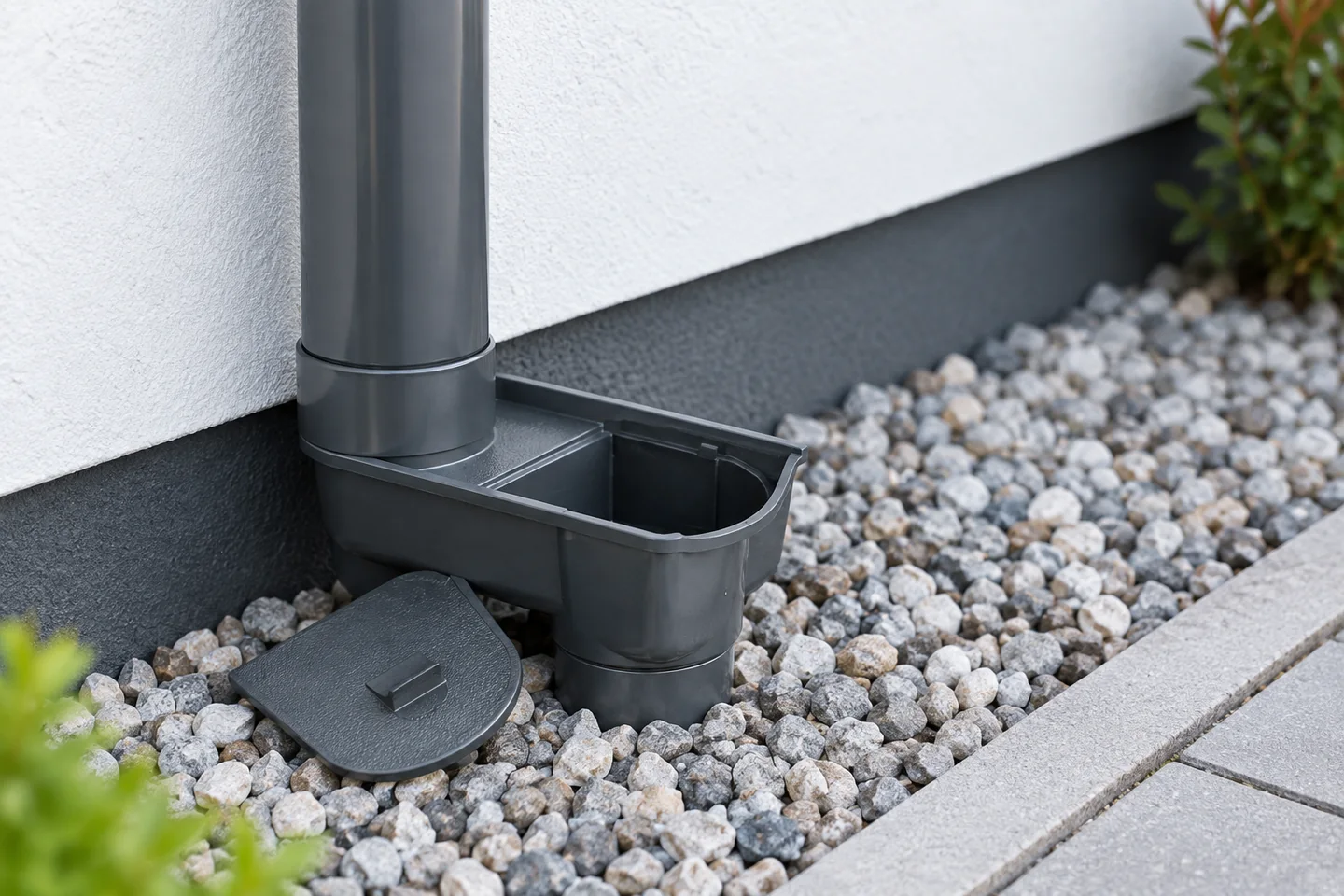
A silt trap beneath the downpipe catches leaves, twigs and sediment before rainwater reaches the underground pipe. Its removable basket lets you empty it and check the outlet without dismantling the installation. Before fitting, establish whether the outlet is at the bottom or the side, and match the unit to the pipe diameters and ground loading. Ensure easy access to the basket and firm seating of the body – these are the conditions for correct operation.
What function does a rainwater gully serve?
Water from the roof carries leaves, small twigs and sediment. If these pass directly into the underground pipe, they can impede flow at a point that is inaccessible for cleaning. A rainwater gully with a removable basket retains some of this debris close to the surface. Once the lid is opened, it can be removed without dismantling the pipe.
It is not a device for treating drinking water, nor a replacement for all filters. Fine sand and dust may pass through. Where a rainwater tank or infiltration is used, additional components specified in the installation design may be required. Their selection depends on the use of the water and the way it is discharged from the plot.
How to choose a model for existing pipes?
Check the dimensions of the downpipe and the diameter and position of the outlet pipe. It matters whether the outlet is at the bottom or at the side of the device. The lid and the inlet reducer should match the shape of the pipe. The opening should not be enlarged by eye if the manufacturer has specified a particular method of fitting.
Also determine where the rainwater gully will be installed. A component by a wall, away from vehicle traffic, has different conditions from a device on a driveway. A light plastic lid does not become resistant to a car simply by being surrounded with paving blocks. If the location is subject to loads, a product and method of installation intended for such conditions are required.
How to plan the height and installation location?
The lid should remain accessible after the final surface has been laid. Its future height must be taken into account, as well as the thickness of the base layers. A rainwater gully positioned too low may collect soil and water from its surroundings. One positioned too high will make access difficult and may be damaged during work on the façade.
When planning, leave room to open the lid and remove the basket. The downpipe must not obstruct this operation. It is worth carrying out a trial assembly of the components before bedding the body. A small adjustment of position at this stage is far easier than subsequently breaking open the surface.

How to provide support and connect the outlet?
The substrate should support the device and the connecting section stably. The method of forming the bedding, backfill or encasement depends on the rainwater gully’s instructions and the ground conditions. The body should not be left hanging on the pipes. Settlement of the ground may then cause the connection to leak or the inlet to deform.
The discharge pipe is laid at the correct fall to the designed receiver. The joints must be cleaned and made in accordance with the type of seals. Before backfilling, check that water drains away and that the joints remain watertight. Fitting the rainwater gully alone will not remedy a backfall or a blockage located several metres further on. Once the surface has been completed, check again that the lid opens. Access to it must not depend on moving heavy planters or dismantling the pipe.
Which errors most often restrict operation?
A common mistake is the absence of a basket or leaving it full after construction. Mortar residues, foil and soil end up inside. In such a case the device may restrict the outflow instead of protecting it. Before the first rainy season, it is worth thoroughly cleaning both the rainwater gully and the gutter and downpipe.
Another problem is connection to the wrong receiver. The rainwater path must comply with the design and the conditions of the given installation. It should not be assumed that every pipe in the ground can take water from the roof. The rainwater gully also does not serve as reliable protection against sewage backflow unless the specific product has a documented such function.
How should the rainwater gully be checked after installation?
After heavy leaf fall, check the basket and the outflow. Inspection is also needed after roof work that produces small debris. If water overflows at the device, first establish whether the cause is a full basket, a blocked pipe or an overloaded receiver. Merely enlarging the opening in the lid does not solve any of these causes.
Before winter, remove deposits that hold back water. Do not use sharp tools to chip ice off the delicate body. In the case of recurring blockages, the entire installation needs to be inspected. A well-chosen rainwater gully is a simple and useful component, provided that it remains accessible, clear and connected to a functioning outflow.
7 branches. Materials closer to your project.

- SEROCK — Dzierżenin 34 E
- BŁONIE — ul. Sochaczewska 138A
- RADOM — ul. Grobickiego 8
- ŁÓDŹ — Natolin 8
- OLSZTYN — Barczewo, ul. Prosta 9
- WROCŁAW — ul. Jerzmanowska 10C
- GORZÓW WLKP. — ul. Zielona 33/34