Trapezoidal steel sheets
Choosing a trapezoidal sheet profile for the conditions on your roof
In brief
When choosing trapezoidal sheet, start by establishing the support spacing, expected loads, roof pitch and the conditions around the building. T18 and T35 are common profiles, but the name alone does not settle suitability. Steel thickness, product geometry and coating type also matter. Prepare the roof slope dimensions, its fall and the batten or purlin spacing, state the building’s function and whether the loft will be heated. Give the site location too, as snow and wind loads differ by region. Without these details, a seller can only indicate a product group, while the full structural system must be confirmed by the designer.
What data should you start the selection with?
Prepare the roof slope dimensions, its pitch and the spacing of battens or purlins. Determine the building’s use and whether the space under the roof will be heated. The location is also needed, because snow and wind loads differ between places. Without this information, the seller can indicate the product category but cannot confirm the entire structural system.
During renovation, the condition of the existing supports must be checked. It should not be assumed that a structure built for the old covering will be suitable for the new steel sheet. The support width and the possibility of correctly fixing the screws are important. A substrate that is too weak limits the effectiveness of even a well-chosen sheet.
When is it worth considering T18, and when T35?
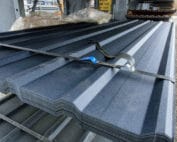
T18 is often chosen for small roofs and enclosures, where the low profile suits the scale of the building. T35 has a higher section which, with the appropriate thickness and geometry, can provide greater rigidity. However, it is not needed in every small structure. The final choice requires comparing data for the actual support spacing.
The designations T18 and T35 do not guarantee identical dimensions from all suppliers. Cover width, rib spacing and the shape of the overlap may differ. An extension to an old roof must not be ordered solely by profile name. Before connecting to existing sheets, a cross-section drawing and a compatibility check are needed.
What role does steel thickness play?
Greater thickness usually changes load-bearing capacity and rigidity, but it must be assessed for the specific profile. In the order, the nominal thickness of the steel core should be clearly specified. The paint layer does not replace the steel, and an attractive colour says nothing about load-bearing capacity. The material grade stated in the documentation should also be checked.
Choose the sheet using load tables for its support arrangement and orientation. Check deflection and fixings as well as strength. Even a small difference in price per metre can mean the two quotations are for different sheet thicknesses. Check the design again before treating those alternatives as equivalent.

How do you choose the coating for the conditions?
Different requirements apply to quiet residential development than near the sea, an industrial plant or a livestock building. Moisture, salinity and aggressive contaminants matter. The coating must be matched to the environment, and the warranty conditions may provide for restrictions on location and manner of use.
Also assess the underside of the covering. Condensation and humid air inside the hall can affect it more strongly than the weather affects the outer surface. In a heated building, the insulation and airtightness arrangement matters. The anti-condensation layer beneath the steel sheet alone does not turn it into an insulated roof and does not solve the ventilation problem.
Does the sheet length affect roof quality?
A sheet spanning the entire length of the roof slope avoids a transverse joint. This advantage must be weighed against transportability and safe handling. An overly long element is easily damaged during lifting. On a difficult-to-access site, shorter sheets may be more practical, but their laps must comply with the instructions and the roof pitch.
When ordering, calculate the effective coverage area. The overall width includes the part intended for the lap. It is worth ordering a roof slope layout plan, especially when the roof has hips or openings. This makes it easier to assess waste, the number of sheets and the cost of the necessary flashings.
What should a complete quote include?
In addition to the steel sheet, include the flashings for the eaves, ridge, edges and penetrations. Suitable fixings, seals and a solution for the underlay are needed. Determine the delivery cost, the method of unloading and the installation date. Prolonged storage of a wet pack can damage good material before it is even laid.
Choose the variant whose parameters and instructions you know. T18 will be a good solution if it meets the requirements of the specific roof; T35 will work where the loads and geometry justify it. “The best steel sheet” means a product suited to the task, with correct details and fixing. Profile height alone or warranty length alone does not provide that answer.
7 branches. Materials closer to your project.

- SEROCK — Dzierżenin 34 E
- BŁONIE — ul. Sochaczewska 138A
- RADOM — ul. Grobickiego 8
- ŁÓDŹ — Natolin 8
- OLSZTYN — Barczewo, ul. Prosta 9
- WROCŁAW — ul. Jerzmanowska 10C
- GORZÓW WLKP. — ul. Zielona 33/34