Roof coverings
When can anti-condensation fleece help under metal roofing, and when does the roof build-up need attention?
In brief
Felt under steel sheet can reduce dripping condensate, but it must have conditions to dry out. It will not repair a leak or replace any roof layer. Before choosing, it is worth establishing where the water comes from. Condensation on cold steel sheet requires a different response from a leaking joint letting rain in. Felt is a fibrous layer bonded to the underside of the steel sheet. It retains some of the water condensing on the cool surface. This reduces the formation of droplets falling into the interior. However, its capacity is finite and depends on the specific product.
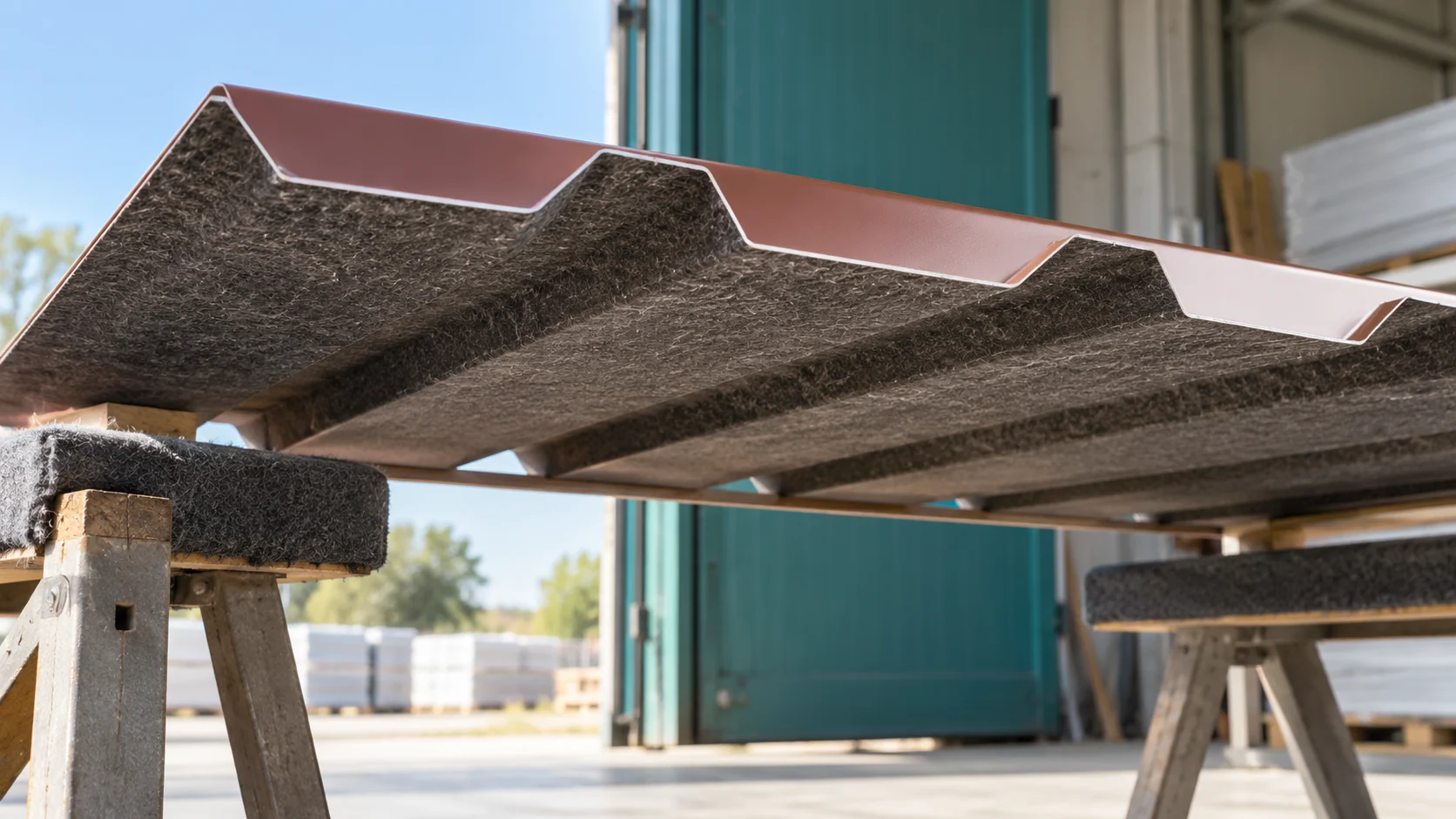
How does the anti-condensation layer work?
Trapped moisture must later evaporate. This requires suitable conditions and air exchange. If the roof constantly supplies more condensate than the layer can release, felt alone will not solve the problem. The sources of moisture and the ventilation must then be checked.
This solution is found, among other places, under uninsulated coverings of garages, carports and warehouses. For each building, the way it is used must be assessed. A wet car, fresh wet works or damp goods can increase the amount of vapour in the air under the roof.
How to distinguish condensate from a leak?
Pay attention to when the water appears. Condensation can also occur without rain when the steel sheet cools down. A leak more often becomes apparent in connection with precipitation or standing water. This is a clue for inspection, not proof of the cause on its own.
Check the distribution of the traces. Moisture over a larger area of the underside of the covering may indicate a problem with the internal conditions. A localised stain at a flashing or penetration requires inspection of that detail. Water can also move along components, so the point where it drips does not always coincide with the point of entry.
Record the weather, temperature and use of the building on the day of observation. Inspect the joints and the ventilation paths. Only after such an assessment can the repair be chosen. Adding an absorbent layer under a leaking covering may only delay the detection of the leak.
Why is ventilation part of the solution?
Airflow allows moisture released by the nonwoven fabric to be removed. The inlets and outlets provided in the roof system must be kept clear. A single opening in a random part of the building is not enough. The entire flow path matters.
During modernisation, check whether the former ventilation paths have been covered. New flashings, soffit cladding or added insulation can change how the roof performs. Felt that previously dried out may remain damp after such a change. The system is therefore assessed after all works are completed.
Do not assume that heating the interior alone will remove the cause. If moisture continues to form and is not removed, it may condense in cooler places. An assessment of ventilation and the layers of the building envelope is needed. In a heated building, proper airtightness on the interior side must also be ensured.

What to do with felt at the eaves and laps?
The fleece should not uncontrolledly draw rainwater from the edges of the covering. Its contact with water at the eaves or at the overlap can cause capillary action. Therefore, in these places the solution specified for the particular steel sheet and anti-condensation layer is used.
The extent of removal or elimination of the fleece’s absorbency follows from the instructions. There is no single strip width suitable for all profiles and slopes. It is worth agreeing the preparation of the ends already when ordering. Some solutions can be carried out before delivery.
Do not improvise with heat treatment or a random coating. An incorrect method can damage the steel sheet’s protection. Also check the side and transverse overlaps. Correct execution of the edges is just as important as the presence of the fleece on the larger surface of the sheet.
Will felt replace the membrane and insulation?
The roof membrane performs a different function in the layer build-up. It can protect the structure and insulation from water penetrating under the covering. The fleece remains part of the steel sheet and temporarily retains condensate. The designed membrane should not be removed simply because sheets with fleece have been ordered.
The fleece is also not equivalent to a thermal insulation layer. Converting an unheated shelter into a heated workshop requires checking the entire roof. Adding material between the supports without analysing airtightness and moisture can create a new problem.
Before purchase, record the roof’s function and the expected changes in use. If the building is to be insulated later, take the target build-up into account now. Show the cost of the fleece separately in the quote. This will allow its role to be assessed without assigning it tasks that other layers should perform.
Short answers from the building site
Does wet fleece immediately mean a material defect?
No. Retaining moisture is part of its function. It is necessary to check whether it has the opportunity to dry out and whether it is not drawing water from a leak or from the edges of the covering.
Will fleece solve the problem in a permanently damp warehouse?
On its own, it does not guarantee this. Its capacity is limited. Conditions for water to evaporate are needed, along with control of moisture sources and air exchange in the building.
7 branches. Materials closer to your project.

- SEROCK — Dzierżenin 34 E
- BŁONIE — ul. Sochaczewska 138A
- RADOM — ul. Grobickiego 8
- ŁÓDŹ — Natolin 8
- OLSZTYN — Barczewo, ul. Prosta 9
- WROCŁAW — ul. Jerzmanowska 10C
- GORZÓW WLKP. — ul. Zielona 33/34