Stages and execution
How should you prepare cutting insulated panels so as not to damage the facings?
In brief
Cutting panels is best minimised through good measurement and ordering the correct lengths. Some openings, however, must be prepared on site. What matters then is the tool, the support and cleaning up after cutting. Damaged coating or swarf left on the sheet metal can make itself felt long after installation is complete. Before production, check wall lengths, roof slopes and the position of openings. Determine which elements can be ordered ready-made. A brief check of the structure is often cheaper than subsequently shortening an entire delivery. Do not base the cutting plan solely on the design dimension if the completed frame already has other deviations.
Which cuts are worth moving into the order?
Every opening should appear on the agreed drawing. A cut-out for a door, duct or skylight changes how the panel performs. It may require additional structure and flashings. It should not be assumed that any opening is neutral for load-bearing capacity or fire resistance.
Prepare a list of components and the cutting sequence. Mark which offcuts can be used. A mistake in the direction of a roof panel or the side of the interlock can mean that a seemingly good offcut will not fit in the planned location.
Which tool suits steel panels?
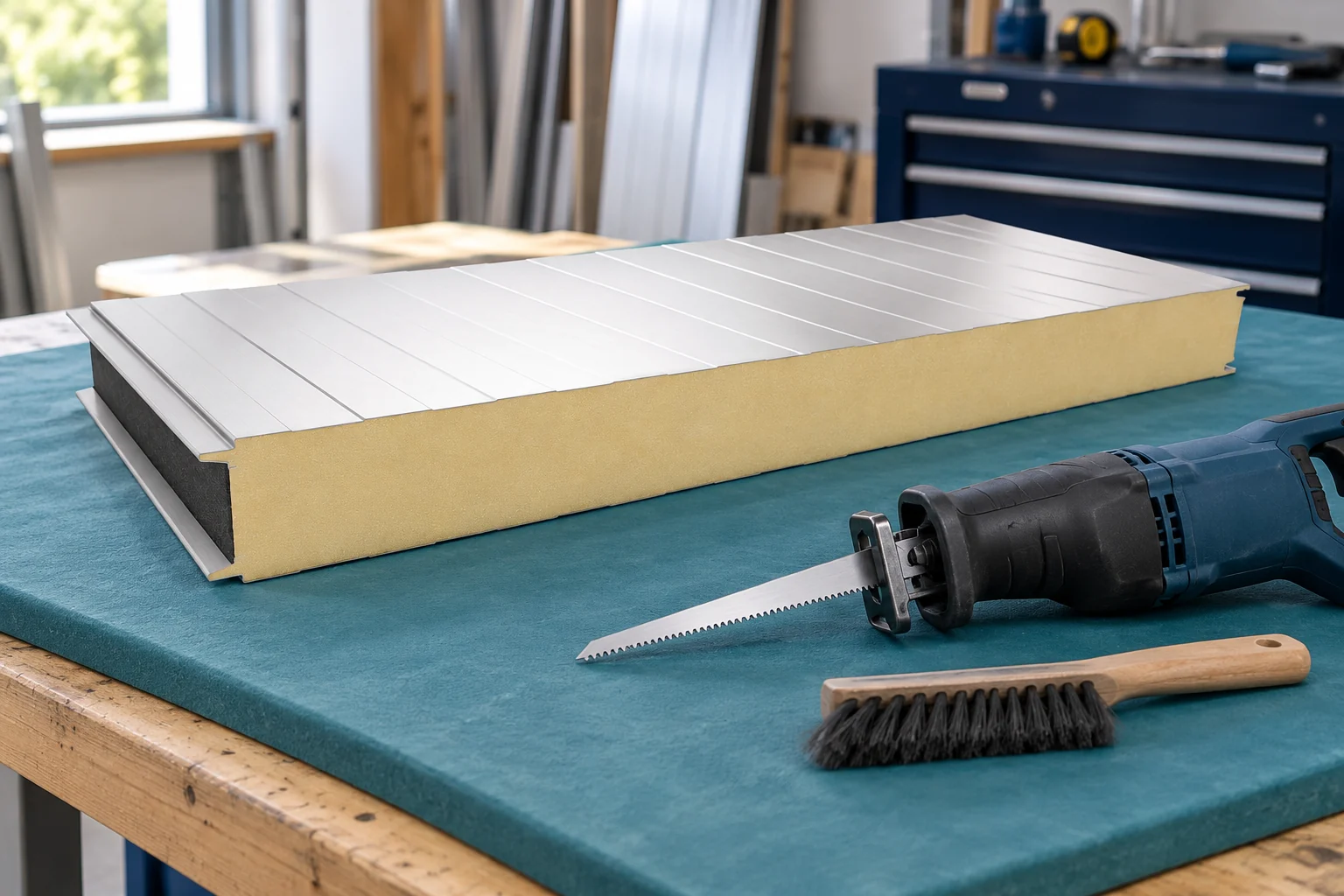
Use cold-cutting tools intended for the given type of panel. These may be suitable saws with the correct blade or saw blade, and sheet metal tools. The choice depends on the panel thickness, the core and the type of cut. The fact that a device cuts steel does not confirm its suitability for coated cladding.
Do not use an angle grinder or methods that generate high temperature at the edge. Hot sparks and filings can damage the protective layers beyond the cut line as well. The mark is sometimes small at first and later becomes a point of corrosion.
Before work, check the condition of the blade, the cutting depth and the way it is guided. Make a trial cut on an offcut intended for this purpose. A core of mineral wool, foam or polystyrene behaves differently. The tool should produce a straight edge without tearing the cladding away from the core.
How does support affect edge quality?
Place the panel stably on suitable supports. Protect the surface from scratching and provide support for the part being cut off. When a heavy fragment breaks away at the end of the work, it can tear out the core or bend the sheet. A simple straight line drawn on top does not protect against this damage.
Do not press the panel in a way that deforms its profile or crushes the edge. Ensure there is space under the tool. The support set must match the length of the component and the available space. A large panel should not be resting accidentally on one corner.
The layout of the work area should limit the movement of material over dirty ground. Sliding a panel over swarf scratches the cladding. Separate the clean component zone, the cutting zone and the waste zone. This is a simple way to avoid damaging an entire subsequent batch.

What should be done with the opening after cutting is finished?
Check the shape, the condition of the cladding and the edge of the core. The opening should receive the intended framing, support and sealing. The trim is not there solely to conceal an uneven edge. It must also protect the interior of the panel and work together with the adjacent layers.
For a service penetration, determine separately how its weight is to be carried. The pipe or unit must not hang on an incidentally cut panel edge. If the partition has fire requirements, the penetration must match that system. Any ordinary mounting foam does not confirm that the class is maintained.
Do not tear off loose sheet metal or cut further into the core to “make room”. If the cut has revealed damage or detachment, assess whether repair is possible before installation. Covering it with a flashing does not automatically restore the properties of the component.
How should prepared panels be cleaned and received?
Remove swarf from both sides, from the profiles and from the adjacent panels. Do not wait until the end of the whole project. Particles left on the coating can rust and cause discolouration. Use a cleaning method that does not scratch the surface or press metal into the coating.
Also check the soles of your footwear, the table and the supports before setting down the next panel. Dust and fragments should not get into the finished joints. Protect cleaned components from moisture and mark them temporarily in such a way that the marking does not damage the coating.
On acceptance, compare the dimensions with the drawing and check the edges. Keep a record of the openings made. If another penetration is needed later, return to assessing its location. A finished wall is not a surface for cutting at will.
Short answers from site
Is a metal cutting disc in an angle grinder sufficient for a panel?
No. Cold cutting with the correct tool is required. An angle grinder can damage the coating through heat and hot particles.
Can swarf be left for cleaning after the entire hall is installed?
They should be removed as you go. Leftover particles can cause scratches and surface corrosion, including on adjacent components.
7 branches. Materials closer to your project.

- SEROCK — Dzierżenin 34 E
- BŁONIE — ul. Sochaczewska 138A
- RADOM — ul. Grobickiego 8
- ŁÓDŹ — Natolin 8
- OLSZTYN — Barczewo, ul. Prosta 9
- WROCŁAW — ul. Jerzmanowska 10C
- GORZÓW WLKP. — ul. Zielona 33/34