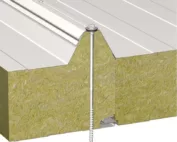
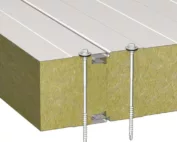
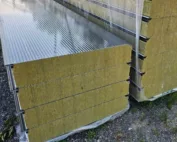
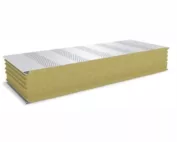
Mineral wool walls
How to choose mineral wool panels from 60 to 200 mm for a building extension?
In brief
The thickness of the mineral wool panel is selected after defining the wall requirements. First, the interior conditions and the function of the partition must be established. Then the thermal, fire and mechanical parameters are compared. The 60–200 mm range is not a list of interchangeable options for any use. Each variant can change the weight, fixings and finishing details. Determine the target temperature and the way the building will be used. An unheated warehouse, a constantly warm workshop and an internal partition require different assessments. Humidity and the possibility of changing the function after the extension are important. A thickness chosen only for the first stage may later limit the use of the building.
What information should you start with?
Next, determine the fire and acoustic requirements. These do not follow automatically from temperature. A wall may need a specific fire resistance independently of small heat losses. Therefore, do not start with the thinnest panel and only then look for justification.
It is worth recording the criteria in a short project table. This will facilitate discussion with the supplier and the assessment of alternatives. Each proposal should meet the same set of requirements.
How does Uc change in an example family?
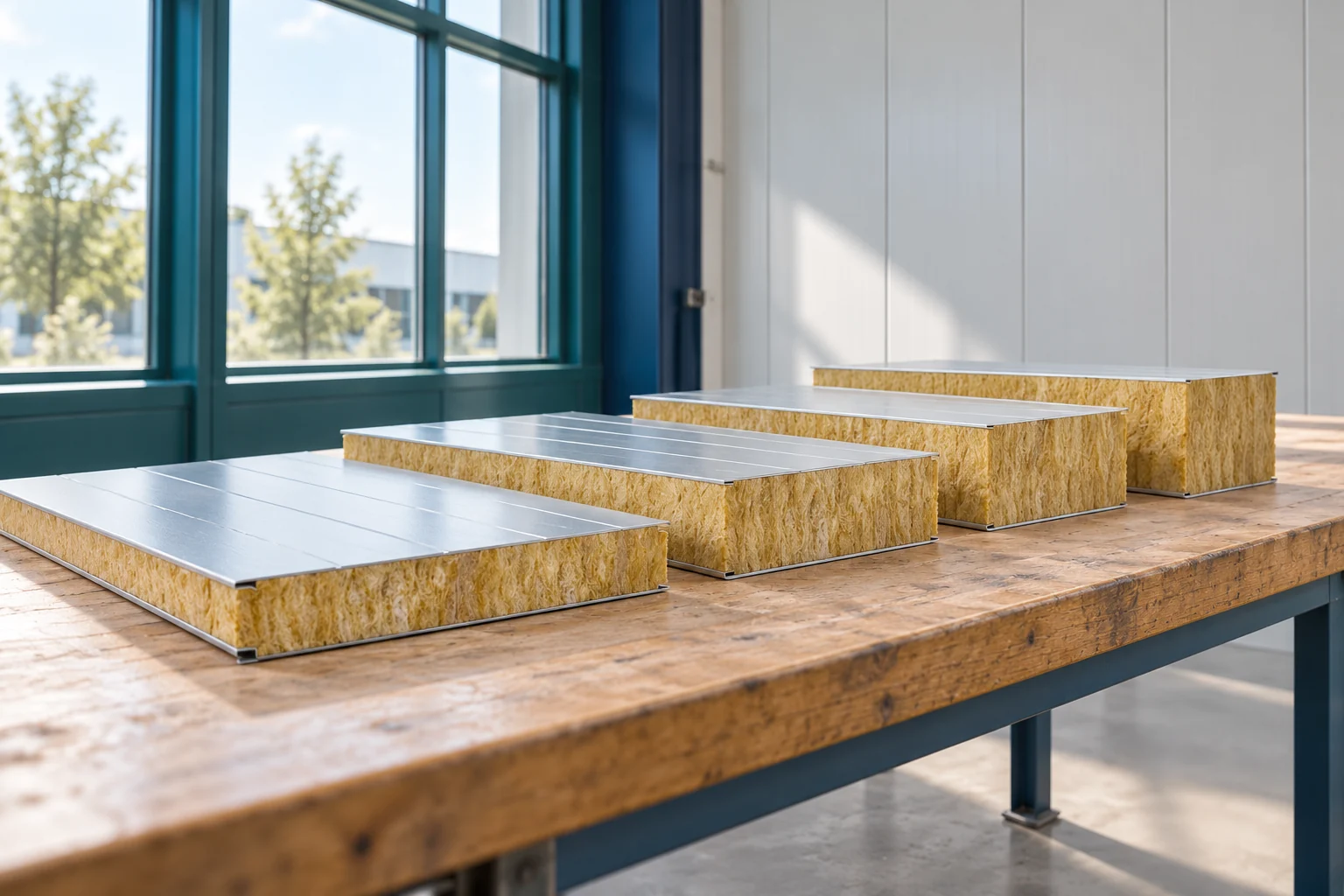
For one set of mineral wall panels, the values can be compared: 60 mm — 0.66; 80 mm — 0.49; 100 mm — 0.39; 120 mm — 0.33; 150 mm — 0.27; 200 mm — 0.20 W/(m²K). They show the direction of change but are not a universal table for the entire market.
When comparing, the same family and configuration must be maintained. A different core or joint can change the result. Check whether the stated value describes the panel or the entire wall assembly. Openings, joints and thermal bridges require separate consideration.
If the project adopts a specific U-value target, it should be verified for the completed assembly. It is not always sufficient to find an identical number in the panel catalogue. Airtightness and details can affect the final result.
Why does the weight increase with thickness?
A larger core means more material. In the same example family, the mass increases from 14.1 kg/m² at 60 mm to 28.1 kg/m² at 200 mm. For 100 mm it is 18.1 kg/m². The data refer to 0.5/0.5 mm facings and a specific core.
For a large area, the difference translates into tonnes of material. This matters for transport, unloading and the structure. However, it does not mean that the weight of the entire wall acts at a single point. The way the load is transferred depends on the installation layout and requires a design.
The choice of thickness should therefore precede the determination of equipment. A long 200 mm panel may be more difficult to handle than a shorter 100 mm variant. It is necessary to compare not only the price but also the conditions available on site.

How to check fire and load-bearing capacity?
Each of these features requires its own verification. A thicker panel may have different permissible spans, but a simple conversion factor must not be assumed. Loads, the number of spans and the facings matter. The maximum production length is not the answer to the question of support spacing.
Fire resistance relates to a specific wall solution. Certain supports, fasteners and details may be required. The classification of one variant does not automatically apply to the entire family of thicknesses. For some features, a declaration may be lacking.
With an existing frame, the selection begins with its measurement. If the chosen panel does not match the conditions, either the material or the structure must be changed. Adding random screws does not replace this verification.
When should the decision on thickness be finalised?
Before ordering flashings, fixings and joinery related to the wall depth. A change of a few centimetres may affect the plinth, reveals and the connection to the roof. For an extension, the junction with existing cladding of a different thickness must also be resolved.
Ask for a comparison of complete sets for two selected variants. Include the panel, accessories, transport and installation. If future heating is the goal, describe it explicitly. This will allow the value of the surcharge to be assessed without applying the rule that thicker is always better.
After approval, keep the complete set of parameters. When changing suppliers, also compare Uc, weight and fixing conditions. Changing only the product name while keeping the same number of millimetres may mean changing the entire solution.
It is worth examining a sample reveal detail. Greater thickness may change the position of the window relative to the face and the width of visible flashings. With existing joinery, this cannot always be solved with a wider strip of sheet metal alone. Sealing and drainage need to be checked. Such a trial fit before ordering allows a problem to be caught with one piece instead of the entire façade.
Short answers from the site
Is the thinnest panel always sufficient for an internal wall?
No. A partition may have fire, acoustic or mechanical requirements. A similar temperature on both sides removes only some of the thermal criteria.
Can the thickness only be selected on acceptance of the delivery?
By then many details and structural elements are already fixed. The thickness must be approved in advance, and the delivery is to confirm conformity with the order.
7 branches. Materials closer to your project.

- SEROCK — Dzierżenin 34 E
- BŁONIE — ul. Sochaczewska 138A
- RADOM — ul. Grobickiego 8
- ŁÓDŹ — Natolin 8
- OLSZTYN — Barczewo, ul. Prosta 9
- WROCŁAW — ul. Jerzmanowska 10C
- GORZÓW WLKP. — ul. Zielona 33/34