Mineral wool walls
How to read U and lambda when choosing a mineral wool wall?
In brief
Lambda describes heat conduction through a material. The U-value relates to the flow through a component or building element. These values have different units and cannot be interchanged. When choosing mineral wool boards, you must also check how Uc is stated. The finished wall also has joints, openings and structure that affect the result. The thermal conductivity λ is given in W/(mK). At the same thickness, a lower value means greater thermal resistance of the layer. For a homogeneous layer, the simple calculation is R = d/λ, where d is expressed in metres. This is useful for comparisons, but it is not a complete calculation of a layered wall.
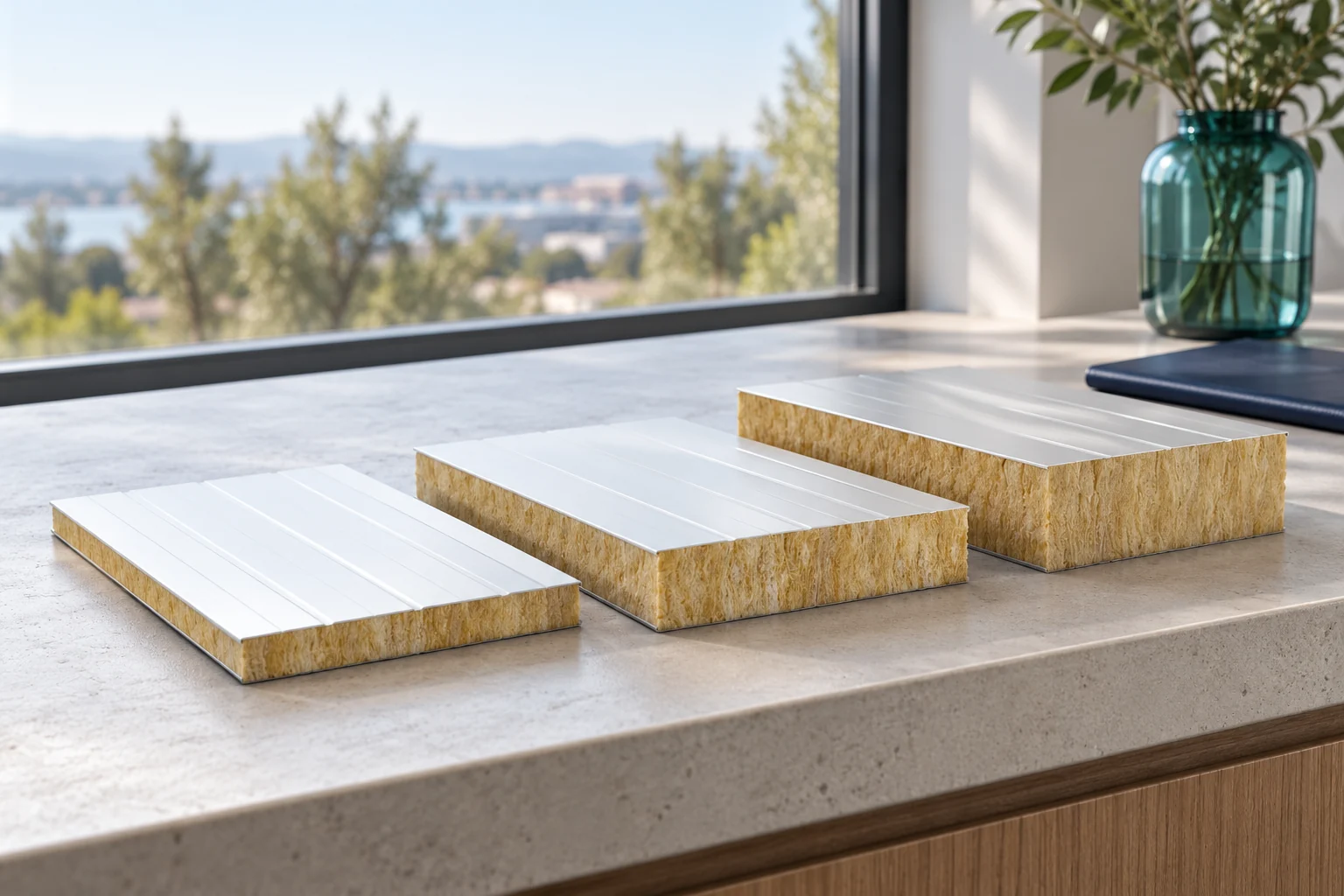
What does the material’s lambda tell you?
In the calculation example, 0.10 m of material with λ = 0.040 W/(mK) gives R = 2.5 m²K/W. Doubling the thickness gives R = 5. These are assumed data to show the method. For ordering, use the properties declared for the selected product, not any value associated with mineral wool.
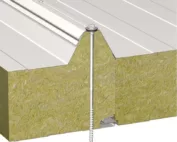
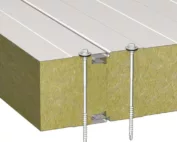
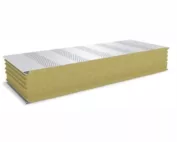
The core of the panel is part of a composite product. Therefore, when selecting a finished panel, its declared thermal transmittance in a specific configuration is the more direct information.
Pay attention to the units in the table. λ has the unit W/(mK), and U — W/(m²K). The resistance R is given in m²K/W. Swapping these designations can lead to an incorrect order, even though all the numbers used look credible.
How to compare Uc for different thicknesses?
In an example family of wall panels with mineral wool, the Uc values are approximately 0.49 W/(m²K) for 80 mm, 0.39 for 100 mm and 0.27 for 150 mm. The 200 mm variant has approximately 0.20 W/(m²K). This is a data set for a specific family. It should not be transferred to all products with a mineral core.
A lower value means less heat flow through the element under consideration at the same temperature difference. However, changing the thickness also affects weight, fixing lengths and flashings. Thermal selection should therefore take place before ordering the substructure and the details at windows.
Check whether the compared data refer to the same calculation method and assembly. Do not set the coefficient of the panel alone against the result for the entire wall of another building as if they were identical quantities.
What does a simple loss calculation show?
For a simplified comparison, the relationship Q = U × A × temperature difference can be used. With an area of 80 m² and a difference of 20 K, a panel with U = 0.39 gives 624 W of heat flow. For U = 0.27, the result is 432 W. The difference under these conditions is 192 W.
This comparison covers two idealised wall areas. It does not include ventilation, door openings, thermal bridges or weather variations. It cannot be converted into annual monetary savings without additional data. Such an assessment requires heating operating hours, climatic conditions and the way the building is used.
The calculation does, however, help to show why the same material carries different weight in the balance of a small room and a large hall. Both the U-value and the area of the building envelope, as well as the temperature difference, matter.

Why can joints change the effect?
The junction with the plinth, the window frame and the connection to the roof can create additional heat flow paths. In these places the geometry does not resemble a simple, flat panel area. An assessment of the details is needed, especially where there is a risk of low surface temperature on the inside.
Air leakage is another problem. Moist, warm air can penetrate through discontinuous joints. This phenomenon is not described by the lambda of the core alone. The choice of thickness must therefore go together with correct installation and a sealing solution.
When extending a hall, the junction between the old and new envelope must be checked in particular. Increasing the thickness of the new panels does not automatically eliminate a weak point at the connection between the two parts.
How do you determine the parameter for ordering?
First define the target interior conditions and the project requirements. Then select a panel that meets them in the specific assembly. If, for example, a target wall U-value at a certain level has been assumed, the contribution of the details must be checked. It is not enough to choose a product with an identical figure in the Uc table.
In the enquiry, state the thickness, the parameter family, the facings and the lengths. Do not mix the properties of two variants. A lighter core may have different insulation performance, but also different mechanical data. The set should correspond to the solution actually available.
Finally, keep the selection result and the panel documents. If the supplier proposes a replacement, compare the same items. This avoids a situation in which a seemingly equivalent thickness changes the thermal balance of the entire investment.
Short answers from the construction site
Is a low lambda enough to assess a finished façade?
No. You need the thickness, the parameters of the whole product, and the detailing for joints and openings. Lambda describes the material, not the entire façade.
Does a panel twice as thick halve all of a building’s losses?
No. It changes part of the losses through the building envelope. Doors, ventilation, thermal bridges and other building elements remain, so the balance for the whole building will be different.
7 branches. Materials closer to your project.

- SEROCK — Dzierżenin 34 E
- BŁONIE — ul. Sochaczewska 138A
- RADOM — ul. Grobickiego 8
- ŁÓDŹ — Natolin 8
- OLSZTYN — Barczewo, ul. Prosta 9
- WROCŁAW — ul. Jerzmanowska 10C
- GORZÓW WLKP. — ul. Zielona 33/34