Walls with mineral wool
Where do droplets on an insulated wall panel come from?
In brief
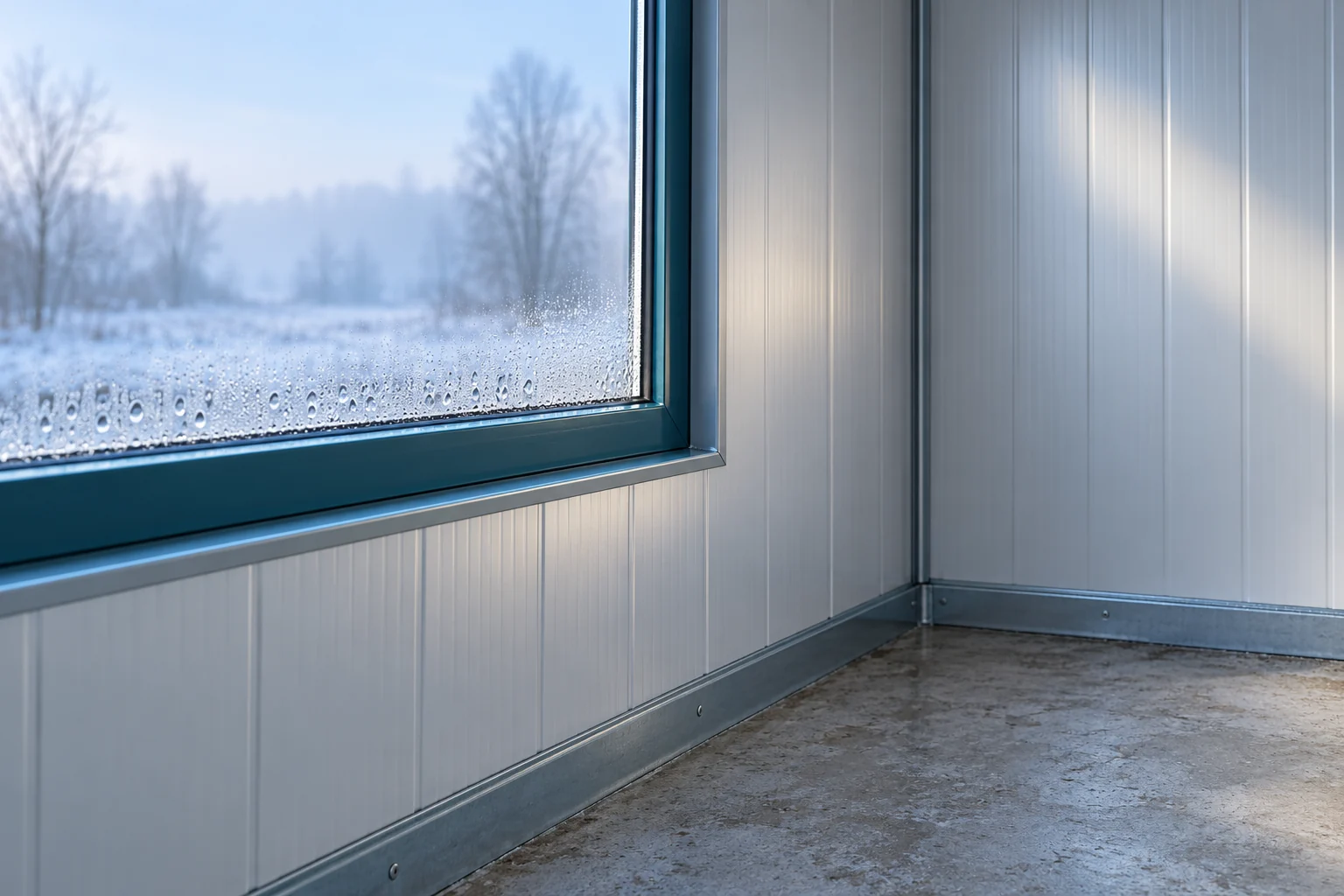
Droplets on the panel can indicate condensation of water vapour or water ingress through a leaky detail. These causes require different actions. First, establish when the moisture appears and what form it takes. Only then assess the joints, surface temperature and ventilation. A thicker panel alone does not solve every case. Water vapour can condense on a surface colder than the dew point temperature for the given air. Both humidity and temperature therefore matter at the same time. There is no single temperature at which every wall starts to sweat. Conditions change with the use of the building.
When does condensation occur?
After a new hall is closed, moisture from wet trades may remain inside. Starting heating without adequate air exchange may reveal the problem. Some details at the plinth, windows and structure are particularly cold. There, droplets may appear earlier than on the central part of the panel.
It is worth recording temperature and humidity at several times of day. A single reading after opening a large gate may not show typical conditions. The data help establish whether the problem is constant or linked to a specific activity.
How do you distinguish condensation from a leak?
Check the link with the weather. Water appearing only after rain from a specific direction may indicate a façade detail. Droplets on cold mornings without precipitation more often suggest condensation. However, both causes may act simultaneously. A diagnosis should not be based solely on the location of the wet patch.
Examine the course of the streaks, the joints and the areas around openings. Water may travel within the detail before it shows from inside. Before the flashing is dismantled, the symptoms should be well documented. This will allow the condition after repair to be compared and whether the actual cause has been removed to be assessed.
If the moisture is spread widely over a cold surface, sealing a single screw will not be enough. If it enters through the flashing, simply increasing ventilation will not solve the problem either.
Does metal cladding replace checking for airtightness?
The full steel surface forms a strong barrier to vapour diffusion. However, the wall has joints, penetrations and edges. Moist air may enter through leaks. Seals on the correct side of the building envelope and continuity of connections with other building elements are therefore important.
Tapes on the support and seals in the interlock should not be swapped at will. They have different tasks. The detail should be consistent with the system and the interior conditions. An additional layer of foil placed at random will not repair discontinuities and may hinder the drying of a damp area.
When extending a building, pay particularly close attention to the junction between the new and old sections. Materials may have different properties and surface temperatures. A solution is needed for the entire connection, not just filling the visible gap.

What role do thermal bridges and ventilation play?
In areas with greater heat flow, the surface temperature may be lower. This applies in particular to certain connections with the structure and the framing of openings. Improving the detail may be more important than increasing the thickness of the entire wall. The assessment should take the actual geometry into account.
Ventilation removes moisture generated inside. Its performance must match the way the building is used. Drying materials, washing or the operation of equipment can increase the amount of vapour. Opening the gate from time to time does not always provide predictable air exchange. It is worth checking whether the system is working as intended.
When the function of a room changes, these assumptions must be revisited. A dry storage room converted into a wash bay has different conditions. An enclosure that previously worked correctly may require a different detail and ventilation solution.
In what order should the problem be resolved?
First, stop the water supply if a leak has been identified. Then assess the condition of the dampened parts. In the case of condensation, establish the source of the vapour, the operation of the ventilation and the cold spots. The repair should follow from the diagnosis. Painting or wiping the surface removes the symptom only temporarily.
If a thermal and moisture analysis is required, the input data must correspond to the building. The humidity, temperature and layer arrangement must not be selected merely so that the calculation comes out favourably. Difficult details may require a more thorough assessment than a simple wall section.
After the changes have been made, observe the building envelope under comparable conditions. Record the weather and the way it is used. Only such monitoring will show whether the problem has been resolved. A dry wall on a warm day should not be taken as proof of a lasting improvement.
Short answers from the site
Does an insulated wall panel with a mineral wool core generate moisture itself?
No. The water comes from the air, precipitation or other sources. The panel and its details can create conditions for condensation or a path for leakage.
Does increasing the thickness always stop condensation?
No. The problem may be down to ventilation, leaks or a local thermal bridge. The cause needs to be identified before choosing a repair.
7 branches. Materials closer to your project.

- SEROCK — Dzierżenin 34 E
- BŁONIE — ul. Sochaczewska 138A
- RADOM — ul. Grobickiego 8
- ŁÓDŹ — Natolin 8
- OLSZTYN — Barczewo, ul. Prosta 9
- WROCŁAW — ul. Jerzmanowska 10C
- GORZÓW WLKP. — ul. Zielona 33/34