Budget planning
When should you choose first-grade panels, and when is an outlet batch worth checking?
In brief
A markdown makes sense when you know its cause and can assess the impact of the defect on the application. A scratch on a less visible side is a different issue from a damaged interlock. For an extension, compatibility with the old panels is also a factor. It is therefore worth comparing the complete scope of work, not just two prices per square metre. Do not assume that every use of the term “outlet” means the same condition of material. It may refer to the end of a series, a leftover from an order or pieces with defects. Ask for an exact description of the batch. The information should indicate which items are marked down and for what reason.
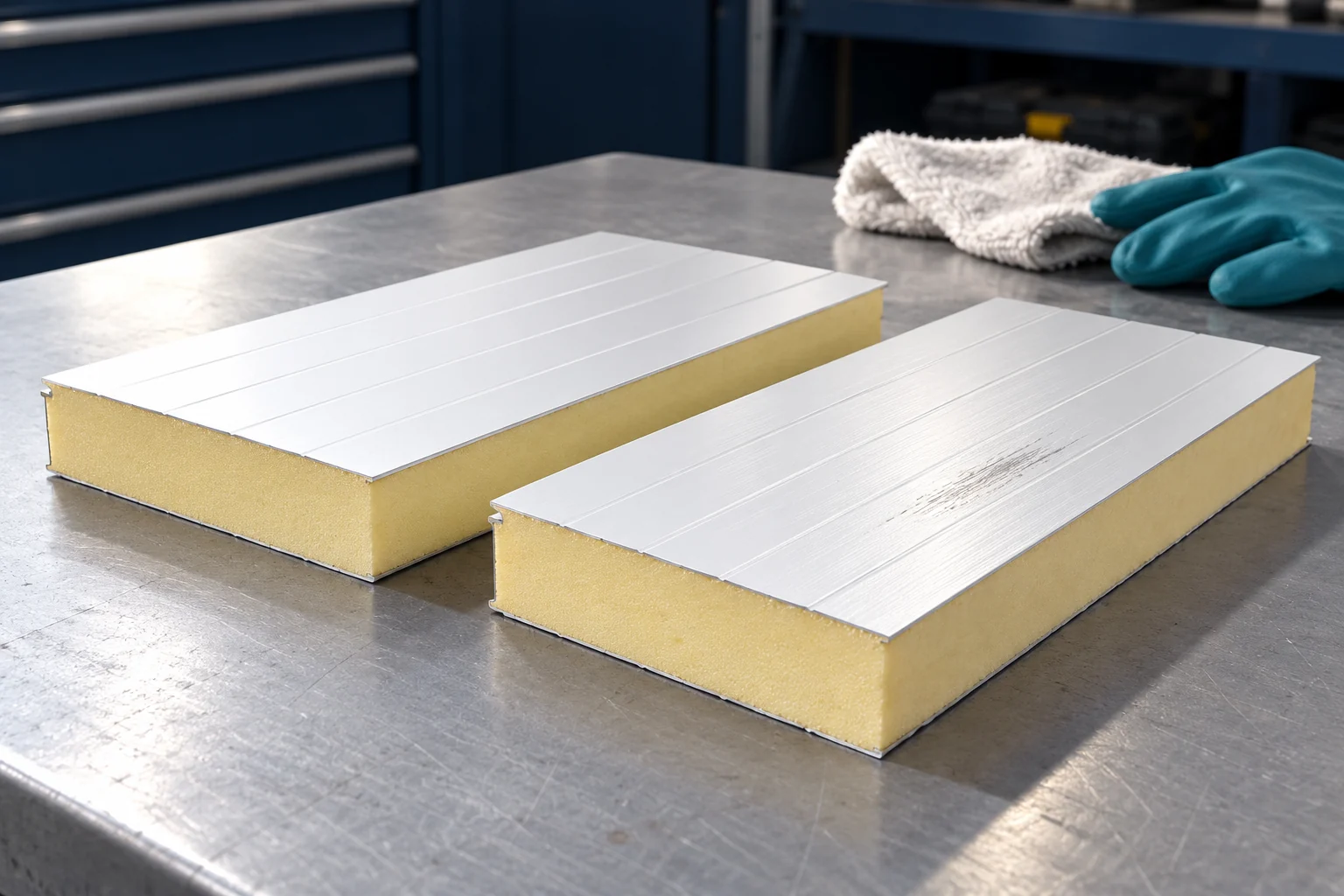
What does grade mean in a specific offer?
First-grade panels must also be defined by parameters. Core thickness, facings, colour and length should match the order. The comparison will not be meaningful if the full-value panel has different steel sheets or a different coating than the discounted variant.
Check the documents relating to the offered material. A defect may limit the application, even if the panel comes from a family with known parameters. Not every damaged piece should automatically be attributed all the properties declared for a correct product.
How do you distinguish an appearance defect from a technical problem?
Cosmetic marks must be assessed for depth and location. A fine scratch in the top layer has a different significance than exposed steel. Damage to the surface protection may require repair. The repair method should correspond to the type of coating and the operating conditions.
Inspect the edges, the connection between the facings and the core, and the entire joint. A dented edge can make it difficult to close the joint. Delamination or core loss is not just a matter of aesthetics. Without a technical assessment, one should not assume that flashings will hide the problem and restore the parameters.
Also check flatness and dimensions. A shorter panel may not reach the supports specified in the design. Replacing the missing length with a wide flashing does not automatically create correct support. Any change in dimension requires verification within the entire wall or roof system.
Can the entire stage be completed from the available batch?
Draw the cutting plan on specific pieces. The total square metres stated in the advertisement is not enough. A package may have a large area but few panels of the required length. After rejecting damaged ends, the usable area will be even smaller.
The example is hypothetical. A batch of 100 m² costs €18.52 net per m², that is €1,852.00 net. After cutting and excluding defective pieces, you will use 78 m². The material alone therefore costs €23.74 net per usable square metre. Additional cutting and flashings may be added to this.
For a building constructed in stages, ask whether matching components can be purchased later. Do not assume this without confirmation. The end of a production run may be sufficient for one wall, but not for the next. Shade differences will be particularly noticeable on a large, uniform surface.

How do you calculate the cost savings after installation?
Add transport, sorting and additional labour to the reduced price of the batch. If the installer has to adjust each piece individually, labour costs may increase. Also allow for coating repairs and the cost of waste. These items are often not visible in an initial comparison.
Compare two solutions for the same finished surface. If full-quality panels allow fewer joints, the difference in material price may be smaller than the difference in the entire installation. More joints also mean more places requiring sealing and later inspection.
When replacing a single panel, the cost of access may exceed the saving on the material itself. Flashings have to be removed, equipment prepared and connections recreated. In such a case, it is particularly worth assessing the condition of the purchased piece very carefully. Replacing the same place again will duplicate part of the costs.
What should be established before accepting discounted panels?
Ask for photos of the specific items, a description of the defects and a set of dimensions. Establish whether you are receiving the same pieces that were assessed. The agreed condition of the batch should be included in the order. A general photograph of similar panels does not confirm the appearance of the delivered material.
During unloading, compare the delivery with the description. Check whether additional dents or edge damage have appeared. Document the condition of the packs and mark the pieces requiring further assessment. Do not install them immediately in places that will be difficult to return to later.
Make the decision according to the application. A minor visual defect may be acceptable in a sheltered, little-visible part of the building. However, it does not justify disregarding airtightness, load-bearing capacity or fire requirements. The reduction should result from a conscious compromise, described before purchase.
Brief answers from the construction site
Does a reduced-price panel have to have poorer thermal parameters?
This cannot be determined from the name alone. What matters is the reason for the reduction and the condition of the specific panel. Damage to the core or the connection may affect the parameters differently from a superficial mark.
Can flashings cover a defect without further checking?
Concealing a spot does not confirm its correctness. First, the impact of the damage on the panel’s performance and tightness must be assessed. Flashings serve a specific function but do not repair any structural defect.
7 branches. Materials closer to your project.

- SEROCK — Dzierżenin 34 E
- BŁONIE — ul. Sochaczewska 138A
- RADOM — ul. Grobickiego 8
- ŁÓDŹ — Natolin 8
- OLSZTYN — Barczewo, ul. Prosta 9
- WROCŁAW — ul. Jerzmanowska 10C
- GORZÓW WLKP. — ul. Zielona 33/34