Roof coverings
What do 100 linear metres of steel sheet cost, and how much roof will they cover?
In brief
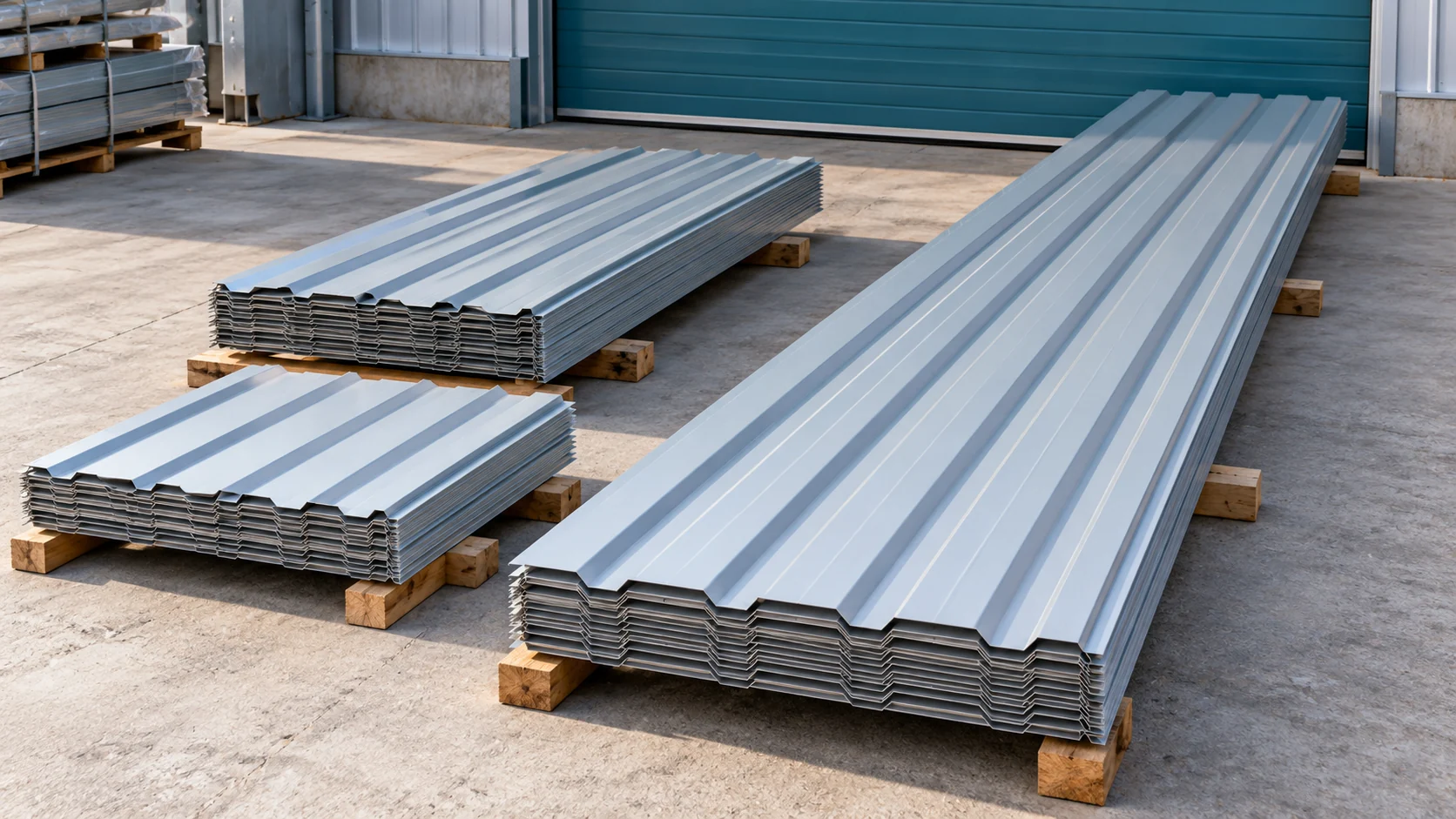
One hundred linear metres of steel sheet does not mean one hundred square metres of roof. The result depends on the sheet width and the coverage width. You also need to know the unit used in the quote. Simply separating these concepts allows you to compare offers and order the right number of elements without double-counting the overlaps. A linear metre describes the length of a sheet of a fixed width. If an order comprises ten elements of 10 m each, the total is 100 linear metres. Twenty elements of 5 m each give the same total. However, this does not mean the same laying pattern on the roof.
What does a linear metre mean in an order?
The area is calculated by multiplying length by width. You need to choose the correct width: overall or effective. The first describes the full sheet. The second takes into account its coverage after joining with the adjacent strip. It is this distinction that most often changes the reading of the price.
Before calculating, note the profile and its exact dimensions. The name T18 or T35 alone may not be enough to determine the width. Different families have different cross-sections and modules. The calculation must use the data of the sheet actually covered by the quote.
How do you convert 100 linear metres to square metres?
Let us take a specific T35 profile with an overall width of 1.082 m and an effective width of 1.035 m. One hundred linear metres gives 108.2 m² of overall area. In relation to the coverage width, this corresponds to 103.5 m² effective, before taking into account cuts and longitudinal overlaps.
The difference between these values is 4.7 m². It results from the lateral connection of adjacent strips. It is not additional usable area. Nor should the same part be subtracted a second time if further calculations are already carried out in effective metres.
The resulting 103.5 m² does not guarantee coverage of any roof of that area. Sheet lengths, roof slope division and edge layout must fit. Material may remain as waste. A cutting plan is therefore needed, not just a balance of the total metres.
How do you calculate the price at a rate per total metre?
In the calculation example, let us assume €8.80 net per m² of the total. The price for 100 lm is 108.2 × €8.80, that is €952.16 net. One linear metre therefore corresponds to €9.52 net. Rounding and the method of settlement should follow from the quotation.
The rate can also be converted to an effective metre: €8.80 × 1.082 ÷ 1.035. The result is approximately €9.20 net per m². Minor differences when multiplying the rounded rate are due to rounding. In the final order, the agreed unit and pricing rules apply.
This is the cost of the sheets alone in the agreed example. Flashings, fixings, transport and installation must be considered separately. If the advertised price refers to a linear metre, it must not be multiplied again by the area without conversion. First establish exactly what the stated amount covers.

Why does the division of lengths affect the cost?
Ten long sheets and twenty shorter ones may give the same total number of metres but different installation requirements. A longer element requires suitable access and lifting. A shorter layout may introduce additional transverse joints if used on the same roof slope.
The longitudinal overlap consumes part of the material. It must also have the correct support and sealing detail. Its dimension cannot be determined arbitrarily, solely according to the available sheet length. The solution for the specific profile, pitch and roof conditions applies.
For phased construction, the delivery sequence can be important. Material for the first section should be easily accessible in the pack. If long sheets have to be moved repeatedly, the labour input increases. This cost is not visible in a simple calculation of one hundred linear metres.
How should I word an enquiry to get comparable prices?
State the profile, steel thickness, coating and colour. Attach a table of lengths and quantities. Ask for the price to be shown in the unit used and the billing area. This allows you to check whether both offers cover the same scope.
Separately record the roof area that is to be completed. This allows waste and the cost per utilised metre to be assessed. If the supplier proposes a change in the cutting layout, ask for a new schedule. A lower total number of metres only makes sense if the sheets still correctly cover the entire roof slope.
Finally, establish the cost of delivery, unloading and the acceptance conditions. Confirm which lengths can be produced in the chosen variant. Not every length from the general commercial range will be suitable for every coating and site organisation. The order should be based on a feasible installation plan.
Short answers from the construction site
Will 100 linear metres of two different profiles give the same area?
Only if their widths are the same. Usually the total and effective area of each profile must be checked separately. The sum of lengths alone is not enough.
When pricing per effective metre, do you need to add the side lap?
The part already included in the coverage width is not added again. However, cuts, edge detailing and any longitudinal laps resulting from the cutting plan remain separate.
7 branches. Materials closer to your project.

- SEROCK — Dzierżenin 34 E
- BŁONIE — ul. Sochaczewska 138A
- RADOM — ul. Grobickiego 8
- ŁÓDŹ — Natolin 8
- OLSZTYN — Barczewo, ul. Prosta 9
- WROCŁAW — ul. Jerzmanowska 10C
- GORZÓW WLKP. — ul. Zielona 33/34