Choice of covering
Tile-effect metal roofing or concrete tiles: what suits your roof?
In brief
The choice between metal roofing and concrete tiles depends mainly on whether the roof structure and pitch are ready for the heavier covering. Metal roofing is usually much lighter, while concrete tiles consist of many small, individually replaceable elements. Check the load-bearing capacity of the structure, the roof pitch, the manufacturer’s requirements for underlayers and fixings, and the full estimate including accessories and flashings. The price per square metre of material alone does not settle the comparison, and the decision should be made before ordering.
How important is the weight of the covering?
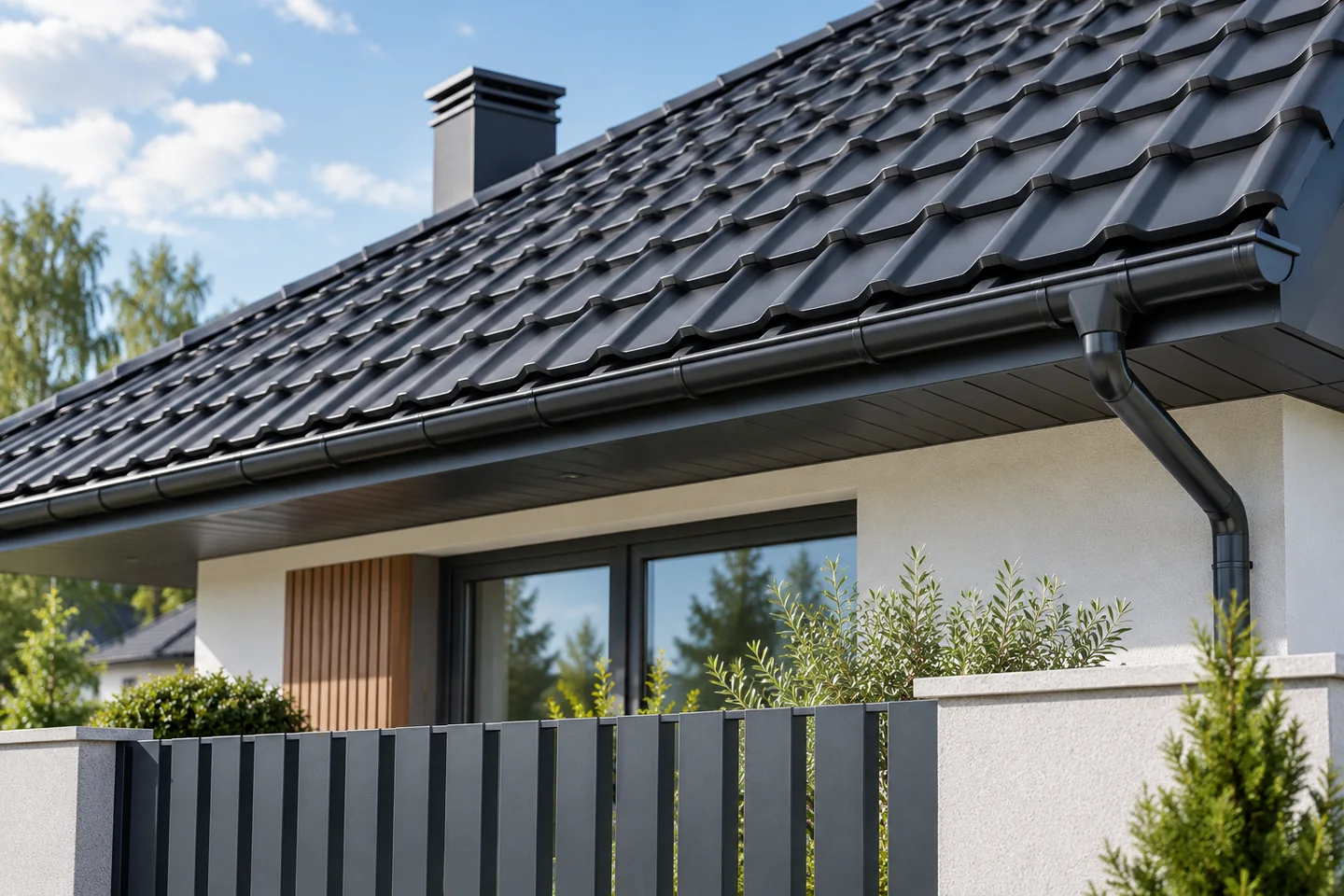
The difference in weight is one of the most important criteria during renovation. Tile-effect metal roofing usually weighs a few kilograms per square metre, while concrete tiles weigh several tens of kilograms. The exact value must be taken from the data sheet of the selected model, and its consumption per square metre must be taken into account. Battens, underlay and accessories are additional.
Lower weight does not exempt you from assessing the roof structure. The structure must also carry snow, wind and other loads. If the old timber is damaged or the connections are weakened, replacing it with lightweight sheet metal will not solve the problem. Conversely, switching from sheet metal to concrete tiles requires checking for greater weight. The decision must be made before ordering the material.
Do both coverings suit the same pitch?
Each model has specified conditions of use. The minimum pitch for tile-effect metal roofing must not be transferred to concrete tiles or vice versa. For concrete tiles, the requirements for the underlay may change with the slope and the degree of exposure of the roof. A complete instruction manual is therefore important, not a single slogan from the offer.
Similarly, it is not enough to increase the sheet metal overlap to reduce the slope of the roof pitch arbitrarily. If the roof is too flat for the selected profile, the solution must be changed or the layout redesigned. The basis is measuring the actual geometry. In an old building, some sections may have a different pitch from that recorded on the original drawing.
What difference does the format of the material make?
Concrete tiles consist of individual elements. This allows a locally damaged piece to be replaced and the layout adapted to the geometry of the roof pitch. However, installation involves a large number of elements and proper protection against lifting. Clips and fastenings are selected according to the model, roof zone and wind load conditions.
Tile-effect metal roofing cut to size covers long sections of the roof pitch with a single sheet. Modular versions provide smaller parts and easier planning of hips and valleys. On a complex roof, it is worth preparing two cutting plans and comparing the waste. Do not assume in advance that every small format will be the cheapest. Cost is also affected by cuts, edges, roof valleys and the way details are executed.

Does tiling keep the attic quiet and cool?
Heavier covering may react differently to rain impacts than thin sheet metal. However, comfort in the room depends on the entire roof. Insulation, airtightness, sheathing, internal lining and the way it is fixed all matter. The external material alone should not be treated as a complete acoustic solution.
The same applies to the temperature in the attic. Insulation, shading of windows and ventilation matter more than a simple slogan about a cool or hot covering. Tile-effect metal roofing does not replace thermal insulation. Concrete tiles also do not provide grounds for omitting it. For a usable attic, compare complete building components, not just the layer visible from the outside.
What does maintenance look like for both solutions?
Every roof requires inspections, clear drainage and checking of flashings. On metal, the condition of the coating, edges, seals and fastenings should be checked. On tiles, cracks, displacements and securing elements are checked, among other things. In both cases, the roof valleys and the area around chimneys, where leaves easily accumulate, must be assessed.
Repairs are carried out with materials compatible with the system. Coated steel should not be cleaned with an aggressive brush or an arbitrary agent. Tiles should also not be washed using a method that forces water under the overlaps. The scope and timing of inspections depend on the surroundings. A house under trees requires different attention than a building standing in open terrain.
How can prices be compared fairly?
Order a cost estimate for the entire roof in both variants. It should cover preparation of the structure, covering, accessories, flashings, transport and labour. If the heavier variant requires reinforcement of the roof truss, add this work. If the light variant needs additional layers for the intended acoustics, also include them in the comparison.
Look at the selected materials on a larger sample and check compatibility with the architecture of the house. Then match specific requirements with the budget. Tile-effect metal roofing will often be a sensible proposition when weight is limited. Concrete tiles may suit an investor who prefers their appearance and format. A good decision is a covering matched to the building, without hidden costs in subsequent stages.
7 branches. Materials closer to your project.

- SEROCK — Dzierżenin 34 E
- BŁONIE — ul. Sochaczewska 138A
- RADOM — ul. Grobickiego 8
- ŁÓDŹ — Natolin 8
- OLSZTYN — Barczewo, ul. Prosta 9
- WROCŁAW — ul. Jerzmanowska 10C
- GORZÓW WLKP. — ul. Zielona 33/34