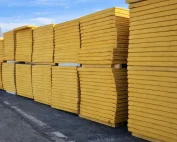
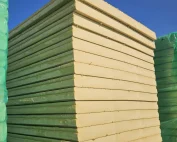
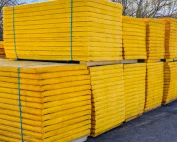
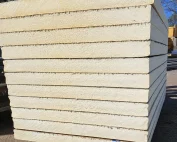
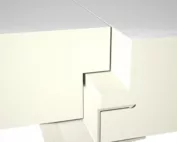
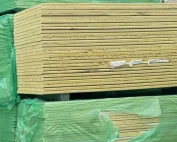
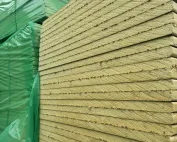
PIR insulation
Preparing for insulation work with PIR, cellulose and wood fibre
At a glance
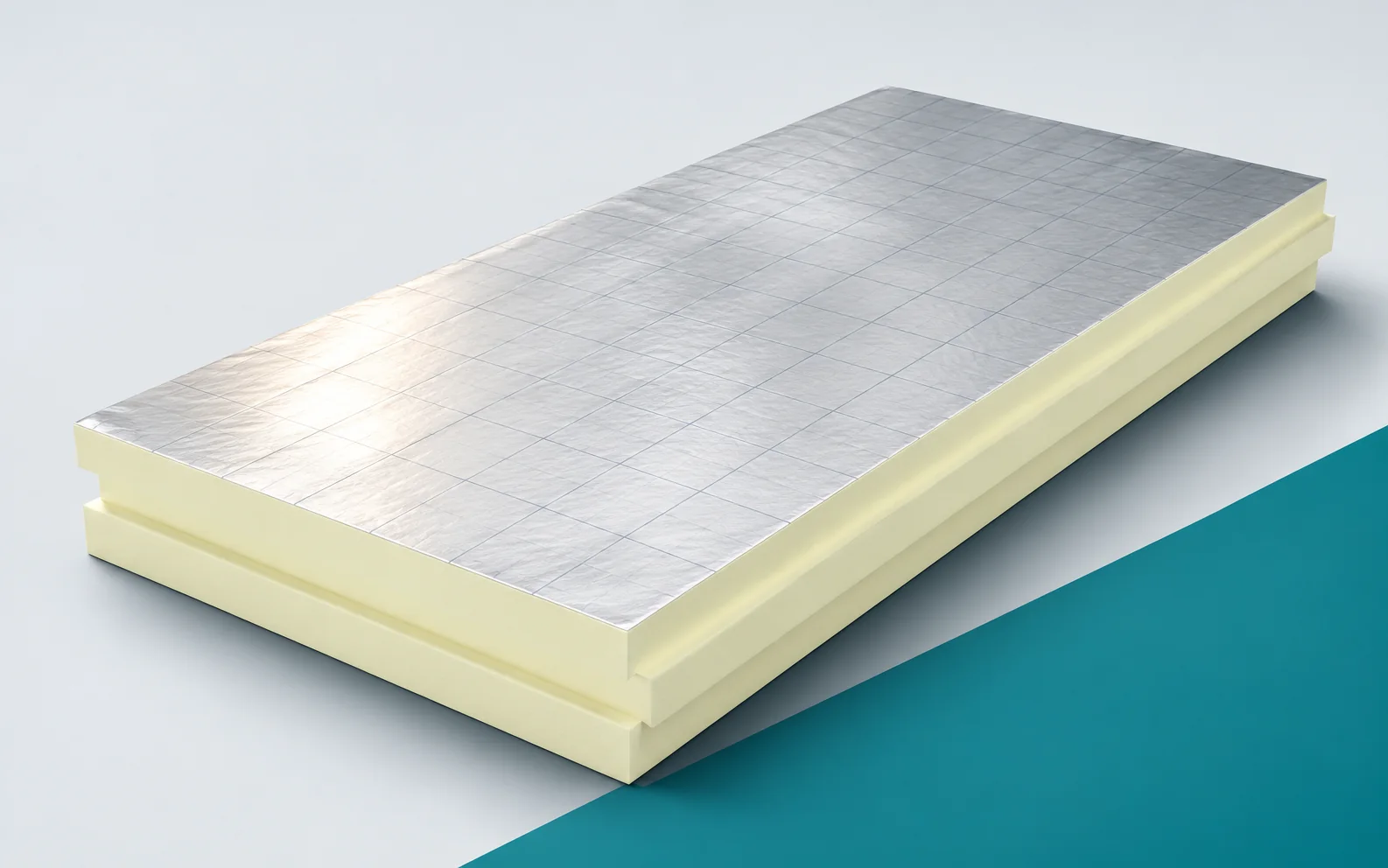
Rigid board, mat and blown-in material each require a different organisation of work. PIR boards offer a controlled factory thickness, while fibrous insulation can conveniently fill prepared cavities. A good choice takes account of access, protection of the material and how the finished layer will be checked. PIR boards are rigid products with a defined thickness and facing. Cellulose can be blown into prepared cavities. The blowing cavity must have prepared boundaries and installation access. Rigid boards, in turn, need space for cutting and for checking the joints. Before starting, it must be confirmed what space the insulation contractor is receiving. Blowing requires prepared cavities and agreed access. With boards, the support and the possibility of introducing the full format must be checked.
Different forms of the material
These are different conditions for work readiness. It is worth accepting them before the material appears on site, so that the chosen method can actually make use of its installation efficiency.
What determines summer comfort
Low thermal conductivity limits heat flow, but it does not determine the room temperature on a hot day. The heat capacity of the layers, the glazing, shading and air exchange also matter. The heat capacity parameter does not replace the quality of the fill.
A layer installed too loosely or a lack of material at an obstacle changes the actual cross-section. The catalogue properties refer to a specific material and a specific way of installing the layer. An empty space at a duct or incorrect compaction changes the actual cross-section. Similarly, a gap between boards requires a correct solution. One cannot expect that a greater heat capacity of a single material will compensate for installation shortcomings. Acceptance should therefore check continuity and thickness in accordance with the technology.
Where a small thickness is useful
In a place of limited height, a well-chosen PIR board allows a high thermal resistance to be achieved with a small thickness. If the space has an irregular shape, the installation speed also depends on the precise fitting of the rigid elements.
It is worth assessing the number of cuts and the feasibility of correctly filling the corners. It is worth inspecting the most irregular places even before choosing the method. A closed chamber may be convenient for blow-in insulation, while a flat surface is suitable for laying PIR. If there are numerous narrowings, the method of checking the fill must be determined. With rigid boards, the cuts and their support must be planned. Such a survey makes it possible to estimate the working time without relying on the floor area alone.
Shared partition and moisture flow
Combining PIR with fibrous insulation is possible in a designed arrangement. However, the layers must not inadvertently trap moisture in the timber or the sheathing. Before the chamber is closed, the required sealing must be accepted.
Later, access to the membrane or the connection behind the board will be limited. The sealing layer must be checked before the insulation blocks access. Particular attention is required at the corners, penetrations and the connection to the wall. With blow-in technology, the closing of the installation openings must also be provided for. The boards require a proper treatment of the joints in accordance with the adopted arrangement. Good organisation of the acceptance inspection makes it possible to avoid later opening of the finished space in order to repair a missed connection.
Acoustics and fire protection
One should not choose between PIR, cellulose and wood fibre on the basis of the raw material name alone. The reaction to fire is determined by the document for the specific product, while fire resistance is tested for the entire building element. The layer intended to improve acoustics must be laid in accordance with its function.
Accidental compression or a rigid connection can change how the system performs. A layer serving an acoustic function should retain the laying method intended for the whole building element. It should not be accidentally blocked by a rigid connection or have its degree of compression changed. PIR can be used in the appropriate part of the thermal system, but a substitution requires an assessment of the remaining functions. It is worth establishing these requirements before installation. The team should know which details matter for sound and which for heat.
Choosing for the task, not for the slogan
A reliable comparison starts with the required effect. The available height, the expected thermal performance and the way the rooms are used must be established. With mixed technology, it is worth establishing the order of the teams.
The fibrous material and the PIR should meet at a prepared, accepted junction. With two technologies, the moment of handing over the work front must be defined. Acceptance should confirm the condition of the layer left by the previous team. It is also worth specifying the protection of the material during the break. Combining boards and fibres can run smoothly when the sequence is unambiguous. Without such an arrangement, a correctly executed part can be damaged or covered before inspection.
An example that brings order to the comparison
For a layer with a density of 160 kg/m³, a specific heat capacity of 2100 J/(kg·K) and a thickness of 100 mm, the area-based capacity is approximately 33.6 kJ/(m²·K), and for an area of 55 m² approximately 1848 kJ/K. This value relates to the assumed layer, not to room temperature or a guaranteed delay time for heating; assessing summer conditions requires the entire cross-section as well as a balance of heat gains and removal. A comparison with fibres requires specifying the core and the facing, because polyurethane boards cover various constructions. Polyurethane insulation in a factory-made board is not the same process as spraying, and the term polyurethane foam alone does not describe the parameters of a finished roof — the form of the material and the place of application need to be specified.
7 branches. Materials closer to your project.

- SEROCK — Dzierżenin 34 E
- BŁONIE — ul. Sochaczewska 138A
- RADOM — ul. Grobickiego 8
- ŁÓDŹ — Natolin 8
- OLSZTYN — Barczewo, ul. Prosta 9
- WROCŁAW — ul. Jerzmanowska 10C
- GORZÓW WLKP. — ul. Zielona 33/34