PIR insulation
Laying termPIR WS: preparing the substrate and protecting the work
At a glance
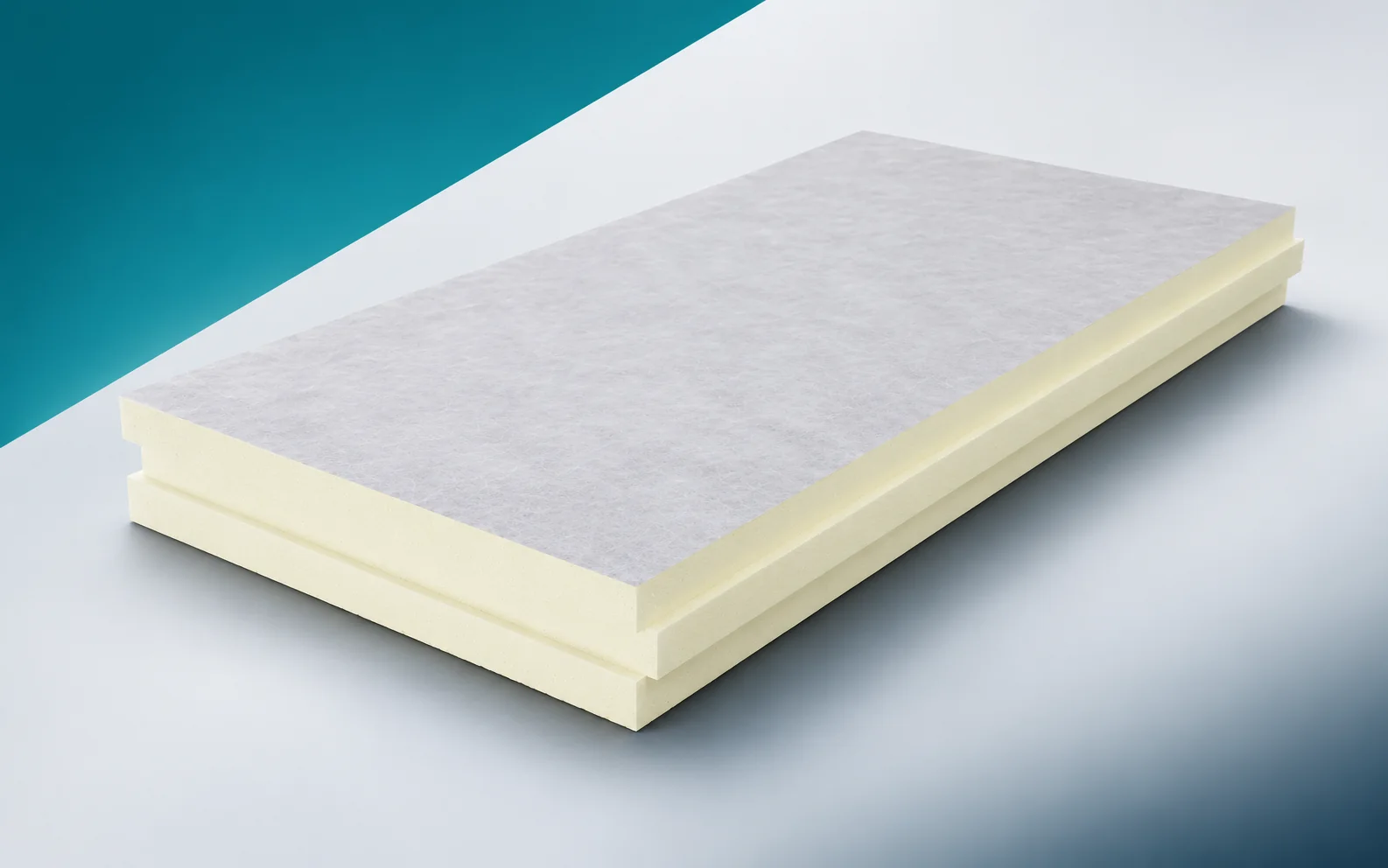
The answer to the question of how to lay termPIR WS begins with preparing the substrate and securing the work area. The boards have a PIR core and a gas-permeable glass-fleece facing on both sides, not a gas-tight aluminium laminate. Before installation, it is therefore necessary to establish how this facing will interact with the covering on the flat roof. At the briefing before distributing the material among the work stations, discuss the layers and the fixing method of the chosen covering. On a large, open roof, the pace of work must go hand in hand with protecting the material from the weather and with planning the sections that can be safely closed with the covering.
Receipt and organisation of materials
Delivering the right packaging is not enough, because an identical PIR core does not guarantee identical adhesion of every facing. Before the PIR boards reach the workstations, the approval of the specific combination – board, fastening layer and waterproofing – must be agreed with the person managing the works. This preparation of the work front helps avoid the assumptions about the interaction of the materials only diverging once work is under way on a large area.
How to proceed with successive sections
termPIR WS is available with a square edge and with edge-profile variants depending on the order. The boards must be laid with careful tight fitting on a stable substrate.
On the first section to be executed, check the layout of the last rows around the roof outlet and the adjacent service enclosure. Cut pieces at the outlet require stable support and space for correctly forming the detail before the working method is repeated in subsequent rows. The profiled edges of full boards do not solve the connection to an element of a different shape, so an error is easily repeated. After assessing the first section, lay a stable substrate for the waterproofing at the drainage points, and before covering the polyurethane insulation, record in the works documentation the arrangement of the cut pieces, the condition of their sides and the feasibility of forming the outlet detail.
The times for laying out termPIR WS must be linked to the possibility of protecting the roof. It is not worth opening up a larger area than the team can properly secure; the last edge of the day’s section requires particular attention. Before resuming work, inspect the material and the places where water may have penetrated. Covering the boards does not replace checking their condition.
Dry storage and closing of the layers
The termPIR WS glass fleece is not a waterproof layer. The thermal insulation requires separate covering and protection during the works.
Before leaving the roof, protect the interrupted zone before the covering is laid so that water has no path beneath the installed insulation. A vapour-permeable facing does not protect against rain entering the open assembly, so decide how the day’s working front will be covered before stopping work. On resuming, assess the condition of the boards and the way the working area was covered before the layer is handed on.
Checking assumptions before cutting
The lambda of termPIR WS is 0.027 W/(m·K) for thicknesses below 80 mm. In the range from 80 to below 120 mm it is 0.026, and from 120 to 250 mm it is 0.025 W/(m·K).
Cutting is preceded by checking the documentation for the narrowing at a low parapet, where the insulation thickness decreases locally. Assign to the elements installed in this narrowing the lambda appropriate to the local thickness, not to the average thickness of the roof field, which does not describe the thinnest point at the termination. On acceptance of the delivery of polyurethane boards, record the actual thickness and the thermal conductivity assigned to it in each analysed section.
How to limit damage during the works
termPIR WS carries the designation CS(10/Y)120. Its product reaction-to-fire rating varies with thickness: the 20–49 mm range is class F, while boards from 50 to 250 mm are class E.
Consider the service zone around equipment installed above the termPIR WS roof layers together with the support and protective layers before allowing further trades onto the finished layer. The CS120 result does not on its own describe the performance of the assembly under the constant pressure of a support, and analyse the pressure and fire requirements without conflating the board’s characteristics with the roof classification. In the section record, confirm the service access solution and the conformity of the substrate and covering with the assessed assembly, and report any discrepancies before continuing the task.
Material reconciliation and documentation
Before purchasing termPIR WS, specify the thickness, format, edge and method of connection with the covering. Some systems require a specific adhesive or fixing.
When accepting works described as “polyurethane insulation”, check the pricing of the glued and fixed variant in the manner envisaged for the specific roof. In the roof costs, include substrate preparation and work at the perimeter and penetrations, settling the material and handing the section over to the next trade. A lack of agreement on the fixing method can change the quantity and type of auxiliary materials, so establish the scope of works needed to close the covering before ordering the insulation. In the as-built documentation, keep the number of boards by coverage, the consumption of fixing materials and the scope of flashings on the roof, so that acceptance is not based only on the number of packages used.
7 branches. Materials closer to your project.

- SEROCK — Dzierżenin 34 E
- BŁONIE — ul. Sochaczewska 138A
- RADOM — ul. Grobickiego 8
- ŁÓDŹ — Natolin 8
- OLSZTYN — Barczewo, ul. Prosta 9
- WROCŁAW — ul. Jerzmanowska 10C
- GORZÓW WLKP. — ul. Zielona 33/34