Fibre cement coverings
Annual fibre cement roof inspection: a checklist
At a glance
An annual inspection helps to spot a change before it becomes extensive damage. Fibre cement sheets primarily require checks of the joints, the finishes and the drainage. Asbestos-free fibre cement does not mean a roof that needs no inspection. Work should be carried out from a safe position, without walking directly on the sheets. It is worth preparing a plan of the roof slopes, acceptance photographs and notes from earlier inspections. This makes it clear which places required attention. Not every stain is new and not every change intensifies over time. Comparing photographs helps to assess whether a real problem has arisen. The inspection date is best linked to the rhythm of the building’s use. An inspection after an event that could have damaged the covering, for example a strong gale, is also important.
Start with the documentation and previous observations
An annual date does not mean that a new symptom has to wait until the next season. The scope of the assessment should match the situation.
Inspect the roof slope without getting onto it
Fibre cement sheets can be assessed preliminarily from the ground, from a platform or from the inside. Look for cracks, displacements and changes at the edges. The strength of a suspect area should not be checked by stepping on it. The covering remains brittle under point loading.
Skylights require separate attention, but this does not mean that the sheets surrounding them are a safe route. Proper safeguards and a prepared team are needed for closer inspection. It is worth first establishing which activities actually require access from above. This limits unnecessary loading of the roof.
Check the fastenings and the condition of the seals
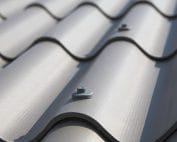
Visible corrosion, a tilted washer or a change in the position of the fastener require investigation. The sheet itself may be in good condition while the connection is no longer. Fibre cement sheets do not rust, but the metal parts of the system have their own durability conditions. Assessing them is an important part of the inspection.
Asbestos-free fibre cement should not be compressed preventively by tightening all screws more firmly. The required contact pressure is determined by the system. If a leak occurs, the hole and the substrate must also be checked. A worn seal or damaged support may require a different action than tightening alone.
Follow the entire path of the water with your eyes
The inspection begins above the point where water appears inside. It is worth examining the ridge, penetrations, laps and flashings. Water can travel along the support before it drips down. A stain on the ceiling does not always point directly to the damaged sheet.
Fibre cement sheets should drain precipitation along the corrugations to the eaves. Leaves, deposits and fragments from other work can alter this path. Particular attention should be paid to places near equipment. An added cable or bracket should not block the drainage or load the edge of the sheet.
Assess the gutters, downpipes and the surroundings of the building
A blocked drainage outlet can cause water to overflow even when the roof covering is watertight. Gutters must be checked for leaves, sediment and damage. The downpipe should direct water to where it will not dampen sensitive areas. It is also worth inspecting the ground next to the building after rainfall.
The inspection is an opportunity to check the accessibility of the outlets. If the surroundings have changed due to a new fence or a storage area, servicing may be more difficult. This matter should not be postponed until a failure occurs. A safe place to set up equipment is part of roof maintenance.
Do not omit the ventilation and the underside
The air inlets and outlets should remain clear. Accidental sealing during other work can change the humidity conditions. Fibre cement sheets can buffer some of the vapour, but they will not replace air exchange. Repeated condensation requires an assessment of the whole building.
Asbestos-free fibre cement can have damp spots without mechanical damage, but this should not be assumed automatically. A distinction must be made between condensation and a leak. Information about the weather, cleaning and the way the building is used helps. It is worth recording whether the symptom occurs locally or over a larger area.
Assess changes in appearance according to their cause
Moss, lichen and white mineral bloom are different phenomena. Not every change in colour requires intensive cleaning. What matters is whether it affects drainage, the lap or the condition of the surface. Strong chemicals should not be used merely to even out the colour without checking the recommendations.
Fibre cement sheets are cleaned using a method permitted for the specific variant. High pressure and an arbitrary preparation can damage the material or the coating. If lichen does not hinder the roof’s function, the scope of the treatment should be assessed sensibly. When it blocks the gutter or the lap, the cause needs to be properly removed.
Record the result and establish the order of actions.
After the inspection, it is worth preparing a short list of places with no changes, of defects and of matters for further assessment. For each problem, the location and a photo are recorded. This makes contact with the contractor easier and allows comparison during the next inspection. The document does not have to be long, but it should be unambiguous.
Asbestos-free fibre cement is maintained more effectively when minor symptoms have their own history. Then the diagnosis does not have to start from scratch every time. Repairs should be carried out in accordance with the system and with safe access arrangements. A well-executed inspection ends with specific findings, not merely with the information that the roof has been looked at.
Record the inspection results on the roof plan and take photographs of the same details. This will make it possible to identify changes more quickly and to plan the necessary repair.
7 branches. Materials closer to your project.

- SEROCK — Dzierżenin 34 E
- BŁONIE — ul. Sochaczewska 138A
- RADOM — ul. Grobickiego 8
- ŁÓDŹ — Natolin 8
- OLSZTYN — Barczewo, ul. Prosta 9
- WROCŁAW — ul. Jerzmanowska 10C
- GORZÓW WLKP. — ul. Zielona 33/34