Profiles and steel structures
Staged steel section deliveries: coordinating schedules, packing and installation
In brief
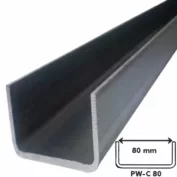
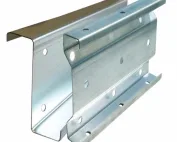
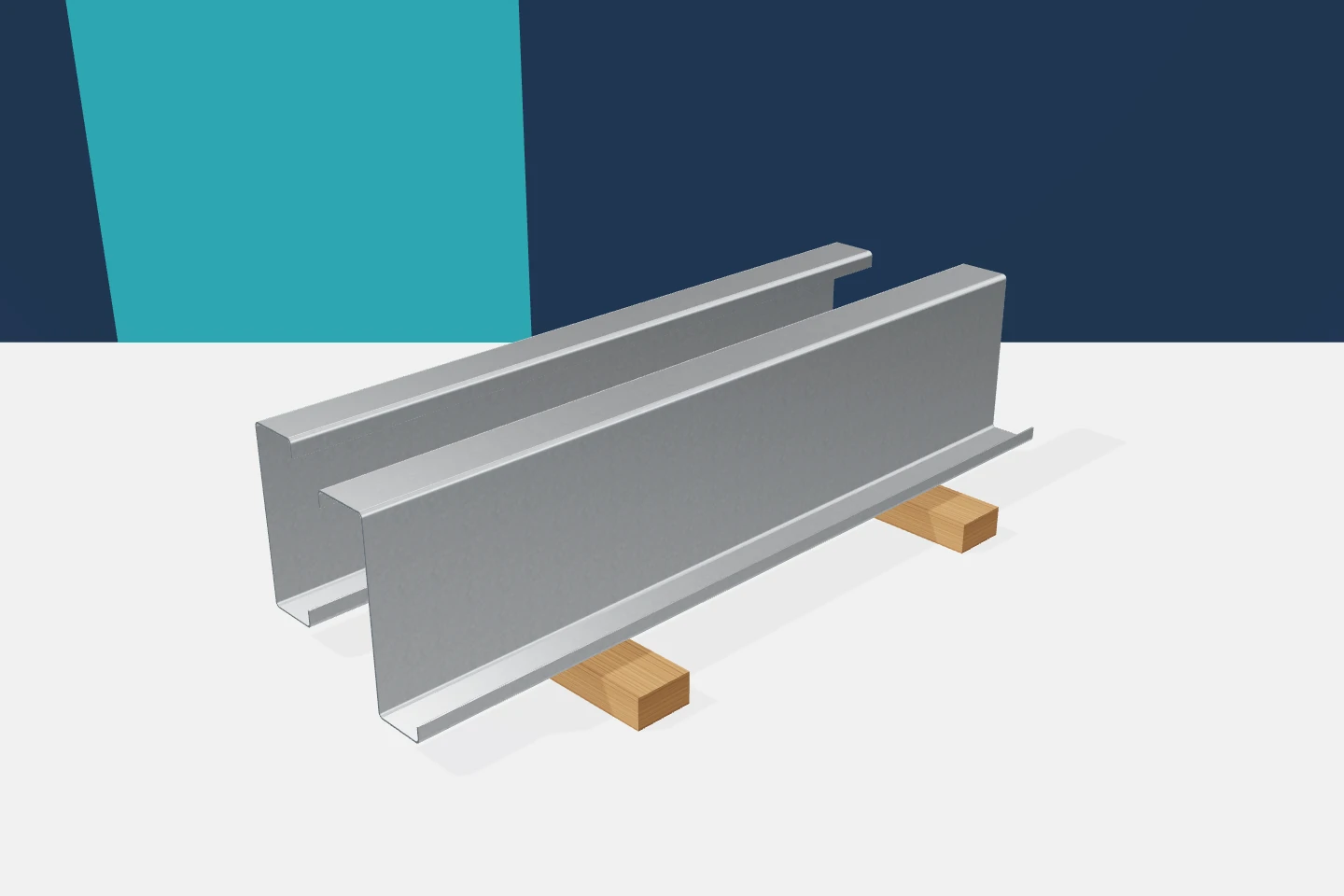
Well-prepared cold-formed profiles can wait their turn without holding up the build. A poorly planned delivery has the opposite effect. The parts you need are lying under other bundles, the accessories are on a separate transport, and the equipment has to come back for unloading. It is worth aligning the production schedule with the actual installation sequence. This applies to z-sections, c-sections, sigmas and omegas, even if their total weight seems small. The stages should correspond to areas that can sensibly be completed. This will not always be a division into roof and walls only. Sometimes the sequence of axes or hall sectors matters more. Profiles and accessories must be assigned to each stage. Delivering the main parts alone is not enough if stabilising elements or connectors are missing.
Splitting the delivery starts with the structural plan
It is also worth checking the dependencies between the works. Installing one zone may require the adjacent bracing to be completed first. The material should not be divided in a way that leaves an incomplete layout. Galvanised profiles can be prepared in several batches, but their division must take the structure into account. The commercial schedule should follow from the works plan, not the other way round.
Deadlines are measured by readiness for installation
The lorry’s arrival date is not the only relevant deadline. Approved drawings, finished supports and site access are needed. If any of these conditions is not met, the material will wait. Time should be allowed for acceptance and for clarifying any discrepancies. A plan without such a margin is sensitive to minor delays.
A large stock reserve should not, however, be treated as the solution to all problems. Long storage requires space and suitable conditions. Cold-formed profiles can become damp or damaged during repeated handling. The decision on earlier delivery should take the actual site possibilities into account. Sometimes smaller, complete batches are better.
The package should be clear without unpacking
The package description should be linked to the stage, axis or group of elements. It should allow the contents to be identified before unloading. The number of parts, their markings and the package weight, if needed for selecting equipment, are important. The information must remain legible despite transport conditions. One should not expect the contractor to reconstruct everything from a single summary document.
It is worth avoiding mixing elements from distant stages if this later requires the package to be opened repeatedly. Edge and internal Z-sections can be grouped in a way that supports the installation sequence. C-sections at openings should remain linked to the relevant wall. Omegas and short details are easily overlooked, so their identification is equally important.
Unloading is planned by length and location
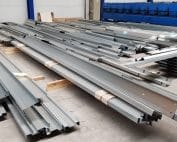
The equipment must match not only the weight but also the length and the susceptibility of the load. Incorrect lifting can deform thin profiles. Suitable slings or the method of using the trolley must be planned. Access and approach to the packages are important. Changing the unloading sequence can be difficult if the lorry was loaded without taking the site into account.
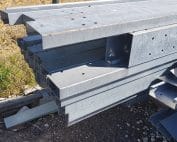
Galvanised profiles should be delivered to prepared supports. They should not be temporarily placed in mud simply because the final location is occupied. Such an additional stage increases the number of operations and the risk of damage. The location of storage zones should be agreed in advance with other contractors. Steel logistics affect the organisation of the entire site.

Production lengths affect the crew’s work
Components cut and drilled to the design may reduce on-site processing. The condition is correct dimensions. It is worth establishing which parts will arrive ready and which require further preparation. The latter need space, tools and inspection of workmanship. The scope of processing should be visible in the schedule and the quote.
Profiles should not be shortened merely to facilitate transport without checking the new connections. Dividing a purlin or a rail changes the structural solution. Z-sections, C-sections and sigma sections have different connection options. Every additional node means material and labour. The logistical saving should be weighed against these consequences before ordering.
Changes require updating all batches
If the geometry or openings change during construction, the impact on material already produced must be checked. It is important which revision applies to a given delivery. Several unmarked versions of the schedule must not remain in circulation. This leads to errors in picking and installation. Unambiguous identification helps maintain control over the change.
This also applies to accessories. A new profile may require different cover plates, screws or support sheets. Updating only the main item is insufficient. Cold-formed profiles form a system of interrelated parts. The delivery plan should cover the complete set needed for the current solution, not a mixture of successive design versions.
It is worth assessing the delivery cost together with the handling cost
One large delivery may reduce transport costs but increase storage requirements. Several smaller ones may facilitate installation but require more unloading operations. There is no single best variant for every site. Transport, equipment, space and labour must be calculated. The risk of damage during handling of material should also be considered.
Galvanised Z, C, sigma and omega profiles allow repeatable parts to be prepared for efficient assembly. A good schedule makes use of this feature. Material arrives when it is needed, in a batch that can be completed and with a full set of accessories. Cold-formed profiles organised in this way support the pace of construction. They do not become another task to sort out after delivery.
7 branches. Materials closer to your project.

- SEROCK — Dzierżenin 34 E
- BŁONIE — ul. Sochaczewska 138A
- RADOM — ul. Grobickiego 8
- ŁÓDŹ — Natolin 8
- OLSZTYN — Barczewo, ul. Prosta 9
- WROCŁAW — ul. Jerzmanowska 10C
- GORZÓW WLKP. — ul. Zielona 33/34