Profiles and steel structures
Erecting Z-purlins: the installation sequence that helps avoid rework
In brief
Installing Z-purlins starts before the first profile is lifted. You need to know the sequence of the elements, their orientation and the connection plan. Properly prepared Z-purlins can make the crew’s work considerably more efficient. Errors in identifying the parts quickly cancel out that advantage. Cold-formed profiles require careful assembly, because their geometry and hole pattern correspond to a specific roof layout. The erection drawing should show the axes, the supports and the purlin markings. It is worth clearly distinguishing the edge elements from the internal ones. Where different thicknesses occur, this information should be visible in the schedule. On the roof, this should not be decided on the basis of how heavy the profile feels in your hand. A similar height does not mean an identical part.
The roof plan should be clear to the crew
Before starting work, the conformity of the plan with the main structure must be checked. The dimensions of the supports and the position of the openings should correspond to the adopted documentation. If changes have occurred, they must be clarified before installing the purlins. Galvanised profiles with pre-formed openings do not compensate for arbitrary deviations. Early checking is simpler than reworking a series of fixed Z-purlins.
The direction of the flanges results from the system solution
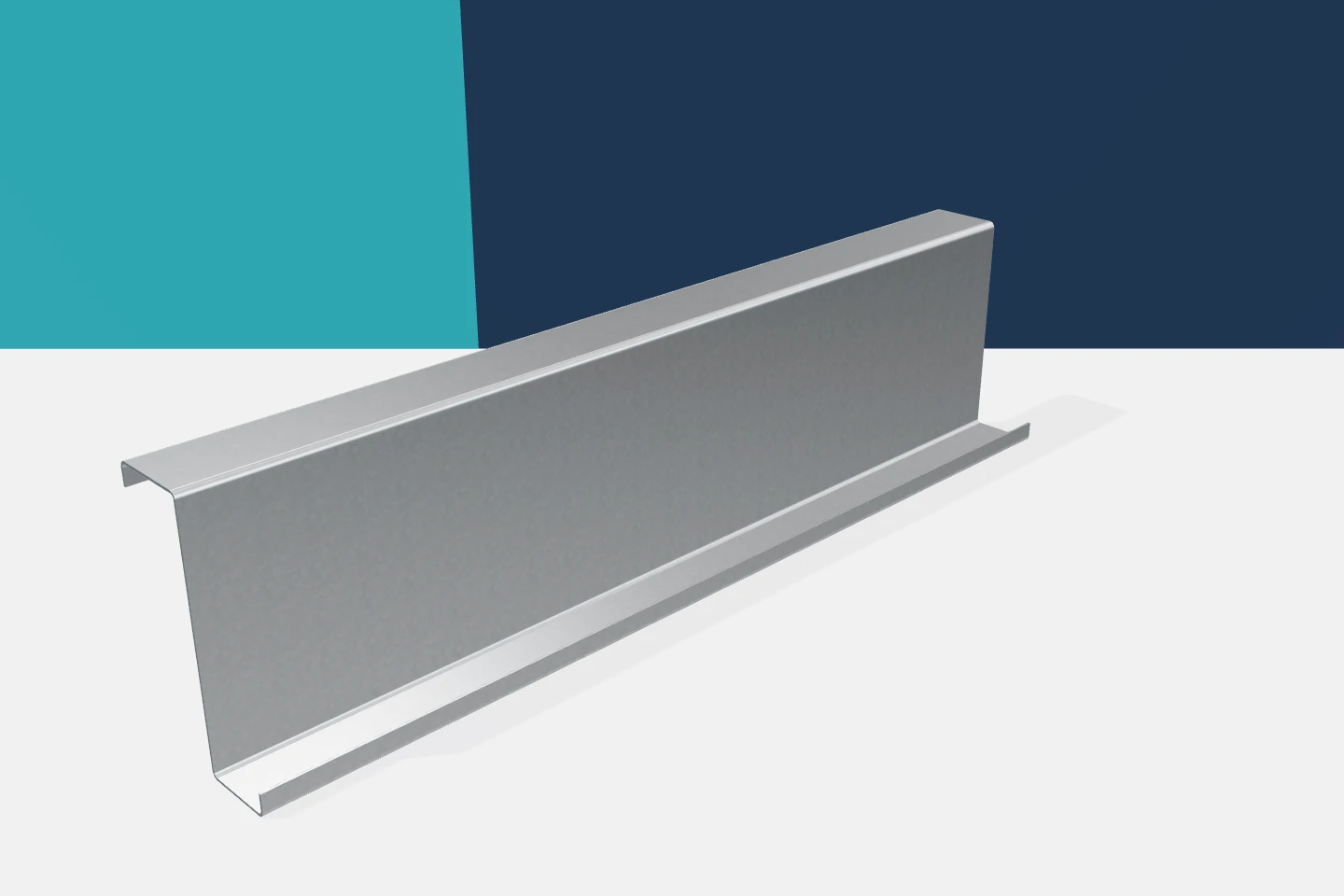
The Z-section is not symmetrical in a way that would allow it to be rotated freely. The orientation affects how the element behaves and how the connections work. In many roof systems, the documentation specifies the orientation of the upper flange relative to the ridge. This guidance should be followed for the selected system. It is not worth replacing it with a general rule remembered from another site.
The position of the wider and narrower flange is also important. It enables specific laps to be formed correctly. Changing the order can make it difficult to insert the next profile. This is why some of the installation is carried out according to the plan, and not according to temporarily more convenient access. Channels and sigma profiles have different details, so habits should not be transferred between them without checking.
Lifting must not change the shape of the profile
A long element made of thin sheet metal requires proper handling. Its length, mass and susceptibility to deformation must be taken into account. A support or grip concentrated in the wrong place can bend the web. The Z-purlins should also not be slid over one another. This protects both the geometry and the zinc surface. The method of handling the material should be agreed in the work organisation.
Bundles are not placed on the roof in random locations. The concentrated mass of a delivery is a different load than evenly distributed elements after installation. The location for temporary storage must be planned. Cold-formed profiles have limitations also during construction. The installation state deserves the same attention as the final structural arrangement.
The lap is assembled according to the drawing
If the system provides for a lap, its length and hole pattern must be maintained. The profiles should fit without forcing the shape. The correct elements on both sides of the support and the complete set of fasteners are important. The lap must not be shortened to bypass a collision without a design assessment. Such a change affects how the purlin behaves, and not only the convenience of installation.
Sometimes another solution is used, for example a splice plate or separate sections. The crew should know which scheme applies at a given location. Details from different systems should not be mixed. Galvanised profiles remain predictable when the connection matches the calculations. Double sheet metal visible above the support does not by itself confirm a correct arrangement.

Bracing is installed at the stage provided for it
The elements stabilising the purlins are not an addition that can be left until the end without checking. The erection design defines their role and the sequence of execution. They may limit displacement or twisting. The absence of a tie during the works can be significant, even if the roof is later to receive a rigid covering. At every stage the actual support conditions must be known.
It must not be assumed that the future sandwich panel solves the current stability problem. Not every covering also provides the required lateral restraint in the final state. The interaction must be confirmed for the given fixing arrangement. Omegas under covering details, channels at the edges and Z-purlins in the roof field perform different functions. They should not replace one another by chance.
Before enclosing, the entire purlin line must be inspected
After fixing, the position, straightness and completeness of the connections are checked. Attention should be paid to local dents, twisting and missing screws. Inspection before covering is easier than after the covering is completed. This is a good moment to confirm that the bracing and edge elements conform. A minor discrepancy can then be corrected in an agreed and accessible manner.
Swarf and dirt produced during the works must also be removed. Areas of coating damage require handling in accordance with the documentation. Galvanised profiles are not resistant to every form of processing. If deformation has occurred, surface repair alone is not sufficient. The structural assessment must be separated from the anti-corrosion protection.
Efficient installation results from repeatability
The greatest benefit comes from several things being consistent at once. The drawing, the part marking, the hole pattern and the actual support should describe the same location. The subsequent Z-purlins are then assembled according to a clear plan. Less time is spent searching for the causes of clashes and transporting the wrong elements. Prefabrication relies on this predictability, not on a tolerance for improvisation.
Well-installed cold-formed profiles form an orderly roof base. Z-purlins, channels, sigmas and omegas can complement one another in the details if they have been selected for them. Every change should have a confirmed method of execution. Such organisation helps preserve the geometry, durability and the intended structural behaviour throughout the entire construction process.
7 branches. Materials closer to your project.

- SEROCK — Dzierżenin 34 E
- BŁONIE — ul. Sochaczewska 138A
- RADOM — ul. Grobickiego 8
- ŁÓDŹ — Natolin 8
- OLSZTYN — Barczewo, ul. Prosta 9
- WROCŁAW — ul. Jerzmanowska 10C
- GORZÓW WLKP. — ul. Zielona 33/34