Costs and purchasing
Budgeting for a complete roof with tile-effect metal sheets
In brief
First establish which unit the metal roofing tile price refers to, as this determines how offers compare. The profile, coating and sheet thickness all affect cost, as does the way surface area is settled. Bear in mind that effective area accounts for sheet overlaps, so a rate per total metre alone can be misleading. Add cut-offs, flashings, fixings and installation to the budget. The best approach is to compare complete roofs with identical parameters and scope of work, using the same units, thickness and coating.
What are you actually paying for in the price of a sheet?
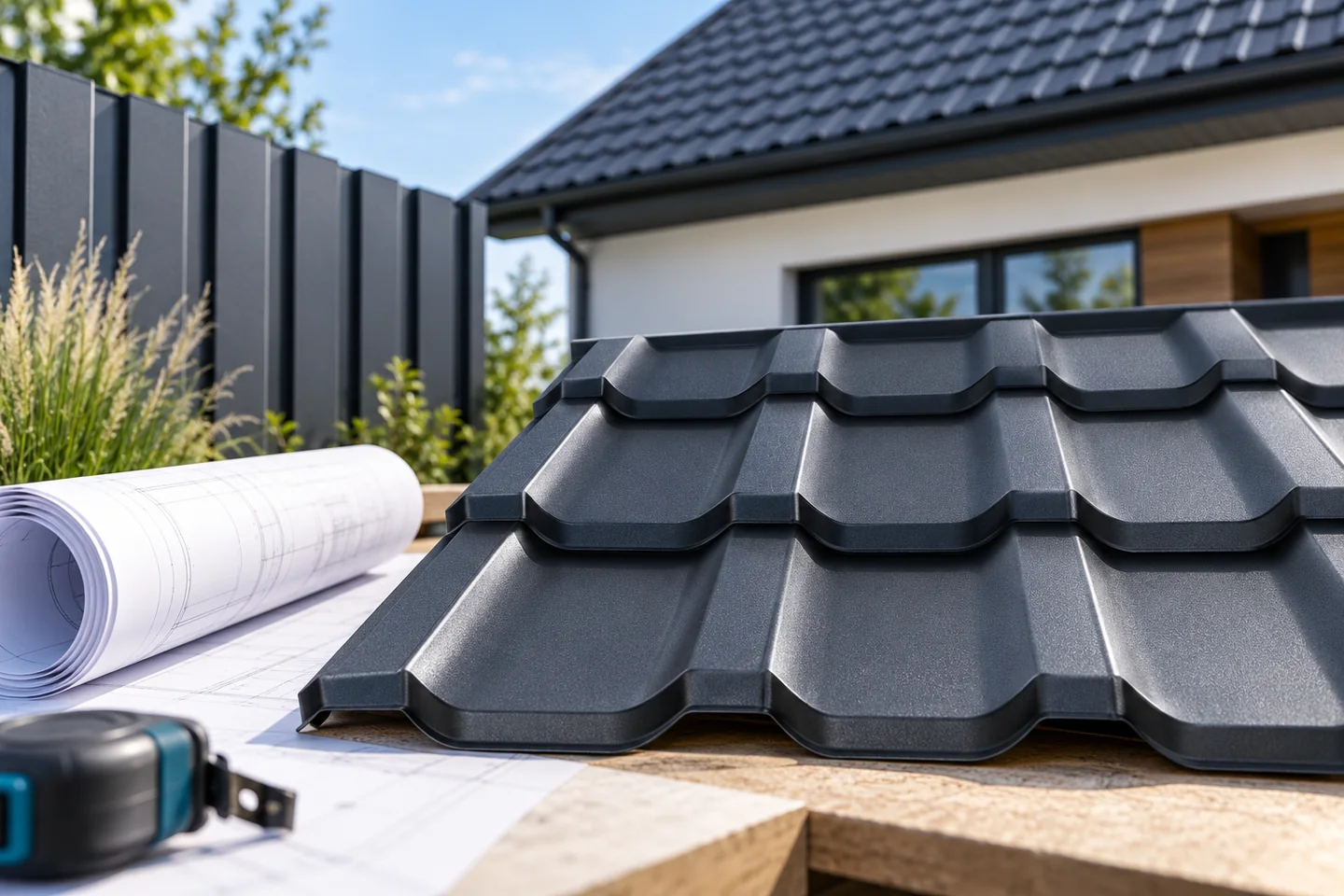
The offer may include a price per piece, per total square metre or per effective square metre. The effective area corresponds to the coverage after accounting for the overlaps intended for the sheet. Therefore, a lower rate per total square metre does not necessarily mean a lower cost for the finished roof slope. Compare the same units and the same thickness and coating.
For modules, the coverage area of one piece is useful. If it is 0.798 m², divide the price per sheet by 0.798. You get the cost per effective square metre before adding waste from offcuts. This is not yet the price per square metre of the finished roof after installation. On a complex roof shape, material consumption may increase due to roof valleys, corners and openings.
What does the dated catalogue example show?
The price list valid from 28 October 2026 quoted a module covering 0.798 m². Converted to euros, the 25 µm polyester finish cost €8.10 per module, or €10.15 per square metre of cover, excluding VAT. The 35 µm matt finish cost €9.03 per module (€11.31 per square metre) and the 55 µm polyurethane finish €11.80 per module (€14.79 per square metre), also excluding VAT. Each catalogue figure has been converted and rounded separately.
Including 23% Polish VAT, the corresponding catalogue prices per square metre of cover were approximately €12.49, €13.91 and €18.19. These figures applied to one product range at a particular date. Prices for other tile-effect roofing sheets can fall outside this range. Discounts, delivery and the terms of a particular order affect the total. Confirm the current quotation before buying.
How do you calculate the number of modules?
For a purely mathematical coverage of 100 m² with a sheet of 0.798 m² coverage, at least 126 pieces are needed. The result of 100 divided by 0.798 is rounded up to a full sheet. This is not a ready order for a real roof. The layout of the slopes and offcuts may increase the number of required elements.
If the cutting plan calls for 110 m² of effective cover, this example requires 138 sheets. At the rounded unit price of €8.10 excluding VAT, they cost €1,117.80 before tax or €1,374.89 including 23% VAT. The allowance used here only illustrates the calculation. Waste varies with the complexity of the roof, so check the final sheet count against the cutting plan.

Which extras change the budget?
Ridge tiles, barge boards, roof valleys and eaves strips can constitute a significant part of the cost. Screws, sealants and ventilation elements are added. A roof with several dormers requires more details than a simple gable roof of the same area. Therefore, the price per square metre of coverage does not allow comparing the entire investment without a plan of flashings.
Also establish the scope of the layers beneath the metal roofing. The membrane, battens, counter-battens and any sheathing are separate items. If the roof is being renovated, removal of the old material and repair of the structure may be required. Do not omit transport and unloading. Logistics conditions can change the profitability of a small order, even with a favourable price for the sheets themselves.
What affects the installation price?
Labour depends on the geometry, access, height and scope of details. There is no single rate that adequately describes every roof. An extensive roof slope with chimneys and roof valleys requires more work than a regular rectangle. Preparation of the substrate is also important. An uneven roof structure may require adjustments before laying the material begins.
Ask for a clear separation of basic and additional works. Establish whether the quote includes gutters, snow guards and roof access. For a renovation, record how hidden damage will be settled. Compare offers with the same scope. A lower final amount is sometimes the result of omitting work that will appear later as a surcharge.
How to prepare a request for a quote?
Send the dimensions of the roof slopes, the pitches, the edge lengths and the number of penetrations. Indicate the expected thickness, coating and colour. If you have not yet chosen the format, ask for a modular variant and one cut to size. Both proposals should have comparable parameters and a comparable set of accessories. Then the price difference will result from the actual solution.
Finally, check the units, quantities and the method of calculating tax in the specific transaction. The supply of material alone and a comprehensive service may require a different tax assessment. Do not automatically transfer the rate from the example to the entire order. A good quote allows the cost of the covering, accessories and labour to be indicated separately. This way you know where a change in a parameter actually affects the budget.
7 branches. Materials closer to your project.

- SEROCK — Dzierżenin 34 E
- BŁONIE — ul. Sochaczewska 138A
- RADOM — ul. Grobickiego 8
- ŁÓDŹ — Natolin 8
- OLSZTYN — Barczewo, ul. Prosta 9
- WROCŁAW — ul. Jerzmanowska 10C
- GORZÓW WLKP. — ul. Zielona 33/34