Installation and details
Roof flashings explained: which details does your roof need?
In brief
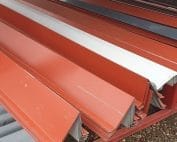
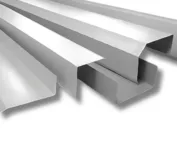
Metal flashings direct water away from vulnerable junctions and close the edges of the roof covering. Readers should check that each element — eaves strip, barge board, ridge cap, valley and chimney flashing — has the correct shape, lap and fixing, rather than relying on sealant alone. Watertightness depends on the detail, so the flashing set must be prepared together with the roof covering and ventilation plan. It is also worth determining where airflow should be left open and where water must drain freely.
Why is the covering not enough on its own?
Sheets provide good protection for the regular surface of a roof slope. Problems arise where the roof ends, changes direction or connects to another part of the building. Water can penetrate under the edge, be drawn up through a tight joint or enter during strong wind. A flashing gives it a safe drainage path and protects the adjacent layers.
Not all flashings should be sealed tight along their entire length. At the eaves and ridge, a designed airflow often needs to be left open. Incorrectly chosen foam can block ventilation. The detail should therefore be considered together with the roof layer build-up. A good flashing protects against precipitation while not hindering the drying of the assembly.
What role do eaves strips play?
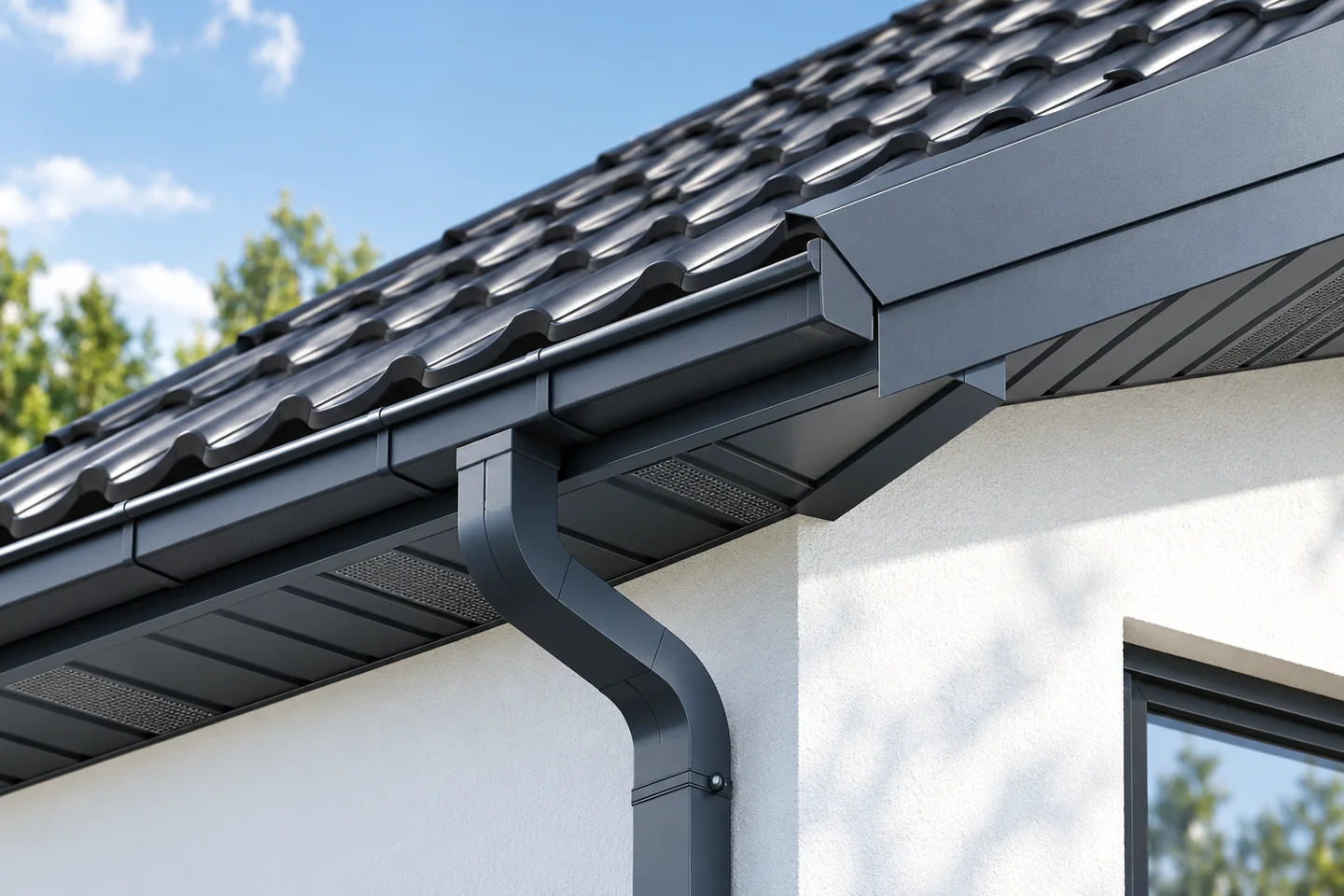
In the eaves zone, water from the covering reaches the gutter, and water from the underlay must have its own correct drainage. The gutter apron directs the runoff according to the adopted detail. The gutter support flashing protects the fascia board or another part of the eaves. Their relative position depends on the construction and the way the membrane is laid.
Do not determine the sheet overhang without checking the gutter. Too small an overhang can direct water onto the board, while too large an overhang can hinder its capture during heavy rain. The ventilation inlet must be protected against birds and larger insects while maintaining the required cross-section. At the eaves, several simple elements must work as one system.
What do the barge flashing and ridge cap protect?
The barge flashing protects the side edge of the roof against water and wind uplift. Its width and height must match the covering profile and the gable board detail. Fixing must account for wind forces. At the edge of the slope, it is not enough to screw the sheets only where it is convenient during installation.
The ridge cap protects the ridge or hip. Depending on the construction, ventilation and sealing elements are located beneath it. The entire space should not simply be filled with foam. Drainage and proper fixing must be ensured, and where ventilation is provided, also a path for air to escape. The shape of the ridge cap does not replace correct preparation of the substrate.

How does a roof valley work?
The roof valley collects water from two converging slopes. During heavy rain, the flow can be significantly greater than on a single roof strip. It requires a suitable substrate, width and free drainage path. The edges of the cut covering should not excessively narrow the active cross-section. The length of the valley and the area of water collected are also important.
Fixings must not create uncontrolled openings in the zone of intensive run-off. Laps are arranged so that water passes from the upper element onto the lower one. In autumn the roof valley requires inspection, as leaves easily accumulate in it. Even correctly executed flashings can stop working when the outlet is blocked by a thick layer of debris.
What distinguishes flashings at chimneys and walls?
At the chimney, elements of different rigidity and differing movement under the influence of temperature meet. The flashings must take this movement into account. The part connected with the covering and the part protecting the junction with the wall should form a well-considered arrangement. A bead of sealant alone at the contact between sheet metal and render does not replace a correct detail.
Behind the chimney, provision must be made for draining water flowing in from above. In larger penetrations the solution may require additional shaping of the run-off. Similar principles apply to the junction with a high wall. The connection should limit the possibility of precipitation penetrating, but must not accidentally close a necessary gap. Sealing materials are selected to suit the substrate and the operating conditions.
How to order and receive flashings?
Prepare a list of lengths and cross-section drawings. Check the developed width of the sheet metal, the width of the laps and the direction of the visible coating. Made-to-measure flashings may require different assumptions than a ready-made catalogue element. It is not worth ordering all parts from one simplified sketch when the roof has several different variants of eaves and edges.
At acceptance, check the continuity of the run-off, the condition of the coating and the fixings. Remove swarf and film remnants. Avoid joining metals that may cause contact corrosion or damage through water run-off. Record the material used and the method of making the connections. This will facilitate later inspection and repair without accidentally mixing incompatible products.
7 branches. Materials closer to your project.

- SEROCK — Dzierżenin 34 E
- BŁONIE — ul. Sochaczewska 138A
- RADOM — ul. Grobickiego 8
- ŁÓDŹ — Natolin 8
- OLSZTYN — Barczewo, ul. Prosta 9
- WROCŁAW — ul. Jerzmanowska 10C
- GORZÓW WLKP. — ul. Zielona 33/34