Insulation and ventilation
Why sheet metal roofing can suit an energy-efficient home
In brief
In Poland, a sheet metal roof covering can work well as part of an energy-efficient home, but on its own it does not guarantee low energy use. The overall roof assembly determines the outcome, so readers should check the properties and continuity of the insulation layer, airtightness and the avoidance of thermal bridges. The metal sheet itself is a thin covering and does not provide insulation, so the roof’s heat transfer value must be calculated for the whole assembly, including structure, gaps and joints. The choice of insulation material should be linked to the building design, not the name of the covering.
What is responsible for heat loss through the roof?
What matters most is the performance and continuity of the insulation layer and the other parts of the building envelope. The steel sheet itself is a thin covering and does not perform an insulating function. The roof’s heat transfer value therefore does not follow from the name of the tile-effect metal roofing. The whole assembly must be calculated, taking account of structural elements, gaps and joints.
Even thick insulation can perform worse if gaps are left at the wall plate, window or chimney. Air flow through leaks creates a separate problem. An energy-efficient house design should therefore indicate the route of the continuous airtight layer. Particular attention is required at service penetrations and at the junctions between the roof and walls.
What benefit does lightweight covering provide?
Tile-effect metal roofing and trapezoidal steel sheet can reduce the weight of the outer layer itself. This makes it easier to use many structural solutions and to modernise parts of existing buildings. Every change still requires a check of load-bearing capacity. The weight of the covering is only one of the loads, alongside snow, wind and equipment.
A low weight is not, however, equivalent to better insulation or less overheating of rooms. Summer comfort depends on the whole building, solar shading, ventilation and the properties of the building envelope. The covering should be assessed as part of the assembly. Attributing all the energy savings to it leads to promises that go too far.
When is it worth using PIR boards?
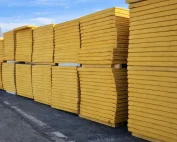
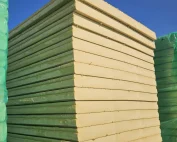
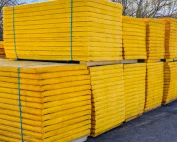
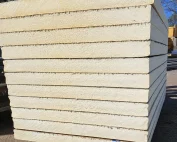
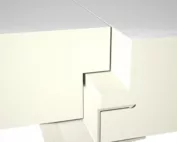
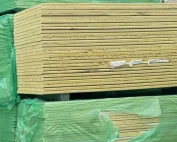
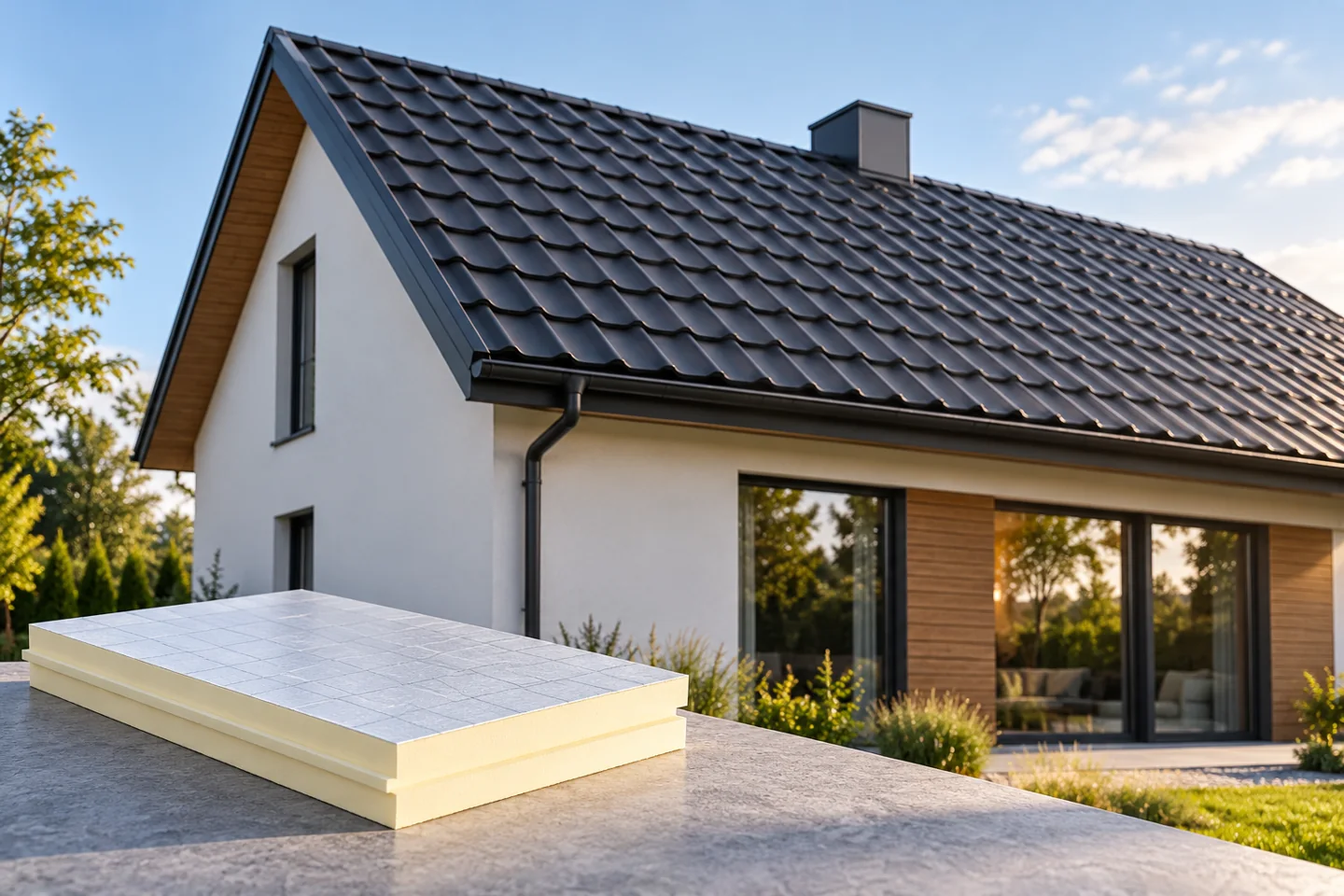
Selected PIR boards have a low declared thermal conductivity. As a result, the required thermal resistance can be achieved with a smaller thickness than with many typical materials. This is useful where detail height is limited or during modernisation. The parameter must be checked for the specific variant and facing, because not all PIR boards have the same lambda.
For example, a layer with a lambda of 0.022 W/(m·K) theoretically needs 110 mm of thickness to achieve a thermal resistance of 5 m²K/W. This is a calculation of the layer alone, without thermal bridges and the other resistances. It is not a ready-made roof specification. The designer must still take account of fixings, structure, moisture conditions and fire protection requirements.

What does insulation above the rafters provide?
A continuous layer above the structure can reduce the effect of timber elements on heat conduction through the roof slope. It also makes it easier to keep the rafters visible inside, if that effect is planned. However, it requires a suitable solution for the eaves, ridge, windows and fixing of the counter-battens. The boards cannot simply be laid on an old roof without assessing the junctions.
Longer fasteners transfer forces through the insulation layer, so their selection is structurally significant. Compatibility of materials with the sarking and covering system is also required. System solutions should be used in gaps and at joints. A good lambda will not compensate for an open gap through which air flows.
Does PIR always have the edge over other insulation?
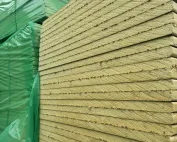
PIR is useful primarily where low thickness with good thermal resistance matters. Mineral wool may have advantages in certain fire and acoustic solutions. EPS is often cost-effective, and suitable XPS grades meet demanding moisture and load conditions. The choice depends on the place of application.
PIR should not be described as non-combustible, nor should low water absorption be equated with waterproofing. Fire classification is verified for the product and the entire solution. In contact with moisture, facings and joints also matter. Comparison of materials should cover all roof requirements, not only insulation thickness.
How do you integrate the roofing with the rest of the design?
Choose tile-effect metal roofing, trapezoidal steel sheet or another system compatible with the roof geometry. Agree ventilation and the drainage path for water from beneath the covering. If you plan photovoltaics, check the fixings and penetrations through the layers. The solution should remain sealed and not create incidental thermal bridges in places that are difficult to access later.
Before closing the assembly, inspect the insulation and all connections. Keep photos and the material specification. An energy-efficient roof results from consistency between design and execution. Steel sheet can be its durable, lightweight outer layer, and suitably selected PIR boards an effective insulation. Both elements must, however, work with the rest of the building.
7 branches. Materials closer to your project.

- SEROCK — Dzierżenin 34 E
- BŁONIE — ul. Sochaczewska 138A
- RADOM — ul. Grobickiego 8
- ŁÓDŹ — Natolin 8
- OLSZTYN — Barczewo, ul. Prosta 9
- WROCŁAW — ul. Jerzmanowska 10C
- GORZÓW WLKP. — ul. Zielona 33/34