Budget planning
Seven decisions that affect the cost of a sandwich panel order
In brief
The cost of the panels is shaped already during the design of the building envelope. Later, decisions about cutting, accessories and delivery date are added. The price per metre is the result of these arrangements. The following seven points help prepare an enquiry that covers the actual scope of work and makes it easier to compare quotes for one stage. First, define the function of the room. A warehouse envelope without heating is specified differently from a workshop, and differently again from a cold store. Thermal, fire and humidity requirements matter. Without this data, it is easy to compare materials that are not intended to achieve the same effect.
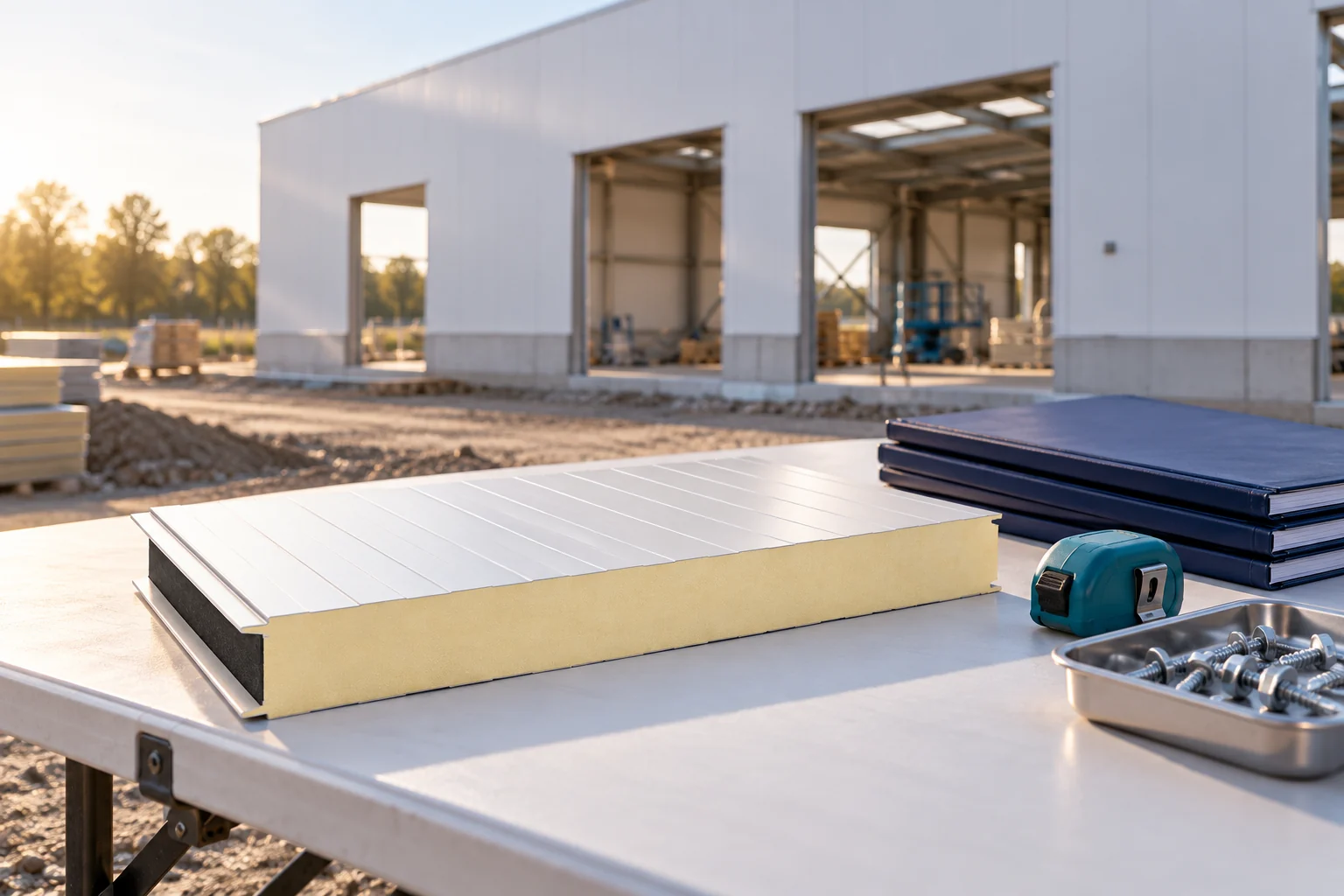
1. What requirements must the finished partition meet?
The choice of core affects price, weight and required thicknesses. No single material is best for every task. A cheaper item does not deliver savings if it does not meet the project requirements. Before requesting a quote, establish the parameters of the entire building envelope, and only then look for variants that provide them.
2. What thickness needs to be ordered?
Thickness affects thermal performance and material consumption. However, it should not be increased without checking the purpose. Within one family of PIR panels, an 80 mm wall has Uc 0.27 W/(m²·K), and a 120 mm wall has 0.18 W/(m²·K). These are data for specific variants, not a universal result for every PIR panel.
Changing the thickness may require longer screws and different flashings. For an extension, adaptation to existing openings is also added. If the new wall projects further out, the window sills, eaves and junction with the plinth must be checked. Include these elements in the budget as well, instead of calculating only the core surcharge.
3. What facings and coatings are needed?
Compare the thickness of the sheets on both sides and the type of coating. Two panels with the same core may have different facings. This matters for durability and mechanical parameters. The coating should match the environment in which the panel will operate.
For moisture, frequent cleaning or aggressive substances, a more detailed assessment is needed. The appearance of a white surface does not confirm chemical resistance. The operating conditions and the approvals of the selected variant must be known. A surcharge for a suitable coating makes sense when it corresponds to the actual need.
4. How much surface area will remain after cutting?
The lengths of the ordered pieces can change the budget more than a small difference in price. Calculate the area purchased and the area that will remain in the enclosure. A large opening does not always mean equal material savings. If it is cut from a full panel, the purchased area still includes the cut-out fragment.
The example is a calculation. At a price of €25.46 net per m², purchasing 120 m² costs €3,055.20 net. If 108 m² remain in the wall, the material attributable to one metre of finished surface costs €28.29 net. Changing the cutting plan can improve this result without changing the material grade.

5. What range of accessories does the installation require?
Screws, seals and flashings are added to the panels. Their quantity depends on the geometry of the building. The same area in one simple rectangle may require fewer flashings than several small walls with many openings. The pricing of extras should therefore be based on the drawing.
Consider separately the details of the junction with the existing part. Sometimes a piece of old flashing needs to be replaced or additional support prepared. A general ‘installation’ item does not always cover these works. Ask for the scope to be specified before you consider two quotes comparable.
6. How should the material be delivered and unloaded?
The transport cost depends, among other things, on the length of the elements, the delivery location and the division of the order. A long panel may require a different vehicle and unloading equipment. Do not assume that the transport price includes removing the packages and carrying them to the final location.
Staged deliveries reduce the need for storage but may increase the number of journeys. It is worth comparing these costs with the risk of damage on a tight site. For an operating plant, delivery times are also important. A delay at the gate can hinder work not directly related to the construction.
7. When should the order be approved and changes closed?
Before production, the lengths, colour and panel layout must be confirmed. A late correction may mean an additional order and unused material. In the case of a renovation, it is worth indicating the moment of the final measurement. Some dimensions can only be confirmed after the old structure has been exposed.
Check the validity of the quote and the conditions for its change. A price without a defined scope and deadline is not a reliable budget. Complete the selection of the supplier with a complete list of elements and confirmation of delivery. An order prepared in this way allows you to assess the cost of the stage rather than just the price of one item.
Short answers from the site
Which of the seven points is worth checking first?
Start with the required parameters of the building envelope. Without them, it is impossible to tell whether the materials being compared are suitable for the same task. The next step is cutting optimisation and a set of full quantities.
Does a larger order always mean a lower cost for the finished envelope?
No. A lower unit price can be eaten up by excess material, storage or unnecessary transport. What counts is the cost of the scope that will actually be used on site.
7 branches. Materials closer to your project.

- SEROCK — Dzierżenin 34 E
- BŁONIE — ul. Sochaczewska 138A
- RADOM — ul. Grobickiego 8
- ŁÓDŹ — Natolin 8
- OLSZTYN — Barczewo, ul. Prosta 9
- WROCŁAW — ul. Jerzmanowska 10C
- GORZÓW WLKP. — ul. Zielona 33/34