Mineral wool walls
What is a 60 mm mineral wool wall panel sufficient for, and are there thinner variants?
In brief
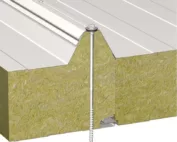
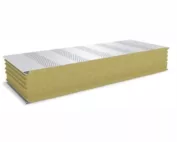
The 60 mm mineral wool panel appears in some wall panel ranges. It may suit certain partitions and conditions of use, but it does not automatically deliver the parameters required in a heated building. The 40 mm variant must be checked within a specific product family. The thickness range known from PIR panels must not be attributed to mineral wool. In an example family of mineral core wall panels, the 60 mm thickness has a Uc of approximately 0.66 W/(m²K) and a weight of 14.1 kg/m² with 0.5/0.5 mm facings. These are the data for a specific product. Other solutions may have different properties or may not be available in that thickness at all.
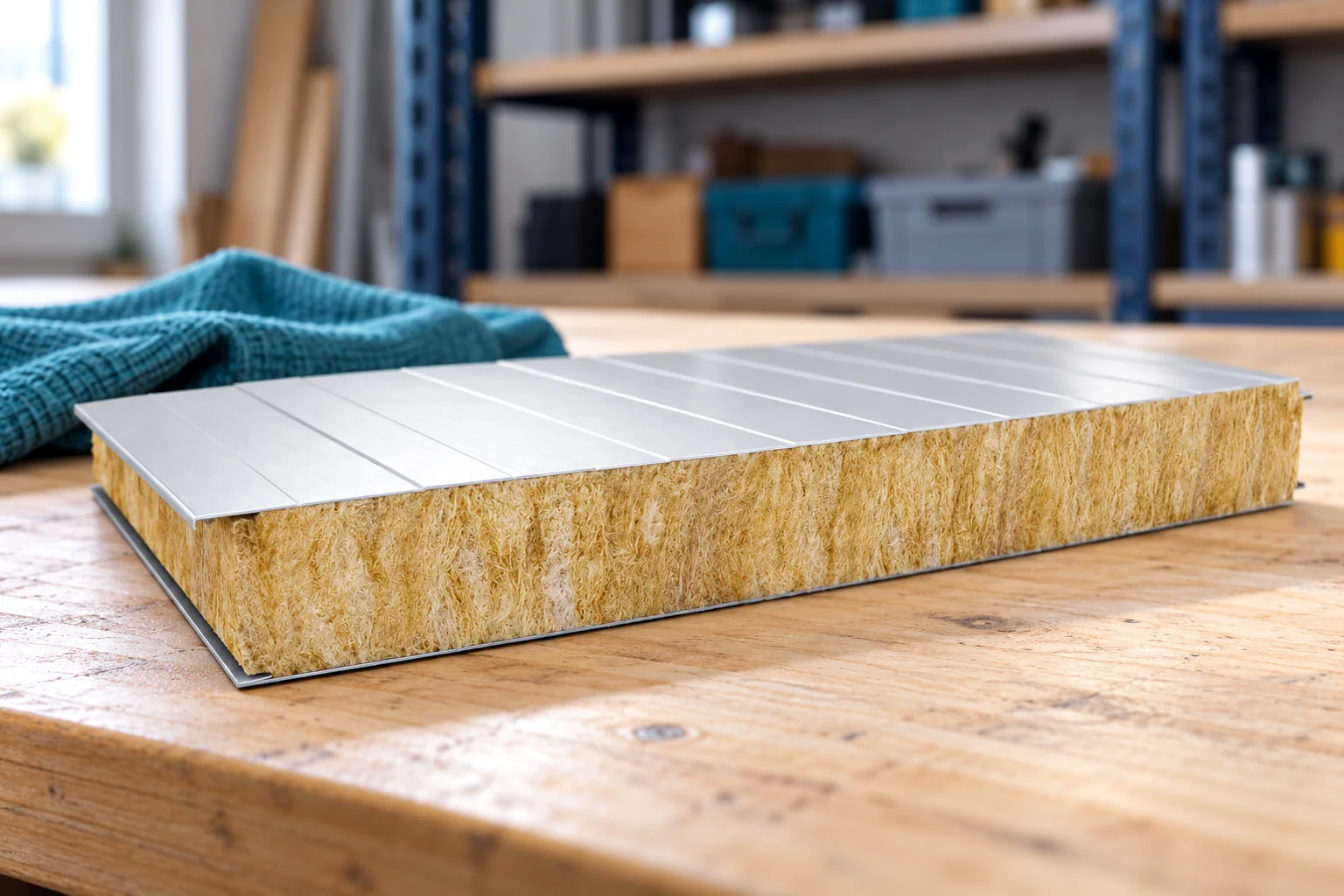
What is known about the 60 mm variant?
A small thickness can be convenient in some enclosures, but the choice should follow from the function of the wall. A partition between rooms at a similar temperature has a different job from the external wall of a heated hall. One recommendation should not be used for both cases.
Before choosing, establish the thermal, fire and mechanical requirements. Only then can you assess whether 60 mm is sufficient. Price and low weight are organisational advantages only when the material meets the required conditions.
Does every mineral wool panel have a 40 mm version?
No. The range of thicknesses depends on the product family. In some catalogues, mineral wall panels start at 60 mm. An offer of PIR panels at 40 mm does not prove that an identical variant with mineral wool exists. These are different product constructions with different properties.
If a mineral panel at 40 mm is offered, ask for its exact identification and documentation. Check whether it really is a panel with two facings or a different material. A photograph of the cross-section or a seller’s description limited to the word ‘wool’ is not enough.
When the core is changed, keeping the same thickness does not guarantee similar insulation performance. The parameters of the finished products must be compared, as well as the fixing and support requirements.
What does lower insulation performance mean in use?
With a higher U, more heat flows through the same area at the same temperature difference. In the example for 60 m² and 20 K, a panel with U 0.66 gives a flow of 792 W. The variant with U 0.39 gives 468 W. This is a simplified comparison of wall areas, without thermal bridges and ventilation.
If the room is heated only occasionally, the operational balance will differ from that of a constantly warm workshop. Surface temperature and the risk of condensation must also be taken into account. A thinner enclosure will not always be a good choice simply because the heating runs for a few hours.
It is not safe to assume that missing insulation can easily be added later from the inside. This creates a new layer build-up. It requires assessment of moisture, fixing and fire protection.

How can fire properties be verified?
The presence of mineral wool alone does not confirm the required fire resistance class of the wall. For the thin variant, some properties may not be declared. The designation NPD means no declaration for a given characteristic, not a positive result with any fire resistance duration.
The document for the specific thickness and configuration must be checked. The classification of a thicker panel must not be transferred to a thinner one simply because they look similar. Reaction to fire and fire resistance are separate pieces of information.
If the wall is to perform a specific protective function, the selection should be approved before purchase. The saving on a thin panel will not be real if the cladding later has to be replaced or the structure rebuilt.
How should you plan the purchase and installation of thin panels?
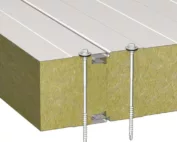
Check the available lengths and the load-bearing table. A small thickness does not mean any span is possible. With an existing frame, the product must be matched to the existing supports or the structure changed. It is also worth establishing how the connections at openings and ends will be made.
Order a complete set of matching components for the delivery. At the second stage, it may be difficult to find an identical thickness, interlock and coating. This applies particularly to non-standard batches. Reserving material requires confirmation, not the assumption that thin panels are always in stock.
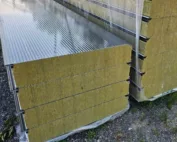
On delivery, check the connections and cladding. Damage to the interlock may be more significant than a minor scratch in the middle of the surface. Installation should maintain the required seals and contact pressure. A thinner element is still part of a building envelope with a specific function.
It is also worth establishing whether the thin panels will be installed as full elements or cut into shorter sections. Every new connection requires support and finishing. The saving on purchasing a short batch may disappear once additional flashings are added. The cutting plan should therefore be produced before the order is confirmed.
Short answers from the site
Can 60 mm of mineral wool be recommended for every heated garage?
No. A thermal balance and a definition of the operating conditions are needed. The requirements for the entire building envelope must also be checked.
What should you do if the 40 mm offer has no clear identification?
Before purchase, establish the exact product and its documents. Do not assume the parameters of a similar-looking panel or a different core.
7 branches. Materials closer to your project.

- SEROCK — Dzierżenin 34 E
- BŁONIE — ul. Sochaczewska 138A
- RADOM — ul. Grobickiego 8
- ŁÓDŹ — Natolin 8
- OLSZTYN — Barczewo, ul. Prosta 9
- WROCŁAW — ul. Jerzmanowska 10C
- GORZÓW WLKP. — ul. Zielona 33/34