PIR insulation
Will PIR insulation fit below the terrace threshold? Work out the thickness
At a glance
When renovating a terrace above a heated room, start with two questions: how much room is left for the PIR board, and what thermal resistance must the board itself provide? The distance from the substrate to the finished terrace surface also has to accommodate other layers. Nor is the conductivity on the label necessarily the value used in the design. Here is how to compare the terrace section with the thermal calculation. A worked example with 90 mm available shows why two boards of the same thickness can give different results and what to check before placing an order.
Mark the two levels on the terrace section
On the section drawing, mark the substrate level after strip-out and the agreed finished terrace level at the door. Record exactly where the measurement was taken. A dimension to the top of the door frame does not tell you the same thing as a dimension to the proposed walking surface.
How much of that space is available for PIR?
Check the section at the drain and wherever the fall changes, too. For a board of uniform thickness, it is the smallest space allocated to it in the agreed build-up that matters. A single reading in the middle of the terrace may miss that point.
Suppose the available depth there is 145 mm and the design allocates a total of 55 mm to everything except the insulation. That leaves 145 − 55 = 90 mm for the board. The 55 mm is an example allowance; for your terrace, take the other layer thicknesses from its detail drawing.
Which conductivity belongs in the calculation?
On the data sheet for the specific board, find its declared thermal conductivity, λD. Alongside it, note the design conductivity, λ, that the designer has adopted for this product and application. Both are expressed in W/(m·K), but that alone does not make them interchangeable.
Check whether the specification sets a resistance R for the insulation alone or a U-value for the entire construction. The calculation below concerns one homogeneous PIR layer. It does not establish the performance of the whole terrace or resolve the junction at the door.
Worked example: a 90 mm insulation allowance
In this example the board alone must provide R = 4.00 m²·K/W and its design conductivity is 0.024 W/(m·K). The thickness needed is R × λ: 4.00 × 0.024 = 0.096 m. That is 96 mm, which exceeds the space on the drawing by 6 mm.
Reverse the calculation as a check. A 90 mm board is 0.090 m thick, and 0.090 divided by 0.024 gives R = 3.75 m²·K/W. The board fits the available space, but with that conductivity it falls short of the specified resistance.
Would a board with a lower conductivity fit?
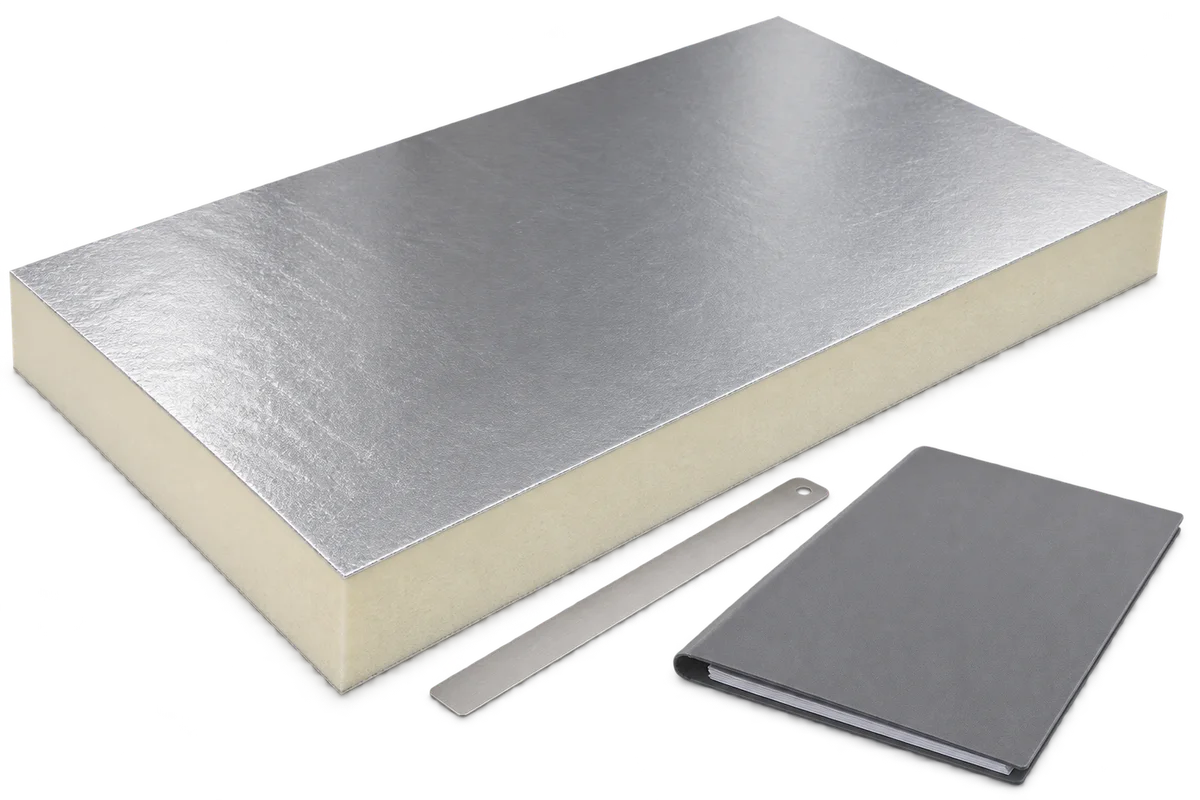
Now consider another product for which the designer confirms a design conductivity of 0.022 W/(m·K). The same target R would theoretically require 88 mm. A 90 mm board would provide about 4.09 m²·K/W. First check that this particular board is available in that thickness and has the specified facing.
The arithmetic alone does not establish suitability. The expected loads and compatibility with the waterproofing system still need checking. Do not reclaim missing millimetres by reducing the specified waterproofing, changing the falls or altering the threshold detail on site.
What to send for review before ordering
Send the designer the section marked at the tightest point, the measurements taken after exposing the substrate, and the selected product sheet. Ask for confirmation of two figures: the board thickness the detail can accommodate and the design conductivity used for that board.
On the order, identify the board model, facing and approved thickness. If a substitute is offered, return to the same section drawing and recalculate the resistance using the appropriate conductivity. The words “90 mm PIR” do not establish that the replacement meets the terrace specification.
7 branches. Materials closer to your project.

- SEROCK — Dzierżenin 34 E
- BŁONIE — ul. Sochaczewska 138A
- RADOM — ul. Grobickiego 8
- ŁÓDŹ — Natolin 8
- OLSZTYN — Barczewo, ul. Prosta 9
- WROCŁAW — ul. Jerzmanowska 10C
- GORZÓW WLKP. — ul. Zielona 33/34