PIR insulation
Insulation and water exposure: comparing PIR, EPS, XPS and mineral wool documentation
At a glance
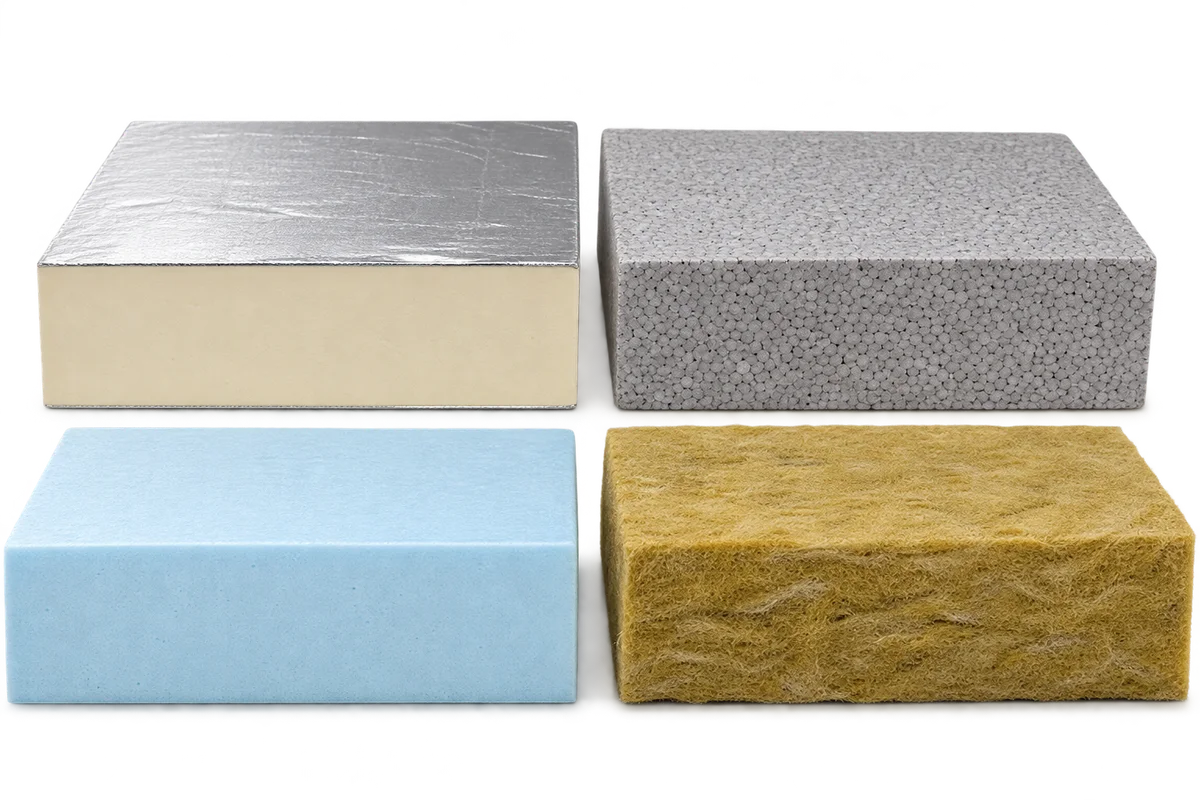
Comparing PIR, EPS, XPS and mineral wool for moisture exposure starts with identifying what the insulation will encounter. Rain during storage, water at a building element and water vapour inside a building call for different questions. Neither a material name nor a single absorption percentage is enough to select a product. You need the exact product’s data, the test description and the requirements of its proposed application. This guide helps organise documents before purchase: separate service conditions from site incidents, identify results that cannot be compared directly and prepare questions for the designer or supplier. It does not replace waterproofing design or assessment of boards that have already become wet.
Identify the source and sequence of moisture exposure
A description of the exposure is the starting point for assessing a particular insulation product.
Mark on a sketch where water may come from and how it is intended to drain away. Separate expected service exposure from a plumbing failure or an uncovered delivery. If the possible duration of wetting is unknown, record that uncertainty rather than replacing it with the general phrase “a damp location”.
Read the result together with its test method
For each water absorption value, record the property designation, unit and stated method. XPS documents may list long-term immersion separately from water absorption by diffusion. These are different tests. Do not rank materials using numbers detached from those different entries.
Check that the declaration covers the selected thickness and board grade. A result for another product in the same family cannot fill a missing entry. Where a property is not declared, mark the data as unavailable and request the evidence needed to assess the application rather than entering zero.
Distinguish water vapour from liquid water
Water vapour diffusion resistance describes a different property from water absorption in contact with liquid water. One cannot substitute for the other. For faced boards, establish whether a quoted value describes the core, the facing or the finished product. Record that scope alongside the value.
If the concern is condensation within an assembly, provide the designer with every layer and the conditions on both sides for assessment. A claim that insulation “breathes” does not resolve the issue. Data for one board cannot describe the behaviour of the complete wall or roof on its own.
Check the limits of the proposed assembly
Distinguish the thermal insulation from the layer responsible for keeping water out on the drawing. Mark terminations, service penetrations and material junctions. A favourable board absorption result does not establish that these details are watertight or remove the need for the specified waterproofing.
Compare the intended location with the installation instructions for each proposed grade. Where an adhesive or protective coating is involved, check that the two products are compatible. Confirmation of one water-related property does not establish compatibility with every adhesive, substrate and fixing method.
Assess wetting on site separately
Document a wet delivery before installation: product identification, packaging condition, visible changes and the circumstances of wetting. Keep photographs and separate material awaiting a decision from accepted stock. Determine the next step using the instructions for that exact product and an assessment of its condition.
Do not extend drying or rejection rules for one product to every PIR, EPS, XPS or mineral wool product. A dry-looking surface alone does not confirm compliance. Until a decision has been reached, leave unaccepted boards accessible rather than covering them with further layers and making inspection harder.
Record the conditions for accepting a material
Conclude the comparison with a short record of service conditions, the selected product, supporting evidence and unresolved questions. Separate the supplier’s confirmation of product properties from approval of the designed assembly. This makes the scope of each agreement and responsibility for outstanding answers clear.
Before delivery, give the installer the storage and protection instructions for the specified material. Agree where pallets will be placed and when inspection will occur before concealment. This organisation does not replace technical selection, but helps prevent correctly specified insulation being installed in an unresolved condition.
7 branches. Materials closer to your project.

- SEROCK — Dzierżenin 34 E
- BŁONIE — ul. Sochaczewska 138A
- RADOM — ul. Grobickiego 8
- ŁÓDŹ — Natolin 8
- OLSZTYN — Barczewo, ul. Prosta 9
- WROCŁAW — ul. Jerzmanowska 10C
- GORZÓW WLKP. — ul. Zielona 33/34