Roof covering
Tile-effect metal roofing or clay tiles: which is easier to incorporate into a roof renovation?
In brief
Choosing a covering during a renovation starts with assessing the roof structure. Only then is it worth comparing appearance, price and speed of work. Tile-effect metal roofing is lightweight, but its cost does not end with the sheets. Clay tiles require accounting for greater weight. Both solutions need a correct layer build-up and carefully executed details. This cannot be determined from the roof’s appearance from the street. An assessment of cross-sections, connections, support and condition of the timber is needed. Defects, dampness or previous alterations change the situation. It is not enough to state that the old covering was heavy, so any new one will be suitable.
Will the old roof structure accept a new covering?
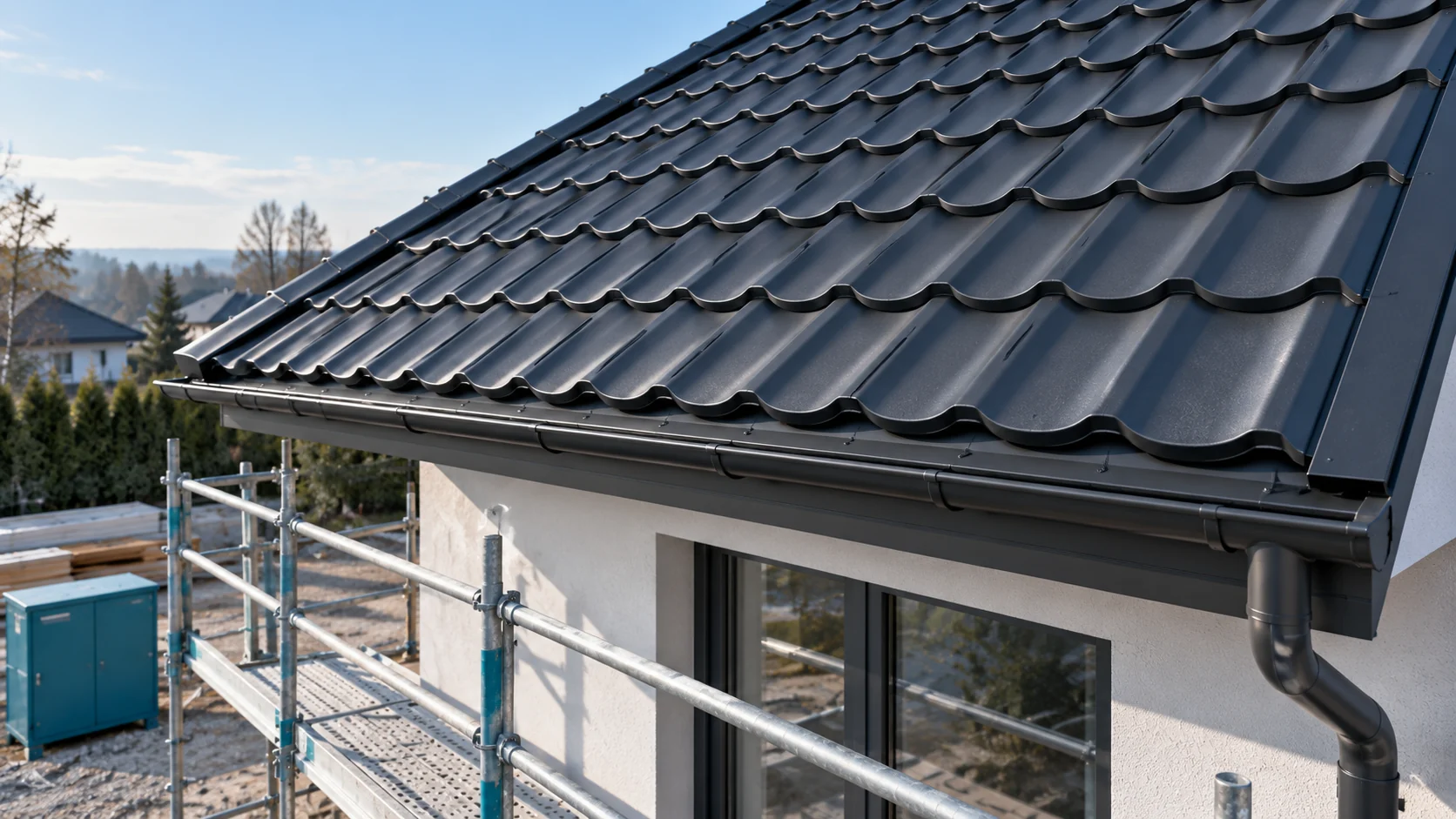
Tile-effect metal roofing usually places less load on the structure than a ceramic covering. However, the roof truss also carries other loads, including snow and wind action. A lightweight material does not exempt you from checking the structure. If the renovation includes the loft, changes to insulation, linings and equipment fixed to roof elements must also be taken into account.
How does the material change the organisation of works?
Long sheets of metal cover a simple roof slope quickly, but they require space for delivery and careful handling. Small modules are easier to bring onto a roof with many breaks. Ceramic tiles are laid from small elements. Their delivery and storage must be planned with weight in mind.
For a house occupied during the renovation, a plan for protection against rain is particularly important. The team should establish which part of the covering it will remove in one day and how it will close it before a break. Choosing a material that is quick to install is not a work plan in itself. The number of chimneys, access to the scaffolding and the scope of substrate repairs also matter.
What should really be compared in cost estimates?
Both quotes should cover the same roof and a similar scope of work. In addition to the main material, there are flashings, ventilation elements, fixings, snow guards and service access. Some of these items have different solutions for metal and ceramic. The price per metre from two advertisements should not be compared on its own.
For example, one quote may include removal and disposal of the old covering, while the other includes only laying the new one. The difference then says nothing about the cost-effectiveness of the materials. It is worth creating a common list of items and only then adding the amounts. Work whose scope can be assessed only after the roof truss is exposed must be recorded separately.
When comparing quotes, also record the completion date and how material left over after cutting is settled. Not every offcut can be returned. A roof with many hips produces different waste than a simple slope of the same area, so an identical rate per metre does not mean an identical order value.

How to assess durability without exaggerated promises?
The durability of tile-effect metal roofing depends, among other things, on the protection of the steel, the coating, the surroundings and the quality of installation. Leftover swarf or surface damage can accelerate corrosion. With ceramics, the properties of the specific tile and the correctness of the entire covering matter. Every roof also has elements that require inspections.
It is not worth equating the warranty period with the time of maintenance-free use. Warranties may cover different phenomena and have different conditions. The possibility of replacing a damaged element after years is important. With ceramics, a single tile is often replaced. With sheet metal, the scope of repair depends on the size of the sheet and the location of the damage.
Does ceramic always give a quieter loft?
A heavier covering may help to reduce noise, but comfort in the room depends on the entire building envelope. Insulation, airtightness, the internal lining and the connections are of great importance. A metal roof over an uninsulated storage room behaves differently from a roof over a carefully constructed attic.
When renovating, it is worth separating two problems: the sound of rain and sounds coming from outside. These are not identical phenomena. If noise is an important criterion, an assessment of the layer build-up is needed, not just the name of the covering. Replacing the material without improving airtightness may not bring the expected effect.
When should the final decision be made?
The choice should be made after measuring the roof slopes and assessing the structure, but before ordering flashings and trims. Materials have different requirements regarding support and minimum pitch. Even two tile-effect metal roofings may differ in permissible slope. Data from one variant must not be transferred to the entire group.
When extending a house, also check the connection between the new part and the old. Sometimes keeping the same material will make the building form easier to accept, but colour matching must be confirmed on samples. A sensible choice is one that fits the structure, the schedule and the way the house is used. The lowest purchase price does not settle all these issues.
Short answers from the building site
Does lightweight sheet metal allow you to skip repairing the old roof truss?
No. Damaged elements and connections must be assessed regardless of the weight of the new covering. Reducing the weight does not remove structural defects.
Can costs be compared without measuring the roof slopes?
The budget can only be estimated in advance. An exact quote requires the roof geometry, the number of details, the scope of dismantling and the method of access.
7 branches. Materials closer to your project.

- SEROCK — Dzierżenin 34 E
- BŁONIE — ul. Sochaczewska 138A
- RADOM — ul. Grobickiego 8
- ŁÓDŹ — Natolin 8
- OLSZTYN — Barczewo, ul. Prosta 9
- WROCŁAW — ul. Jerzmanowska 10C
- GORZÓW WLKP. — ul. Zielona 33/34