Roof structure and design
Scheduling a house build and deciding when to order the roof
In brief
In Poland, the time needed to build a house depends on the technology, organisation, weather and delivery schedules, so no single number of months can be reliably promised for every project. Readers should check what conditions each stage must meet — from documentation through groundworks and structure to the roof, installations and finishing — and which tasks can run in parallel. The roof, while it protects subsequent work, requires earlier arrangements. A schedule should show the dependencies between stages, not just dates written next to team names.
What should be included in the schedule?
The plan covers preparation of documentation, earthworks, structure, roof, installations and finishing. Each stage has conditions for starting. Some works can be carried out in parallel, others require completion and acceptance of earlier works. The schedule should show these dependencies, rather than being just a list of dates written next to the names of crews.
It is worth distinguishing between the time of the work itself and the waiting time. Material delivery, agreeing a change or a technological break can take longer than installation. The required breaks should not be shortened just to keep the original deadline. It is better to identify critical dependencies early and plan a reserve where there is a specific risk of delay.
When to decide on the roof type?
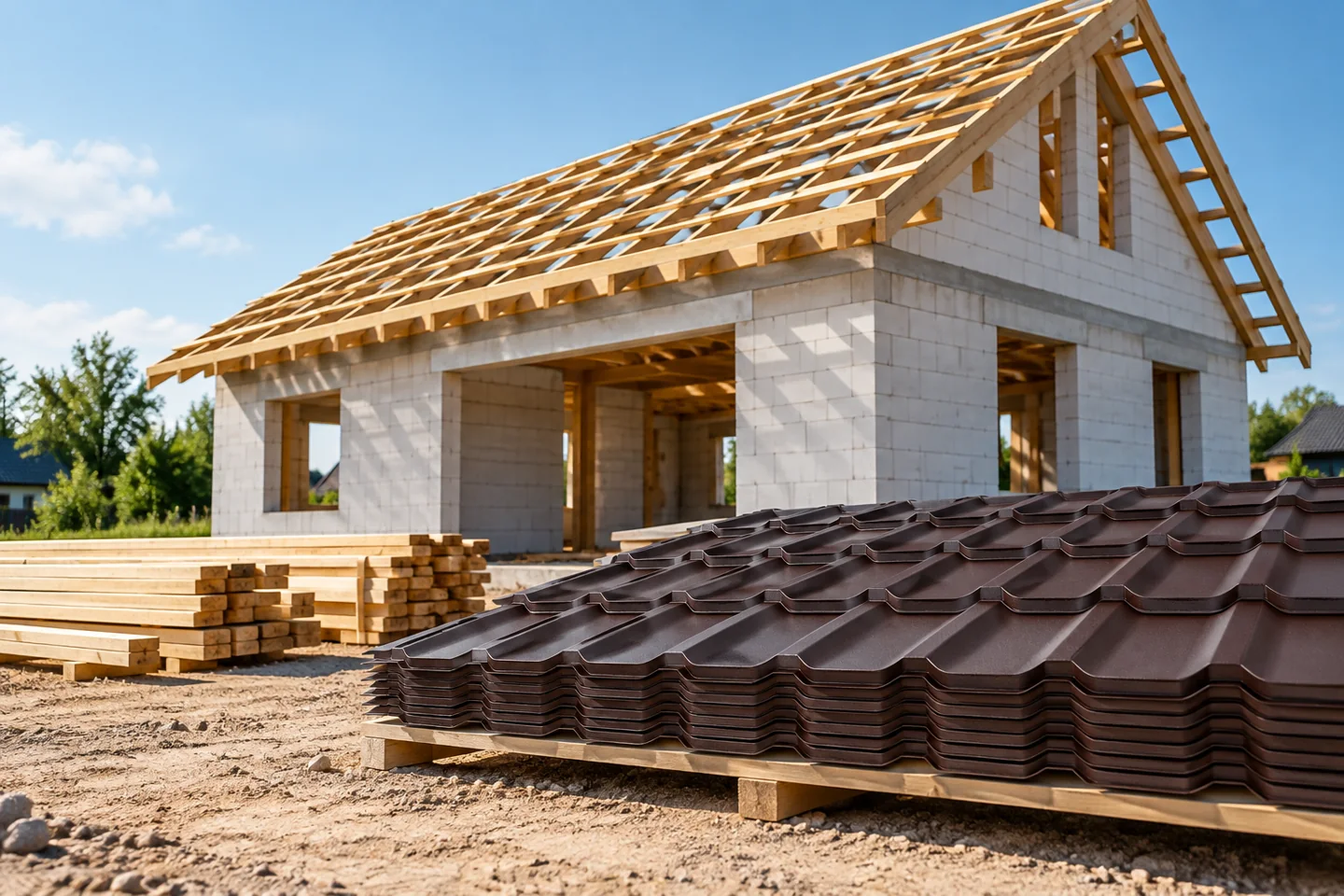
The covering is best chosen at the design stage, together with the layout of the structure and insulation. Tile-effect metal roofing, trapezoidal steel sheet and sandwich panels require different support solutions. A change only after the trusses have been erected may require adjustments. Roof windows, chimneys and planned photovoltaics should also be determined sufficiently early.
The appearance of a sample can be assessed long before purchase. The final list of lengths and number of sheets should, however, correspond to confirmed dimensions. With cut tile-effect metal roofing, a measurement error is particularly costly. Combining early selection of the system with later confirmation of quantities gives greater control over the schedule and budget.
How to synchronise delivery with installation?
Ask about the actual production and transport time for the chosen coating and colour. The availability of one variant does not prove that another will be ready equally quickly. Establish who approves the measurement and at what point the order becomes final. Also record the rules for what happens if the structure is not ready on the planned delivery day.
Material should not lie on site for a long time without need. Sheets and panels require proper support, protection and ventilated storage. Protective film has a limited time for being left on. A shorter wait reduces the risk of the pack becoming damp, mechanical damage and the need to move the entire delivery again.

What can delay roofing works?
Wind and precipitation affect the safety of lifting and installing the covering. Long sheets are susceptible to gusts, and a wet roof surface makes work more difficult. Uneven structure, missing flashings or unagreed installation penetrations also cause problems. A good crew should report such obstacles instead of trying to hide them under the finished covering.
During renovation, surprises emerge after the old layer is removed. Damaged battens, a weak wall plate or damp insulation may require additional work. Before starting, agree how these will be priced and approved. The schedule should allow for securing the building during any break, especially when the house is still occupied.
When can you move on to the next stages?
Laying the sheet metal alone does not always mean the roof is closed. Flashings, drainage and protected penetrations are needed. Before water-sensitive work, it is worth accepting the entire scope. In a heated attic, the sequence of insulation and the creation of a sealed layer from the inside must also be established so that later installations do not damage it.
The drying process of the building matters for subsequent finishing work. A new roof limits precipitation but does not remove construction moisture from walls and floors. Ventilation and heating conditions are selected according to the stage. The calendar should not be regarded as the sole criterion of readiness. Inspections and required measurements are also needed.
How can you limit downtime without rushing?
Designate a person responsible for coordination and keep one current version of the schedule. Confirm deliveries and the readiness of the previous crew before starting the next. A missing flashing component can block acceptance despite most of the roof slope being completed. A full material list and clear responsibility for reorders help.
After every change, check its impact on subsequent dates. Accelerating one stage brings no benefit if the material later waits in unsuitable conditions. Construction runs most smoothly when technical decisions are made on time and acceptances are not postponed. This is usually more effective than trying to fit the entire project into an arbitrary number of weeks.
7 branches. Materials closer to your project.

- SEROCK — Dzierżenin 34 E
- BŁONIE — ul. Sochaczewska 138A
- RADOM — ul. Grobickiego 8
- ŁÓDŹ — Natolin 8
- OLSZTYN — Barczewo, ul. Prosta 9
- WROCŁAW — ul. Jerzmanowska 10C
- GORZÓW WLKP. — ul. Zielona 33/34