XPS insulation
Water absorption of XPS. What do the different test results mean?
At a glance
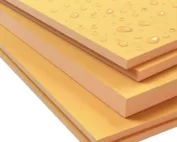
Low water absorption is one of the important advantages of XPS. It helps explain its use at foundations and in inverted roofs. However, several different water-related designations can be found in the documentation. Extruded polystyrene is not described by one universal number. The colloquial term Styrodur also settles nothing in this respect. First, it must be established what was tested and under what conditions. The structure of XPS differs from a fibrous material and from a foam built from expanded granules. Low water absorption is useful where the insulation may come into contact with moisture. This is why XPS is sometimes chosen for assemblies in which a simple dry thermal assessment is insufficient.
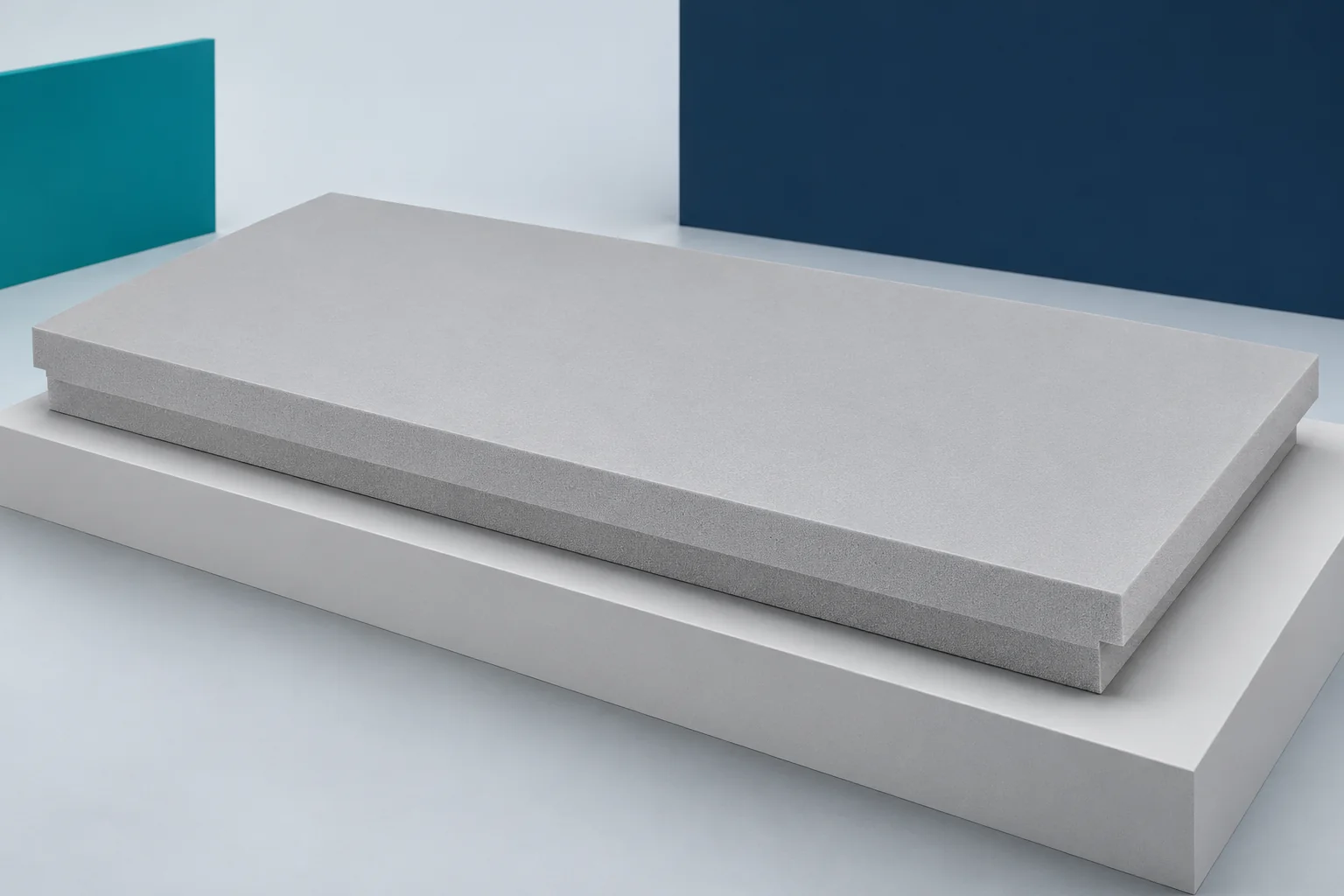
Closed cells limit water absorption
However, this advantage should not be turned into a promise that no water whatsoever will be present. Extruded polystyrene has declared results for specific tests. The actual building element may perform under more complex conditions. Responsible selection is based on documents and an understanding of the application.
Immersion and diffusion are not the same test
The WL(T) designation refers to long-term water absorption by total immersion under test conditions. WD(V) refers to water absorption under diffusion test conditions. The figures should not be compared as if they described an identical situation. Each has its own meaning.
For XPS, it is important to read the unit and the full declaration. A lower result in one test does not automatically prove superiority in every application. Extruded polystyrene should be selected according to the intended contact with water and the layer build-up. It is worth using tables that clearly separate the two properties.
Percentage by volume is not percentage by mass
Data on water can be presented in various units. For XPS, it is important to check whether the result is given in percent by volume. Omitting this information makes comparison difficult and can lead to incorrect conversions. The percent sign alone does not describe the entire method.
Extruded polystyrene is a lightweight material, so comparing mass and volume fractions without calculations can be misleading. A figure from an advertisement should not be transferred into a project without checking the designation. The best basis is the document assigned to the exact grade and thickness of the board.
Thickness and surface area can change the declaration
Within one XPS family, the values may depend on the thickness or on the type of surface finish. A smooth board and a board with a surface prepared for bonding do not necessarily have identical water-related data. The correct row of the table must be checked, not just the name of the series.
Manufacturers of XPS include, among others, PNP, Finnfoam and FIBRAN. Their documentation shows why it is not advisable to attribute a single figure to an entire range. If a shop description gives only the minimum value for a selected version, clarification is needed. The order should correspond to the grade actually used in the project.
The frost test answers a different question
The declaration on freeze-thaw behaviour describes how XPS performs in a specific procedure. It is not the same as water absorption by immersion. It may be relevant in applications where moisture and low temperature occur together. The full scope of the declared characteristic must be read.
The number of cycles or the class must not be treated as a guaranteed number of winters without repair. The durability of the roof also depends on drainage and on the condition of the other layers. XPS with good water-related properties helps to design a robust system, but it does not invalidate defects in the covering or blocked drains.
A board parameter does not describe the tightness of the entire layer
Water can flow through the joints of XPS even though the material itself has low water absorption. The overlap limits the direct path of the gap, but it does not create a fused connection. That is why the foundation and the roof require separate waterproofing suited to the conditions of use.
In an inverted roof, cooling by rainwater is also significant. Good water absorption data do not exempt you from taking this phenomenon into account in the calculations. When assessing XPS, therefore, water in the material must be distinguished from water flowing between the elements. These are different mechanisms affecting the building envelope.
No declaration does not mean a result of zero
If a given property is not specified in the document, a favourable value must not be added. It is necessary to establish whether the characteristic is needed in the specific application and whether other relevant documents are available. In case of doubt, the question should go to the supplier or the designer.
It is worth comparing XPS in a single table with the name of the test, the unit and the conditions. This makes it possible to quickly notice missing data. They should not be replaced by an assurance of high quality. A material may be good for one place and require additional confirmation for another.
Compare the full application, not just the lowest percentage
When making a selection, thermal, mechanical and geometric properties are also needed. XPS with lower water absorption does not have to be suitable if it does not meet the load requirements or does not fit the bonding method. The parameters should be considered together.
An advantage of the documentation is the ability to link the result to the real product. It is worth keeping it together with the delivery label. A well-identified XPS helps to limit the influence of moisture on thermal insulation. A reliable description of this advantage does not require claims of one hundred per cent waterproofness or of the universality of every board.
7 branches. Materials closer to your project.

- SEROCK — Dzierżenin 34 E
- BŁONIE — ul. Sochaczewska 138A
- RADOM — ul. Grobickiego 8
- ŁÓDŹ — Natolin 8
- OLSZTYN — Barczewo, ul. Prosta 9
- WROCŁAW — ul. Jerzmanowska 10C
- GORZÓW WLKP. — ul. Zielona 33/34