Insulation and ventilation
Roofing membranes: how to choose the right underlay
In brief
A roofing membrane forms the first barrier beneath the covering, shielding insulation and timber from water and helping to remove water vapour within its capacity. It does not, however, remove the need for ventilation or for airtightness on the inside. When choosing, compare water resistance, diffusion resistance, strength and conditions of use, including temperature resistance and exposure time. Grammage alone does not guarantee quality. Also check tape and seal compatibility and the installation method, as the membrane will not make up for careless metal laying or leaky flashing.
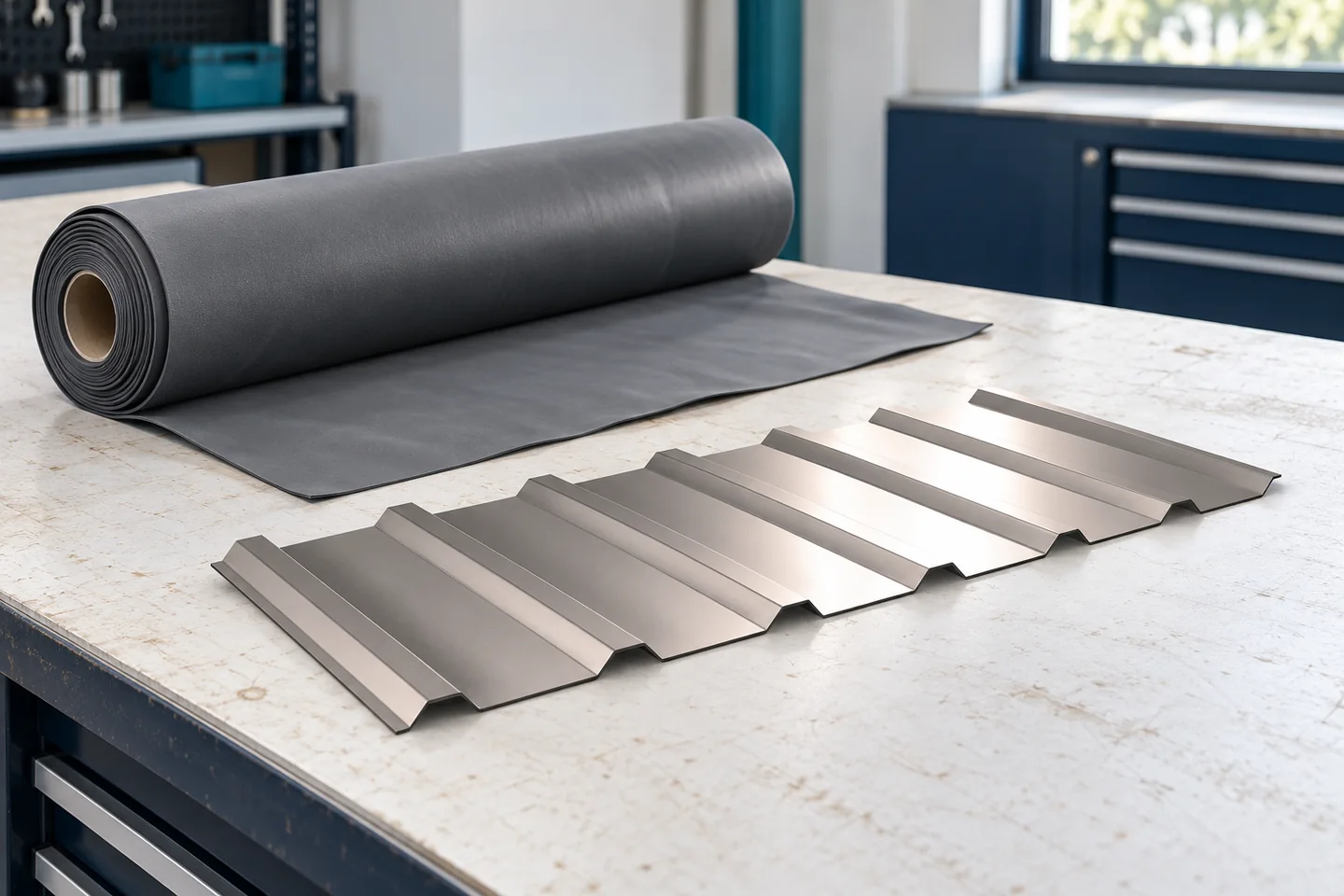
What functions does the membrane perform?
A small amount of wind-driven rain or snow can get under the metal sheeting. Condensation can also form on the underside of the covering. The membrane provides an additional path for draining it away before it wets the insulation. It is therefore an important safeguard, but it should not be treated as a substitute for poorly laid metal sheeting or leaky flashing.
A high vapour-permeability product allows vapour to diffuse towards the outer side of the building envelope. Its effectiveness depends on the entire layer assembly. If the ventilated cavity specified in the design is missing above the membrane, moisture may remain under the covering. The properties of a single roll do not determine how the finished roof performs.
Which parameters are worth reading in the data sheet?
Check watertightness, diffusion resistance, strength and permissible conditions of use. Resistance to temperature and the duration of exposure to radiation before covering are also important. Under dark metal sheeting, surfaces can become very hot. The material must be selected for such an application, not merely by price and the number of layers stated on the packaging.
Grammage describes the mass per unit area, but on its own it does not confirm the quality of all properties. A heavier membrane does not necessarily suit every roof better. Compatibility of tapes, seals and the substrate is also important. A complete system offering makes it easier to check the joints, especially in roof valleys, at the chimney and at roof windows.
Where is the membrane laid relative to the insulation?
In many typical assemblies it is located above the thermal insulation. Certain membranes may be in contact with the insulation, but this must be confirmed in their documentation. This principle should not be applied to every roofing membrane. Older material with a different diffusion resistance may require a different arrangement of gaps.
Above the membrane, a space is left that results from the counter-batten construction and the ventilation method. On the interior side, a vapour control layer suited to the design is used. The two layers have different functions. Swapping their positions can hinder the drying out of the structure. During renovation, the existing material must be identified before adding new insulation.

How should laps and penetrations be executed?
The strips are laid in an order that ensures water drains towards the eaves. The size of the overlap follows the instructions and the roof conditions. The joints should be durable, and the substrate for bonding must be clean and suitably prepared. The mere presence of a self-adhesive strip does not guarantee a seal if it becomes contaminated with dust or water during installation.
At the chimney, pipe and window, the continuity of the layer must be restored. It is particularly important to protect the section above the opening, where run-off water collects. An accidental cut with loose edges left behind is not enough. The tapes and collars should match the material and the place of application, not be chosen solely by colour.
What damage must be repaired before covering?
Tears, holes from incorrect fixing and abrasion require assessment and repair in accordance with the instructions. It is not worth assuming that the metal sheeting will hide the problem and take over all the water. Once covered, access will become limited. It is also worth checking the tension and the run of the material to avoid pockets that collect condensate.
The membrane should not be left exposed for longer than the manufacturer permits. The period also applies to areas lit from below if the product has corresponding restrictions. A material exposed for a long time may look good and yet have deteriorated properties. In such a case, the decision on further use should be based on the documentation and an assessment of the condition.
How can you tell whether the problem lies with the membrane?
Dampness in the attic can result from a leak, condensation or an airtightness failure of the layer on the interior side. First, the relationship of the symptoms to rain, temperature and the way the space is used must be established. Replacing a section of membrane alone will not solve the problem if moist air constantly enters the assembly through an open connection at the installation.
At handover, ask for photos of the eaves, roof valleys and penetrations before the metal sheeting is laid. Also check the continuity of ventilation and the condition of the vapour control layer. A well-chosen membrane is an important part of the roof, but its performance depends on the other layers. The choice should therefore begin with the cross-section of the entire assembly and end with installation that matches it.
7 branches. Materials closer to your project.

- SEROCK — Dzierżenin 34 E
- BŁONIE — ul. Sochaczewska 138A
- RADOM — ul. Grobickiego 8
- ŁÓDŹ — Natolin 8
- OLSZTYN — Barczewo, ul. Prosta 9
- WROCŁAW — ul. Jerzmanowska 10C
- GORZÓW WLKP. — ul. Zielona 33/34