Installation and details
Choosing exterior window sills for a house
In brief
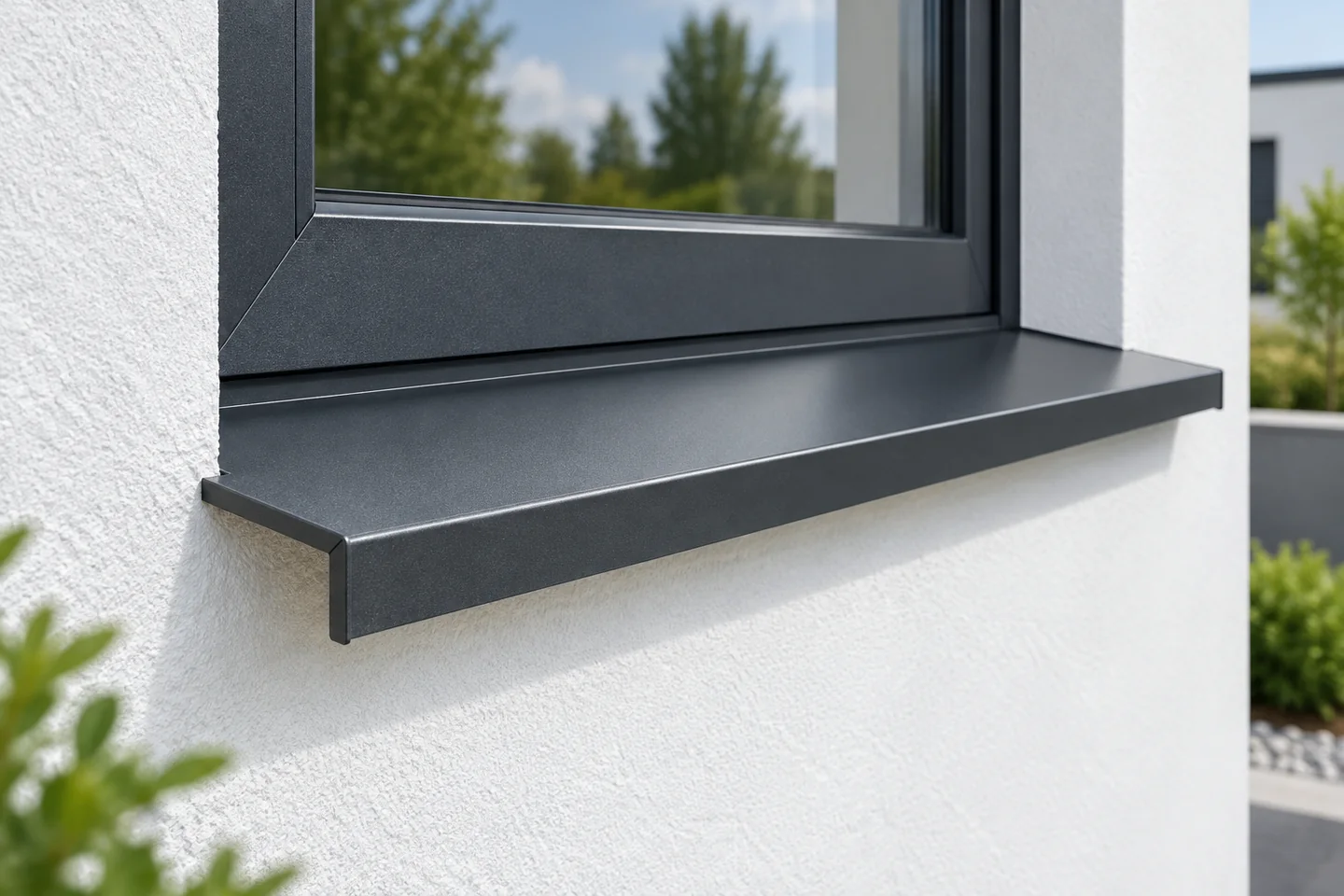
An external window sill must direct water away from the façade and shield the lower part of the window. Effectiveness depends on the slope, drip edge, side terminations and the connection to the frame, not just on material and colour. Coated steel is a popular choice, but other materials are available too. Water from the window should reach the sill and break away from its front edge beyond the façade line. If it returns underneath, it can dampen the plaster and insulation.
What should a well-made window sill do?
Water running down the window must land on the sill and then detach from its front edge beyond the face of the façade. This is achieved by the appropriate slope and a drip edge. If water runs back underneath, it can dampen the render and the insulation layer. A wide sheet of metal alone without a well-formed end detail does not fulfil this task.
The sides are equally important. The connection to the reveal should retain water but allow the material to expand and contract as intended. Rigidly embedding the ends of a long metal sill in mortar can lead to cracks. The detail should be matched to the window and façade system, not executed as an independent add-on at the end of the works.
When should you choose a steel window sill?
Coated steel allows a relatively lightweight component with a chosen colour and depth. It combines well with metal roofing and gutters. When ordering, check the sheet thickness, the type of coating and how the edges are formed. On a wide sill, adequate rigidity and support are particularly important.
The coating requires careful transport and installation. The sheet should not be slid over mortar or left with metal filings on it. Hot cutting can damage the protection. Areas of minor damage should be assessed in accordance with the material instructions, rather than covering the entire surface with an arbitrary paint of similar colour.
What do aluminium, stone and other solutions offer?
Aluminium allows various forms and finishes, but thermal expansion must also be taken into account. Stone elements have a different weight and method of support. Their resistance to external conditions and the correct formation of the drip edge are important. Not every material intended for an internal sill is suitable for external use.
There is no need to choose one material simply because it is the most expensive. When comparing, check durability under the given conditions, the possibility of adapting to the opening and the method of repair. On a façade sheltered by a wide eaves, conditions may differ from a window constantly exposed to driving rain. The right detail is important in both cases.

How to determine the length and depth?
Measurement is carried out taking into account the target thickness of the façade. A sill selected for bare masonry may prove too shallow after the insulation has been laid. Space is also needed for the connection to the window and for the front edge. The exact projection is determined in accordance with the system and the geometry of the opening so that the drip edge is located beyond the façade.
The length includes the side terminations and the required clearances. For a non-standard window, it is worth preparing a template or an accurate drawing. If you are ordering several seemingly identical elements, measure each opening. Construction tolerances can be large enough that a single shared dimension leads to later trimming of finished, coated window sills.
How should a window sill be connected to the window and the insulation?
The substrate must be stable, level and prepared for the chosen method of fixing. A fall to the outside must be maintained. Sealing the visible joint with the frame alone is not enough if water can get underneath the element. The drainage openings of the joinery must not be covered, nor its lower profile damaged by random screws.
In the area below the window, continuity of insulation and adequate support are required. The space under the window sill should not be left as an incidental void. The possibility of vibration, which amplifies the noise of rain, must also be limited. The fixing solution and any damping should be selected to suit the material and the system recommendations, without creating places where moisture can accumulate.
What should be checked at handover and in use?
Check the fall, the side end caps and the continuity of the drip edge. Check whether water collects at the frame and whether the element deflects under light pressure. The protective film should be removed within the period specified for the material. Leaving it on in the sun for a long time can make it difficult to remove and impair the appearance of the surface.
When cleaning, avoid agents and tools that scratch the coating. Plant pots and other objects should be positioned so that they do not block drainage and do not cause permanent damp. The window sill is not a platform to stand on when cleaning the window. A well-chosen element should safely drain water for years, with straightforward inspection of its joints and surface.
7 branches. Materials closer to your project.

- SEROCK — Dzierżenin 34 E
- BŁONIE — ul. Sochaczewska 138A
- RADOM — ul. Grobickiego 8
- ŁÓDŹ — Natolin 8
- OLSZTYN — Barczewo, ul. Prosta 9
- WROCŁAW — ul. Jerzmanowska 10C
- GORZÓW WLKP. — ul. Zielona 33/34