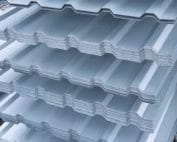
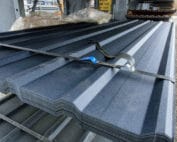
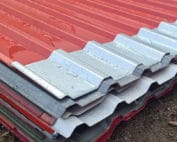
Trapezoidal steel sheet
Understanding the weight of T18 and T35 trapezoidal roofing sheets
In brief
The weight of T18 and T35 trapezoidal sheets follows from the steel thickness, the profile shape and the area the mass is referred to. The coverage area is not the same as the area of the whole sheet. Because T18 and T35 can vary in width, compare their mass in the same unit. With a similar profile, a thicker steel core makes the sheet heavier. Do not rely on the numbers in the profile name alone, as different ribs consume a different strip width per metre of coverage. Catalogue data support transport planning but do not replace roof load-bearing calculations or arrangements for unloading.
Why does sheet thickness matter so much?
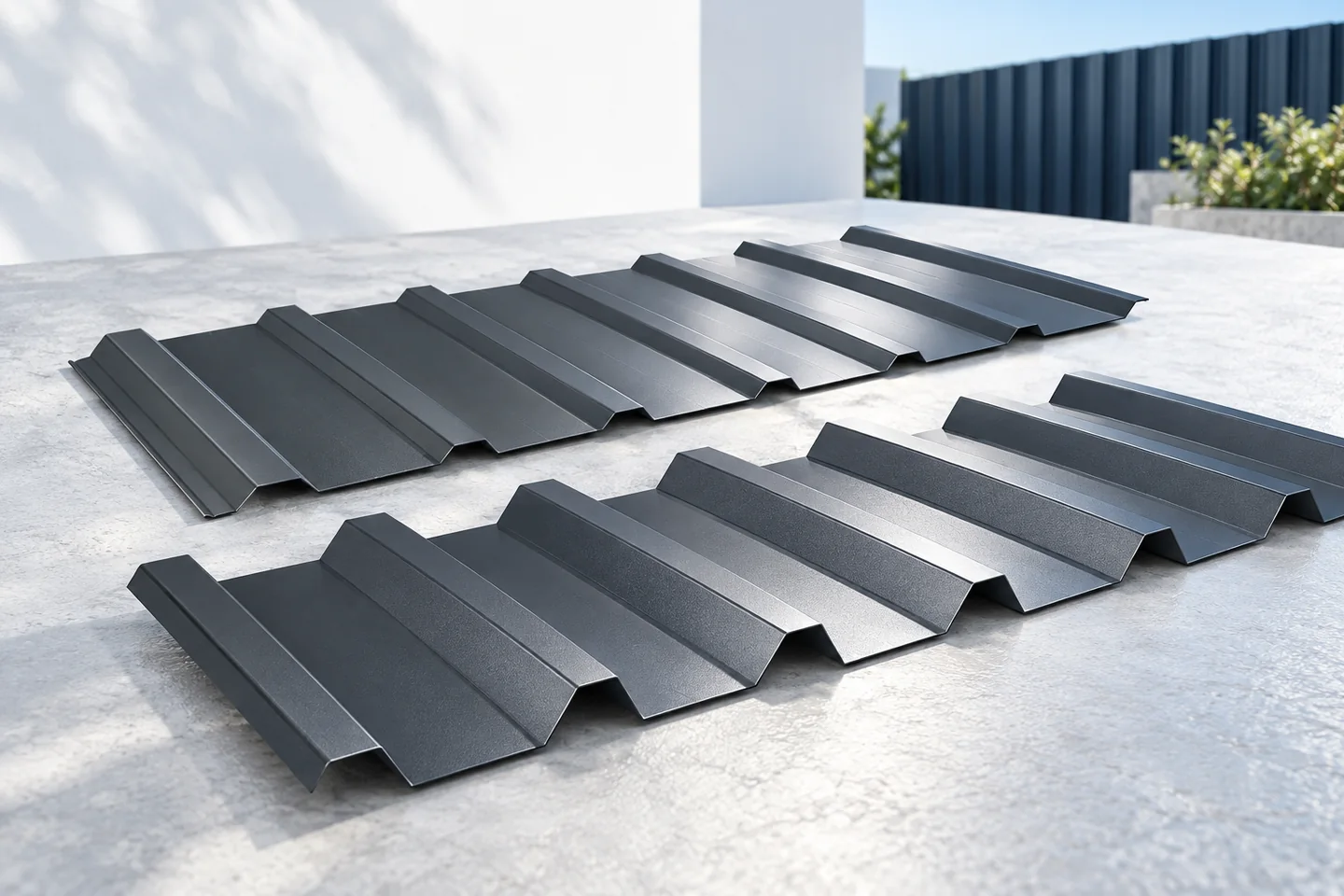
With a similar profile, a thicker steel core means a greater sheet mass. 0.70 mm sheet contains more steel per unit area than the 0.50 mm version. However, you should not compare only the numbers from the profile name. Different profiling consumes a different strip width to produce a metre of coverage. Coatings and the exact geometry also matter.
In the datasheet, look for the unit weight with the unit clearly stated. It may refer to an effective square metre, a total square metre or a linear metre of sheet. These values are not directly interchangeable. If the offer gives only kilograms per metre, ask for clarification. Without the width and the basis of calculation, it is easy to make a mistake even in a simple quantity take-off.
How does total area differ from coverage?
Part of the sheet width forms the side lap. Once installed, it does not increase the covered width of the roof slope. Therefore, the mass assigned to a square metre of coverage is greater than the mass assigned to the same number of square metres of total area. End laps have a similar significance when sheets are joined along the slope.
An example sheet with a total width of 1.142 m and a coverage of 1.100 m at a length of 4 m has 4.568 m² of total area. Its nominal coverage is 4.4 m² before allowing for any longitudinal lap. This is the same physical element described by two areas. One must not use one basis and then the other in the mass calculation.
How much might example T18 and T35 sheets weigh?
In one catalogue listing, T18 at 0.50 mm thickness has a mass of 4.43 kg per effective square metre. For a selected T35 of the same thickness, 4.71 kg/m² is given. At 0.70 mm thickness, the values for these specific profiles are 6.20 and 6.59 kg/m² respectively. These are examples, not uniform parameters for all sheets with such a designation.
The difference does not result solely from the height of the profiling. The widths of the flanges, the inclination of the sides and the coverage width also matter. A taller profile may consume more material for the same roof slope area. Therefore, for ordering and transport, use the product data of the item actually being purchased. Do not replace them with an average found for another model.

How to calculate the mass of a sheet and a batch?
If the manufacturer states 4.43 kg/m² effective, and the sheet has 1.10 m coverage and 4 m length, the estimated mass is 4.43 × 1.10 × 4, i.e. approximately 19.5 kg. In this calculation, the lap width is not added again. The catalogue coefficient already relates the material mass to the coverage area.
For a batch with different lengths, calculate each variant separately. Then add the weight of the packaging, pallet and other delivery items. Screws, flashings and insulation can travel in the same transport. The final shipment weight should follow from the supplier’s documents. An approximate calculation helps with planning, but does not replace the data needed to select the vehicle and handling equipment.
Does lightweight steel sheet mean straightforward unloading?
Not always. A long sheet can weigh relatively little and at the same time bend easily. When lifting, the support points, the number of people and the wind matter. The material must not be dragged over the adjacent sheet or gripped in a way that deforms the edges. Long packs may require a spreader beam and straps selected according to the instructions.
Also check the storage location. The load of the entire pack is concentrated on a small area and on the supports. Do not place it on a ceiling or roof without confirming the permissible load. The fact that a single sheet is light does not mean the entire stack is safe. Organising the unloading is part of the order, especially on a cramped or uneven plot.
Why doesn’t mass replace an assessment of load-bearing capacity?
Dead weight is only one of the roof loads. The structure must also carry snow, wind and loads related to use. The load-bearing capacity of the sheet depends on its profile, thickness, steel grade and support. Two sheets of similar weight can have different parameters. The number of kilograms alone does not allow the purlin spacing to be determined.
For a renovation, an assessment of the entire roof truss and its connections is needed. For a hall, the tables for the specific structural scheme must be checked, together with deflection and fastenings. It is worth separating three questions: how much the material weighs, how to deliver it and what loads it can carry after installation. The answer to each of them is based on a different set of data, although it concerns the same sheet.
7 branches. Materials closer to your project.

- SEROCK — Dzierżenin 34 E
- BŁONIE — ul. Sochaczewska 138A
- RADOM — ul. Grobickiego 8
- ŁÓDŹ — Natolin 8
- OLSZTYN — Barczewo, ul. Prosta 9
- WROCŁAW — ul. Jerzmanowska 10C
- GORZÓW WLKP. — ul. Zielona 33/34